
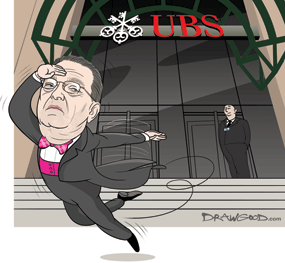
My concern about succession planning at UBS was well founded. As politicians, central bankers and financiers gathered in Washington for the IMF/World Bank meetings, the UBS board met in Singapore. And contrary to what most people including myself had expected, UBS’s chief executive Oswald Grübel resigned, saying that he had to bear ultimate responsibility for the recent rogue-trading scandal inflicted on the bank by Kweku Adoboli.
There is something of a flounce about Ossie’s last dance. Few can comprehend why he resigned when he did. Several bemused bankers have murmured that perhaps he jumped to save the skin of UBS’s head of investment banking, Carsten Kengeter.
I’m not sure that is correct. My analysis is that 67-year-old Ossie had simply had enough. Perhaps he thought that life is short, the banking business today is brutish and the golf course appeared very appealing. "Look, Abigail," an insider remonstrated. "I believe that Mr Grübel did what he thought was in the best interests of the bank."
Grübel retired from Credit Suisse with an impeccable reputation. He was summoned out of retirement to save UBS. He certainly did some good things – putting the investment bank back on a firmer footing and making peace with the US authorities, which in turn staunched outflows from the private bank.
 |
But his abrupt departure does a disservice to his legacy. In essence, he leaves UBS in a mess: albeit less of a mess than he inherited. He certainly is not handing over a stable institution to his successor. As I have written on several occasions, the banking industry has a deep loathing of succession planning. In fact, there is rarely any proper succession plan and this is an enormous disadvantage for stakeholders. Ironically, one of the few orderly passings of the baton took place in 2007 at Credit Suisse when Grübel announced his retirement and Brady Dougan was appointed group chief executive designate. The situation today at UBS is almost the opposite of that seemly succession. Although Grübel insisted he was taking responsibility for the trading loss, he didn’t wait for the results of the internal inquiry, he didn’t wait for the bank’s new strategy to be defined and he certainly didn’t wait for a new chief executive to be appointed. The Abigail with attitude column is not impressed.
"There are still a lot of unanswered questions," a source mused. I suspect part of the answer will include a shrivelled investment bank. Ironically, in an earlier column, I pondered whether UBS’s investment bank needed to be on an expansionist trajectory and suggested that it should focus only on certain business lines and regions.
After the kleptomaniac Kweku loss, I envisage a wholesale lopping of limbs. One source talked about the bank keeping the client-facing equities and M&A businesses – for the IPO pipeline – but maybe retreating from fixed income altogether. Losing this amount of weight is probably too drastic but I do expect a radical restructuring of the investment bank, with big lay-offs before Christmas. UBS’s investment bank currently employs roughly 17,500 people.
The first people to have gone from UBS should surely have been any that had an oversight of risk management in the business.
To lose $2.3 billion through the actions of a rogue junior trader is a colossal failing of risk management and regulation. How can one individual be allowed to carry out trades that expose the institution to such extensive losses? UBS points to the fact that Kweku, a trader on its Delta One desk, was acting fraudulently. But he was obviously dealing in huge amounts. And surely any risk function has to take into account the possibility of fraud when compensation is linked to profitability? It seems pretty basic to me. If crafty Kweku’s dealing volumes had been much lower, and UBS’s oversight much higher, I doubt the bank would be in such a pickle. A source mutters cryptically: "American banks don’t have rogue traders. At American firms, the risk function rules the roost."
Hundreds of column inches have been dedicated in the past few days to trying to explain to readers exactly what Delta One trading is. It is a complex area and I do not understand it fully. But I’m beginning to wonder if the most senior bankers and risk managers in the City understand it fully either. Jérôme Kerviel, Société Générale’s notorious fraudster, worked in the same area. I’ve always believed in the kiss (keep it simple stupid) principle. Given that nearly $9 billion has been lost by two relatively junior traders in this area in the past four years, should banks be involved in Delta One trading at all? The risks certainly seem to outweigh the rewards.
I am not the only person who thinks this way. The appalling UBS incident makes it less likely that long-term investors will buy bank shares. At the weekend, I received an email from a loyal reader in Dubai. "Dear Abigail," he wrote. "The latest Euromoney issue is in front of me and as usual, the first thing I did was to go through your thoughts. As always, I cannot agree with you more on your analysis and will anxiously wait for your comments on the latest bizarre incident where a prime European bank was taken for a ride by a three-decade-old trader.
"You would assume after Barings and Lehman Brothers, at least the big ones would have fixed the issue by bringing on foolproof systems, controls and audits to avoid recurrence of such incomprehensible incidents. Continuation of such occurrences in such large institutions gives you a scare of the highest order as to what else may be going on in the prime financial institutions that we may not be currently aware of."
The key issue is who will succeed Grübel as chief executive of the group. And don’t let’s forget the grisly fact that this CEO will be the fourth in four years at UBS. Quite frankly, that is a disgrace.
To make matters worse, there will be a changing of the guard at the chairman’s office as well. Axel Weber, the former president of the Bundesbank, is due to take over from 70-year-old Kaspar Villiger as chairman in mid-2013. Some say that Villiger is now a lame duck and he should step aside, allowing Weber to provide clear direction to the board. Any way you look at it, the UBS succession is a mess and investors’ queasiness will not be quelled by the fact that UBS’s CFO Tom Naratil has been in the job for only four months.
The board is conducting a search for a new group chief that might drag on to early 2012. Sergio Ermotti, the bank’s chief executive in Europe, has been appointed as interim chief executive. Ermotti joined UBS only in April 2011.
Since he arrived, a number of sources have told me that Ermotti was effectively the group CEO in waiting. He is certainly a prime contender. But Ermotti doesn’t know the bank well and has limited experience of commercial or retail banking. However, a mole reports that he is well connected in Switzerland, especially in the south, and speaks the three main national languages.
Ermotti spent most of his career at Merrill Lynch and rose to become the co-head of global equities. He joined UniCredit in late 2005 to run the investment bank and was appointed UniCredit’s deputy group chief executive in 2007. He quit that bank to join UBS when he was passed over for the UniCredit chief executive role, which went to Federico Ghizzoni.
If I were being harsh, I might ponder why someone who was not considered the best choice to run Italy’s largest bank, where he had worked for five years, is now considered the leading contender to run Switzerland’s largest bank, where he has worked for five months.
Sources tell me that Ermotti is charming and capable. I look forward to meeting him in due course. Away from Ermotti, the field is fallow. I’ve heard Bill Winters, the former co-head of JPMorgan’s investment bank, mentioned. But he has now moved on and has set up an asset management firm, Renshaw Bay. Anyway, I’m not convinced the cultural fit would be ideal.
It’s a terrible testament to the industry that I can come up with hardly any other potential outsiders. A Swiss source murmurs: "UBS needs to go for someone in the Swiss establishment or a private banker to take the firm back to its roots." Occasionally, other UBS insiders are mentioned as potential group chiefs: Ulrich Korner, the group COO, or Jurg Zeltner, the head of wealth management. But my sources insist that Ermotti would be a better choice.
The other question that weighs on my mind is claw-backs. Given the enormous $2.3 billion loss suffered in the investment bank, will Carsten Kengeter’s SFr9.3 million ($10.2 million) bonus for 2010 be pared back? And what about the 2010 bonus awarded to the co-heads of the equities’ divisions who were the ambidextrous Adoboli’s line managers? Shareholders need reassurance on this point. If there are no claw-backs, the industry will have reached a new low of moral hazard.
The Abigail with attitude column is always where the action is. The evening before news of the UBS trading loss broke, I co-hosted a round-table dinner for some senior bankers and businessmen.
One of the division chiefs in UBS’s investment bank attended the dinner. UBS banker was in sparkling form, although at one point he did state: "I am very bearish." The next morning several other guests emailed me to say that they were nicknaming senior UBS banker "the cool cucumber". Even now, I’m not sure if Cool Cucumber was aware that 12 hours after the dinner his investment bank would announce a loss, wiping out all its profits for the first half of the year.
At the dinner, most people were highly pessimistic. One successful international businessman said firmly: "Next year, the world will enter a global recession." For a contrarian like myself, this gloomy sentiment is nirvana. I expect stock markets to bounce in the short term once the Greek drama has had a tragic ending.
 |
Amid all this market turmoil, I was intrigued to see that John Mack, the chairman of Morgan Stanley, was finally stepping down from the firm. Given the mess the firm got into under his watch, I’m not quite sure why he’s still employed by Morgan Stanley anyway. James Gorman will add the chairman title to that of chief executive. For a few weeks now, rumours have been circulating that a poisonous article regarding Morgan Stanley would surface on one of the screen services. When it did appear, it focused on the supposedly hostile relationship between the two co-heads of institutional securities, Colm Kelleher and Paul Taubman. "A silly article," one protagonist sniffed.
"What is there of substance?" rebuked another insider. "Two co-heads don’t get on. What’s new about that in this industry?"
Of course, this is true despite investment banks’ insistence that their senior management teams are one big happy family. What was embarrassing about the story was that it surfaced on the day Morgan Stanley was hosting its annual press reception in London. Coincidence or conspiracy, I ask myself? Nevertheless, Kelleher, who hosted the evening, seemed in excellent form. I like Colm a lot. He has one of the best brains in the business and a withering sense of humour. I wouldn’t want to invoke his ire, so whoever planted the feuding co-heads story might want to watch his or her back.
Recently, I had a delicious gossipy lunch with a well-placed mole. Mole put forward an interesting theory about UK banking: "In the old days," he intoned, "banks and investment banks were seen as wealth creators and a force for good. For every pound earned by a slick banker, four pounds would be spent in Porsche showrooms, London restaurants and poodle parlours. Now banks are seen as a force for evil."
Mole paused, licked his lips judiciously and continued: "I believe the UK authorities would welcome the departure of some of the big British banks which are still too big to fail and frankly a pain in the neck. The animosity towards Bob Diamond is extreme: he is viewed as epitomizing the arrogance of the industry, showing little remorse or responsibility for the death spiral of 2008. The UK authorities would not be sorry to see Barclays headquartered in the US. They are also prepared to lose Standard Chartered. That leaves HSBC, Lloyds and RBS, which makes the banking sector a more manageable part of the UK economy in terms of assets to national GDP. HSBC is unlikely to move its headquarters. Stuart Gulliver is smart and long term he recognizes that there’s limited upside to being regulated by the Chinese communist party." Mole is ferociously bright. I will be interested to see how things play out in the next few years.
Gloom prevailed at the annual IMF/World Bank meetings in Washington according to my sources. Senior bankers have now come round to the Abigail-with-attitude view, expressed in my July column, that frosty times lie ahead and the authorities do not have many weapons of mass optimism left.
And a number of senior bankers have also been telling me that they now agree with my pessimistic assessment of Nomura. Since 2008, I have criticized Nomura for its bloated cost base arising from the acquisition of the Lehman Brother’s Asian and European operations.
Money has been poured down a bottomless pit and vainglorious strategies for global dominance proffered. I exaggerate slightly but Nomura’s desire to expand its equities business in the US and compete in that market strikes me as foolhardy. If analysts expect the top investment bank, Goldman Sachs, to make a third-quarter loss, I shudder to think what Nomura’s numbers will look like.
An impeccable source told me: "Nomura has to fire Jesse Bhattal (the current head of wholesale and deputy president of the firm who used to be Lehman’s chief executive in Asia) and bring in someone who is unemotional about the past and prepared to make drastic cuts. They need to get out of all wholesale businesses that are not profitable and shrink back to areas that build on their core expertise as Japan’s leading brokerage firm." Source is correct and after wasting billions of dollars of shareholder’s money, Nomura should swallow hard and follow his suggestions.
The banking industry is not enjoying an Arab spring or indeed any type of spring. In fact it is in a distinctly autumnal phase. This was underlined for me by two nuggets. First the talented Amir Hoveyda, who was a former EMEA head of debt capital markets at Merrill Lynch, has resurfaced as a managing principal at StormHarbour, a 200-person independent financial advisory boutique.
The fact that Amir has not come back to a big job in a big firm might be a matter of personal choice but it also shows me that the industry is contracting. There are not a lot of plum jobs to go around, especially if you’ve been off the carousel for a while.
In a similar vein, a source told me that when a graduate turned up for his entry-level job at the asset management arm of one of the biggest US banks this September, graduate trainee was promptly made redundant on the grounds that times were tough. "Poor little thing," source sighed. "He’s been scarred for life and of course his prospects of finding another banking job now are non-existent."
How was your month? Please send news and views to abigail@euromoney.com.