
My concern about succession planning at UBS was well founded. As politicians, central bankers and financiers gathered in Washington for the IMF meetings, the UBS board met in Singapore. And contrary to what most people including myself had expected, UBS’s chief executive Ossie Grübel resigned, saying that he had to bear ultimate responsibility for the recent rogue trading scandal inflicted on the bank by Kweku Adoboli.
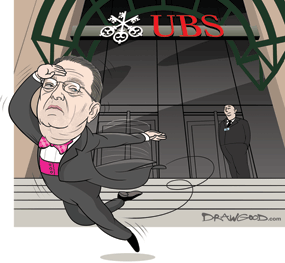 There is something of a flounce about Ossie’s last dance |
There is something of a flounce about Ossie’s last dance. Few can comprehend why he resigned. Several bemused bankers have murmured that perhaps he jumped to save the skin of UBS’s head of investment banking, Carsten Kengeter.
I’m not sure that is correct. My analysis is that 67-year-old Ossie had simply had enough. Perhaps, he thought that life is short, the banking business today is brutish and the golf course appeared very appealing. “Look, Abigail,” an insider remonstrated, “I believe that Mr Grübel did what he thought was in the best interests of the bank.”
Grübel retired from Credit Suisse with an impeccable reputation. He was summoned out of retirement to save UBS. He certainly did some good things – putting the investment bank back on a firmer footing and making peace with the US authorities, which in turn staunched outflows from the private bank.
But his abrupt departure does a disservice to his legacy. In essence, he leaves UBS in a mess: albeit less of a mess than he inherited. He certainly is not handing over a stable institution to his successor. As I have written on several occasions, the banking industry has a deep loathing of succession planning. In fact, there is rarely any proper succession plan and this is an enormous disadvantage for stakeholders.
Ironically, one of the few orderly passings of the baton took place in 2007 at Credit Suisse when Grübel announced his retirement and Brady Dougan was appointed designate group CEO. The situation today at UBS is almost the opposite of that seemly succession. Although Grübel insisted he was taking responsibility for the trading loss, he didn’t wait for the results of the internal inquiry, he didn’t wait for the bank’s new strategy to be defined and he certainly didn’t wait for a new chief executive to be appointed. The Abigail with attitude column is not impressed.
“There are still a lot of unanswered questions,” a source mused. I suspect part of the answer will include a shrivelled investment bank. Ironically, in an earlier column, I pondered whether UBS’s investment bank needed to be on an expansionist trajectory and suggested that it should focus only on certain business lines and regions.
After the ETF loss, I envisage a whole-scale lopping of limbs. One source talked about the bank keeping the client-facing equities and M&A businesses – for the IPO pipeline – but perhaps retreating from fixed income all together. Losing this amount of weight is probably too drastic, but I do expect a radical restructuring of the investment bank with many lay-offs before Christmas. UBS’s investment bank currently employs 17,500 people.
Shortlist for full-time UBS chief executive role looks very short indeed
Will the UK be pleased to wave goodbye to Barclays and StanChart?
It’s time for Bhattal to call it quits at Nomura