
"In 2009, if you are a bank chief executive, your reputation will be lower than a serial killer’s." A senior trader told me this late last year and I winced. "Serial killer," I stuttered. "Surely not?" I now see that senior trader was correct.
The vitriol that ordinary people feel towards senior bankers is palpable. "They are all idiots and what’s worse is they’re taking us down with them," an architect in Florida hissed. And where’s the upside? It’s going to be a long hard grind from here: "bank bosses" and "bonuses" are three words that will not sit happily together in the same sentence for many years.
In my December column, I discussed the takeover of Merrill Lynch by Bank of America. "Might Ken be tempted to renegotiate or pull back given the terrible market conditions?" I asked. I concluded that Treasury secretary Hank Paulson would not allow Ken Lewis to wobble. "Can you imagine the lambasting Ken would receive from Hank if he were tempted to demur?" I wrote.
I’m not sure whether I am a witch, a prophet, or merely a lucky commentator, but we now know that as my article was published, Lewis was flying to Washington to plead with Ben Bernanke and Hank Paulson to allow Bank of America to walk away from the deal. Ken Lewis is tough. Grown men are frightened of him. So why, at that fateful meeting in Washington, did he back down? A mole murmurs: "I guess Paulson asked him: ‘Do you want to be the man who single-handedly brings down the global financial system?’" And Ken caved in. Lewis is not an urbane, Ivy League investment banker. Maybe he fell under the spell of slick Hank the Spank. Or maybe he felt he could make the Merrill deal work in the long run.
Lawsuits loom: they will focus on when did Ken know what? On December 5, shareholder meetings of both firms approved the takeover. Nothing was disclosed about large fourth-quarter losses. Yet by December 17 Lewis had enough ammunition to fly to Washington to talk to the two most senior individuals in the US financial world about his doubts. If Lewis took the time to fly up to Washington, he must have had very serious doubts. After all, what are conference calls for except to thrash out and flesh out details of deals? No, Ken was a worried man. Yet two weeks later he closed the Merrill acquisition.
January was chilly for Lewis. Early in the month, two of the most senior Merrill executives resigned: Greg Fleming, president and former head of investment banking; and Robert McCann, the head of retail brokerage. Brokerage and investment banking were vital franchises for Merrill and a large part of the reason why Ken wanted the firm.
I doubt Ken was prepared for the value destruction in mid-January when Bank of America’s 2008 results were released and it was announced that Merrill had taken a $15.3 billion net loss in the fourth quarter alone and a net loss for 2008 of $27 billion. Bank of America shareholders are incandescent with rage. One disgruntled investor allegedly accused Lewis of thinking with a body part other than his brain when he decided to purchase Merrill.

As the terrible fourth-quarter results were unveiled, Bank of America started briefing against John Thain, Merrill Lynch’s chief executive. This is always a high-risk press strategy. A public relations specialist comments: "Washing dirty laundry in public is dangerous. Now even grannies in Topeka, Kansas, know that Bank of America is in chaos." The Financial Times reported on January 16 that when Lewis heard that Thain wanted to take a $10 million bonus, Lewis was "purple-faced with rage". On January 20, the Wall Street Journal reported a "person familiar with Bank of America" claiming that: "Mr Thain didn’t appear to be fully engaged in issues surrounding the deal just when the scope of Merrill’s losses was becoming apparent." Someone leaked to CNBC that Thain had spent $1.2 million of Merrill Lynch’s money refurbishing his office and paid his chauffeur $230,000 for a year’s work. "$230,000 to drive a car?" a commentator asked incredulously.
The revelation about the office refurbishment will always haunt Thain, who might in future be dubbed "Toilet Thain" (but then the US slang is John anyway) because of the $35,000 purchase of a "commode on legs". In 18th-century France, a commode was the word for a cabinet. Later the Victorians used the word to describe a bedside table in which a chamber pot could be stored and today the word is associated with a portable toilet. President Barack Obama became embroiled in the controversy and confusion and expressed his disgust at "the reports that we’ve seen over the last couple of days about companies that have received taxpayer assistance, then going out and renovating bathrooms or offices or in other ways not managing those dollars appropriately".
Ken's exit interview with John
A vignette dances before my eyes: Lewis storms up to Thain’s office suite on the 32nd floor of Merrill’s World Financial Center headquarters in New York. Ken is breathing heavily: waves of anger mean that he is virtually hyperventilating. A suave Thain pads to the door in hand-embroidered, velvet Gucci slippers. His wife, Carmen, has instructed him not to wear shoes in case he damages the delicate fabric of the expensive carpet. Thain winces at Lewis’s sturdy brogues and considers asking Ken to don a pair of blue plastic overshoes that are carefully concealed in an Hermès carrier bag by the door. Taking in his boss’s steely blue eyes and tightly pursed lips, Thain quickly dispenses with the overshoe strategy.
"Please sit down," Thain proffers, waving to the Regency chairs (cost: $24,286) and the pair of guest chairs (cost: $87,783). Lewis is too cross to sit down and perches, in an ungainly fashion, on the 19th-century credenza (cost: $68,178). A creaking sound can be heard as one leg crumples. Ken and the credenza collapse. As he falls to the floor, Lewis gasps: "You’re fired". Fortunately, the plush rugs (cost: $131,674) prevent him from sustaining a permanent injury. Without another word, Lewis hobbles off, exits the building and returns to Charlotte, North Carolina, by his preferred method of transportation – private jet. Can it be true, by the way, as a mole murmurs, that Bank of America still owns nine private jets? A Bank of America spokesperson had no comment on the jets. But is such luxury appropriate for an institution that has gobbled up billions of dollars of taxpayers’ funds?
"Thain’s reign stained," shrieked the tabloids. "The office refurbishment shows a lack of judgement," an insider comments. "But the real issue is Merrill’s dismal operating performance in the fourth quarter." Merrill lost $13 billion on principal transactions in the fourth quarter of 2008. Some claim that a sizeable part of the fourth-quarter losses were attributable to new trading positions rather than legacy positions. If true, this is unsavoury, given that Tom Montag, Merrill’s global head of sales and trading, is rumoured to have a contract worth $80 million. In an interview with CNBC John Thain however claimed: "The vast majority of the losses in the fourth quarter were from positions that had been there since I started."
Merrill’s senior management is also criticized for paying bonuses worth approximately $4 billion in late December 2008. Some have dubbed these the "secret bonuses", alleging that as Merrill usually paid bonuses in January, these payments were underhand. A Merrill source explains that there were legal reasons for advancing the payments to do with the fact that Merrill would no longer exist as an independent company in January 2009 and would not have a board to approve such payments. Most people will wonder why a company that made a massive loss and received aid from the government was paying bonuses at all.
Lewis had to know about the Merrill bonus payments. Thain would have been a fool and negligent not to have discussed the topic with him. Ken Lewis is now in a foxhole of his own making. He owns Countrywide, which is exposed to the declining US housing market. He owns Merrill, which has a trash can of toxic assets and where morale is very low. And Bank of America’s own consumer operations are highly exposed to the depressed US economy. Will Ken survive? It’s touch and go but he retains the support of the board. In mid-January, Lewis spent over $1 million purchasing Bank of America shares, and board members such as Robert Tillman and Temple Sloan Jr also purchased stock. A constant theme of this column has been that bank chief executives have been found wanting. However, scanning the horizon, I see few candidates who could replace them. Someone who could have stepped in to Thain’s role was former Merrill president Greg Fleming. But sources insist that he is set on his original decision to return to Yale University as a distinguished visiting fellow and senior research scholar. However, my hunch is that Fleming will not be away from Wall Street for long.
Citi caves and carves itself up
Ken is not alone. Other bank bosses are floundering. Over at Citi, Vikram Pandit totters from one crisis to the next. In January 2009, Citi finally caved in and decided to dismember itself. I had been urging this since late 2006. It’s a shame that Citi senior management left it so long that by the time they acted, there was very little value left to any of the limbs. Bob Rubin, former senior counsellor, bears a lot of the responsibility for this. He was hugely influential in the firm during the past decade. I saw a copy of Rubin’s resignation letter to Vikram Pandit. I would describe it as a self-serving, pompous valediction. "From the beginning," Rubin drones, "my role, by being advisory, allowed me to act as a sounding board and advisor for the CEOs, senior management and others on managerial, personnel, strategic and structural issues." A sounding board paid millions of dollars? Nice work if you can get it.
So Rubin is off and Pandit is left with the ashes of Mount Vesuvius. The restructuring announced on January 16 creates Citicorp (a "good bank" of core businesses) and Citi Holdings (a "bad bank" of non-core operations and pernicious assets). It might work. But the names of the two entities are much too similar and no one will remember which is which. The following sentence in the restructuring announcement was astonishing: "A search for a strong manager with operational experience and capital markets knowledge is currently under way to head Citi Holdings." Old Citi had some 300,000 employees. Surely there is someone lurking within its many buildings who has the necessary capabilities to do the job?
Once again, I return to my theme that, in these unprecedented times, there is a lack of suitable candidates to fill the financial fissures. I’m not initially impressed by Citi’s decision to replace the sagging chairman, Sir Win Bischoff, with former Time Warner chief executive Dick Parsons. Parsons has been on the Citi board since 1996 and so is associated with all their recent mistakes. I also don’t remember Parsons covering himself with glory at Time Warner. I am therefore crossing my fingers that Pandit and Parsons have the pedigree to pirouette along the precarious promenade that lies ahead.
I am distressed by the carnage that took place in mid-January among some of the major UK financial institutions. Remember how, 18 months ago, London was hailed as the leading global financial capital? I never agreed that London could surpass New York but I am still saddened to witness the death spiral that is occurring. Almost everyone involved has made mistakes and that includes the government, the Financial Services Authority, the Bank of England and, obviously, bank chief executives.
Binary Barclays
The Financial Services Authority added to the uncertainty by lifting the temporary ban on short-selling of financial stocks on January 15. The next day, Barclays’ shares fell 20% as fluffy rumours billowed about senior management changes and new injections of capital. On Monday, January 19, the UK government announced further measures to help the banks by insuring toxic assets. Details were sketchy. Participants were unimpressed: hadn’t Hank Paulson tried this before in the US with the Tarp and failed? The same day, RBS shocked the market by pre-announcing that in 2008 it would have an attributable loss, before exceptional goodwill impairments, of between £7 billion and £8 billion.
What caused the rout in UK banking shares such as Barclays, Lloyds and RBS in mid-January: long-liquidation or short-selling? Every instinct in me screams short-sellers but this has been denied by Lord Turner, chairman of the FSA. There is of course no compelling case for institutional shareholders to buy these particular bank stocks now. The UK economy is in recession, which has to mean deteriorating bank earnings, and none of these three institutions is paying a dividend.
Since Barclays announced the purchase of Lehman’s dealer/broker operation in the US, I have been critical of the bank. I saw the Lehman deal as being a dangerous doubling–up on the investment banking business when Barclays needed to focus on navigating through the inevitable downturn.
It gives me no pleasure that the market now shares my scepticism. After Barclays announced its decision to purchase Lehman Brothers on September 17 2008, its share price tumbled from about £3 to a shocking 51p on January 23, an 83% decline. Other bank shares have performed badly too but there is a difference of magnitude. JPMorgan stock was down 32% for the period, Deutsche’s by 67%.
Investors are worried about the write-downs Barclays will show in its investment bank when it reports full-year results in mid-February. Barclays took the unusual step on January 16 of releasing a statement saying it expected to surpass analyst’s estimates of £5.3 billion profit before tax for the full year.
The outlook for Barclays is binary: either the bank has been massively maligned and January was an incredible buying opportunity or the institution is in as poor a shape as the share price indicates and further capital injections will be called for. Barclays points to a recent FSA announcement that it sees a core tier 1 capital ratio of 4% as an acceptable minimum. This would imply no urgent need on Barclays’ part to raise more capital unless it has significant write-downs. Thorough disclosure and audited accounts will be crucial.
Bad bank stew
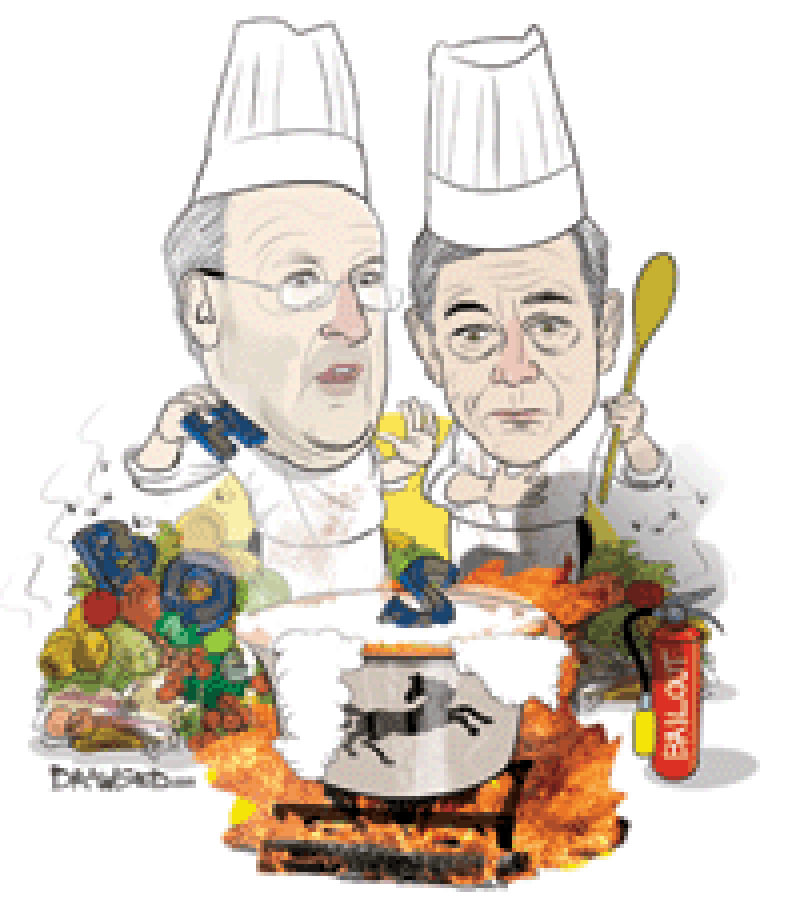
I am also puzzled by recent developments at Lloyds TSB. I am at a loss to understand why Lloyds TSB’s chairman, Sir Victor Blank, and chief executive, Eric Daniels, agreed to merge with troubled HBOS last September. Essentially, they added a bad bank to a good bank and ended up with bad bank stew. This shows a lamentable lack of judgement. A mole whispers that Sir Victor hoped to curry favour with the prime minister and earn himself a peerage. Of course, Lloyds’ senior management might have thought that they were receiving an early Christmas present: the combined group would have an enormous domestic market share and, because of the tumultuous circumstances, the deal was waved through by the UK authorities. Lloyds limps on but it’s going to be a very tough year.
It was a relief to escape from the grey gloom of London to the balmy warmth of Palm Beach, Florida. Palm Beach is an island retreat for the very rich. But its sunny reputation has been indelibly stained by an association with the alleged fraudster, Bernard Madoff. Bernie had a house in Palm Beach overlooking the lake and was a member of the exclusive Palm Beach Country Club where he met many of his victims. In early January, Palm Beach was a ghost town: the expensive restaurants were half empty, the designer shops on Worth Avenue had no customers. A personal trainer told me that 70% of her clients had lost money with Madoff, including a couple in their 90s whose entire charitable foundation had melted away. Madoff’s neighbours in Palm Beach were anxiously seeking advice from security firms in case a vengeful investor bombed the Madoff mansion and their own homes went up in flames as well. The opulent, Breakers Hotel, once frequented by Rockefellers, Vanderbilts and Astors, was suffering with a 15% occupancy rate. Its two big January conferences had both cancelled: Lehman Brothers is bust and AIG can’t be seen to be squandering taxpayers’ money. A mole whispers that some naughty AIG employees wanted to enjoy the Florida sunshine and tried to make the booking under a different corporate name but the Breakers’ management refused to accept it.
Is there no good news around? Well I am pleased that Morgan Stanley’s share price seems to have stabilized. I think the firm will benefit from the joint venture with Smith Barney, Citi’s wealth management business. Morgan Stanley has the majority stake in this new entity. And a friend says that his US bank has had a good start to the year and that first-quarter results throughout the industry might be better than expected.
It is in gloomy times like these that I will miss the old renegade, president George W Bush. Humour is so vital and his ridiculous ruminations always made me laugh. I will leave you with two of the best Dubya credit-crunch jokes. The first:
"President Bush said clients shouldn’t be concerned by all these bank closings. If the bank is closed, you just use the ATM, he said."
The second:
"President Bush said that he is saddened to hear about the demise of Lehman Brothers. His thoughts at this time go out to their mother, as losing one son is hard but losing two is a tragedy."
So how was your month? Please send news and views to abigail@euromoney.com