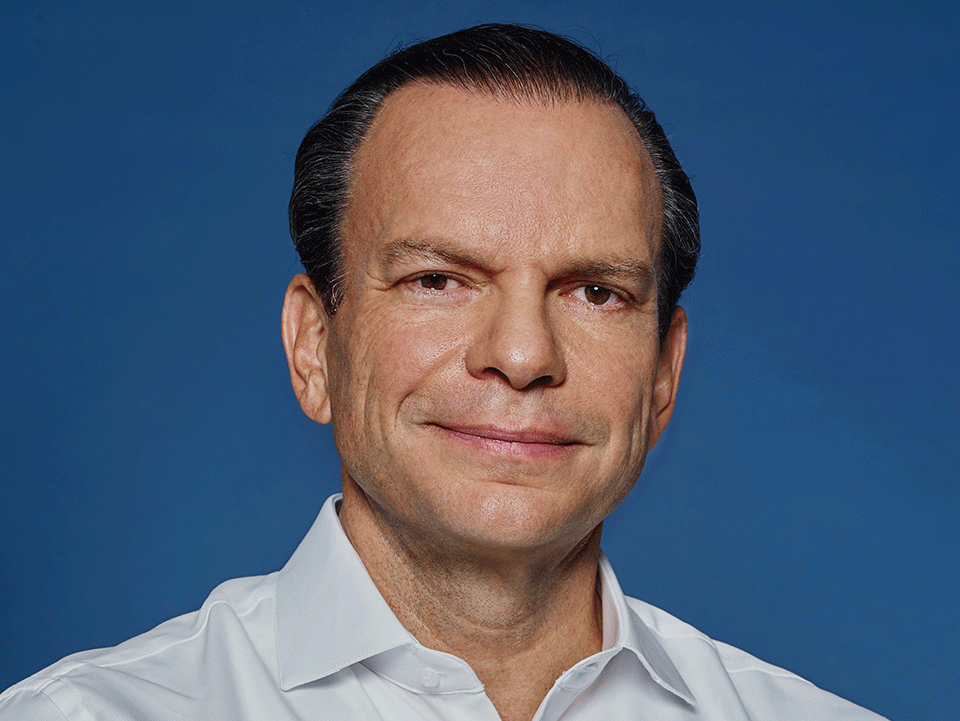
Under Georges Elhedery, HSBC has transformed at an unparallelled pace for such a large and international bank. While change was arguably overdue in key parts of the group’s structure, the recipe for getting things done quickly has been a willingness to act and a willingness to listen: so that when big decisions were announced, they could be implemented with precision.
“Sometimes you think that if you take action, you may break something,” Elhedery tells Euromoney. “But if you first design that action very thoughtfully, you have the best teams to help execute it, and you allow your people agency in the process, you can realise the benefits and avoid distractions.”
As part of the application for the job, Elhedery had already convinced the board that that his vision for the bank was the right one, including a rough outline of what he thought was necessary. He could then use the time between the news of his appointment in July 2024 and officially taking over that September to speak to the bank’s leadership, hear their concerns and bring them on board with a more specific plan.

It was striking to me how the bank was ready to move at pace, and put necessary actions behind us, as opposed to going step by step
Georges Elhedery
This put him at an advantage compared to CEOs of large international banks undertaking similar reorganisations. Only seven weeks after becoming CEO, he announced a new structure for the bank – merging its SME and large corporate divisions and elevating Hong Kong and the UK into standalone businesses, while aggregating coverage for other geographies into two macro-regions covering east and west.
Readier than we thought
“It was striking to me how the bank was ready to move at pace, and put necessary actions behind us, as opposed to going step by step,” he says. “The fears of the past were in hindsight overblown, because our people and customers were readier than we thought.”
As the new structure came into effect, he announced the financial implications as promised in February – including $1.5 billion of annualised savings by the end of 2026, with no revenue implications as it primarily came from getting rid of roles that would now overlap. By mid-2026, the bank was already on track to realise those savings six months ahead of schedule, helping to increase profitability when many feared its returns would fall along with central bank rates.
In fact, progress on the new strategy allowed the bank to upgrade its return on tangible equity target for the coming three years from mid-teens or better to 17% or better, after reaching 17.2% in 2025.
Along the way, HSBC has moved to a simpler business, more focused on where it can shine. It announced 11 business exits in 2025, ranging from retail banking in Bahrain, Bangladesh and Sri Lanka, to its banks in Malta and Uruguay, and residual non-core investments in Argentina, France and Germany. That has further facilitated an end to an often cumbersome matrix approach to management between geographies and business lines. It has also bought out minority shareholders in Hong Kong’s Hang Seng Bank, moving to 100% ownership, in October 2025.
Leveraging your network
While the UK and Hong Kong are clearly special cases for HSBC – earning returns on equity of over 20% and 30%, respectively – Elhedery makes clear the banking environment has fundamentally changed since it built up many of its international retail banking businesses.
Partly due to regulation and the capabilities of locally owned banks, it is no longer the best owner for smaller retail business that might have little to gain from its international network.
“We’re a network bank,” he says. “We bring global customers into a market, and we take local customers from that market outwards.”
Both for the business and its investors, it is increasingly clear that Elhedery’s strategy is working. The bank’s share price roughly doubled in the first two years of his tenure. It is showing consistent growth too. All four of its businesses saw an increase in deposits and revenues in 2025. International wealth and premier banking, and the newly formed corporate and institutional bank saw especially strong growth in business volumes.
As a leader you should hear the challenge, then align your team behind the decision, and everyone commits to it. You don’t relitigate the process multiple times
Georges Elhedery
The decision in February 2025 to exit equity capital markets and M&A advisory in the UK, Europe and Americas was controversial especially in London, the site of the global headquarters. Rivals quickly snapped up some of its top investment bankers. Gerry O’Keefe, who previously co-led global banking coverage, departed a year later after helping to manage the wind-down process.
But difficult decisions were always going to be necessary. Elhedery believes he is vindicated. He points to 70 live IPO mandates in Asia – far higher than it has seen for a decade and says the bank has acted on three of the five biggest IPOs in India over the past year. “By focusing, we’ve been able to serve our customers better,” he says.
His approach is by no means just cuts and asset sales. The Hang Seng Bank privatisation, for example, involved a suspension of new share buybacks and a $13.6 billion investment, making it one of the biggest bank M&A deals globally in recent years – albeit at a relatively low risk given how well it knows Hang Seng. The scope for greater synergies with HSBC meant the privatisation of Hang Seng had long been on the strategic menu for HSBC, but even if the bar for such a large investment remained high, it had become something of a no-brainer.
The wealth and corporate edge
“We could see on the ground that Hong Kong was rebounding and that was not priced in the market,” he says. The bank has subsequently increased exposure to Hong Kong banking just as the local property market rebound gains momentum.
Getting out of areas such as European investment banking and retail in various markets has also freed up space for investment in other businesses, notably transaction banking across Asia and wealth management, where Hong Kong recently surpassed Switzerland to become the world’s biggest international wealth centre, according to Boston Consulting Group.
HSBC is already the second biggest internationally focused private bank in Asia after UBS, according to Euromoney data, with around almost twice as much in assets under management as next-ranked DBS and showing a similar growth rate to the latter despite the higher base. It does not have as much business among ultra-high net-worth individuals outside Hong Kong as firms like UBS, but it banks people across the wealth spectrum – with $100,000 upwards – while benefiting from its corporate banking dominance in Asia.
“Wealth is undoubtedly one of our biggest growth opportunities and it needed very focused investment to really get it off the ground,” says Elhedery.
In September, HSBC achieved a Guinness World Record with what the latter called the world’s tallest bank in a building – one of five new Wealth Centres launched in Hong Kong last year, in this case on the 99th floor of a tower close to a key transport hub from mainland China. It also launched its flagship UK Wealth Centre in London’s Mayfair district in 2025.
In the Middle East and other Asian markets, the bank opened 20 more of these wealth centres – as elevating the UK and Hong Kong into separate divisions further strengthened strategic emphasis on affluent customers in those markets which it has not sold or placed under strategic review. In Mexico, a similar refocus on affluent customers has involved the closure of as much as a quarter of its branch network, alongside a reduction in expected consumer credit losses.
We’re a network bank. We bring global customers into a market, and we take local customers from that market outwards
Georges Elhedery
“We’ve doubled down in mainland China, India, UAE and Singapore, because we have a competitive edge in these markets in the affluent category,” Elhedery says. “You can’t expect to bank new millionaires in India from Singapore, for example. You need serious local presence, with local visibility, recognition and heritage in these markets.”
In all these markets, this mass affluent reach is a key competitive advantage versus peers more focused on the higher end, often implying a higher cost of acquisition.
“If you really want to grow your wealth business, you have to start early in your customers’ wealth journey,” says Elhedery. “Our wealth proposition gives us great access to future millionaires and billionaires, because we’re capturing them through premier and corporate banking.”
Elevating the UK and Hong Kong in the global reporting lines, meanwhile, was clearly intended to emphasise the value of the wider mass-market business in those markets.
It has invested in the UK SME business, attracting and retaining more customers and boosting customer advocacy. Elsewhere, however, combining cover of SME and large corporate coverage was also less about retrenching than simplification and agility. Country heads, for example, now have more direct responsibility for business lines. In many countries, such as France and Germany, corporate and institutional banking is the only thing that the bank does.
The simplification programme has consequently allowed the bank to reduce managing director positions by 15% under Elhedery, cutting global staffing costs by 8%. The restructuring also led to a reduced executive committee from 18 to 12 members, thanks to the combination of leaders in the Americas and Europe, and in Asia and the Middle East, alongside the commercial and large corporate merger. Branding and sustainability roles have also been subsumed under other executives.
This was not always a pleasant process. Where more than one person would now be responsible for the same business, they had to apply for the job. Excluding technology staff, full-time employees reduced by 4,400 net in 2025.
Executive accountability
But today 60% of revenue is now generated under a single point of accountability at the group executive committee, whereas previously every dollar of revenue had at least two accountable executives. “We support our leaders with the skills they need, but the buck stops with them and their business line,” says Elhedery.
The reorganisation has been more radical than under any recent HSBC CEO and it is largely designed to tackle some of the more restricting elements of its business culture. Despite being the first non-British CEO, Elhedery has worked for HSBC for over 20 years. He knows the value of collaboration and sense of responsibility that often thrives in the firm. But he was also aware of how the old management model sometimes disempowered its leaders. The emphasis now is to encourage staff to challenge a decision at the right time appropriately, rather than relitigating it later.
“Sometimes it was felt that politeness was in the way of due challenge,” Elhedery says. “As a leader you should hear the challenge, then align your team behind the decision, and everyone commits to it. You don’t relitigate the process multiple times.”
For the corporate and institutional bank – by far its biggest revenue driver – the financial indicators all indicate a successful integration, in Elhedery’s view. “Being simpler has helped us to shrink the cost base and optimise our capital, but it has also helped us grow revenue,” he says.
“We didn’t have to reinvent the business model, chase new customers or hire new people and change the culture. We just needed to remove that structural complexity sitting in the way.”