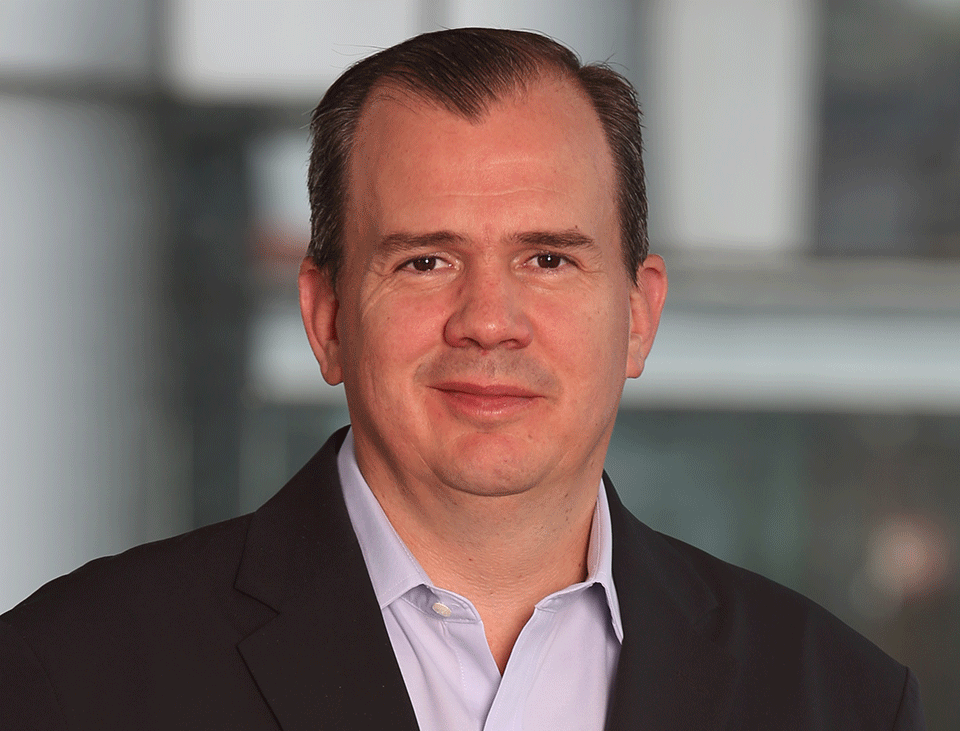
Jochen Friedrich arrived at DZ Bank last year to become head of fixed income. This bank, along with WGZ Bank, is one of the two central institutions linking Germany’s mutual banking network. Consolidation is under way among the cooperatives as well as the Landesbanken. DZ itself is the product of a difficult merger between DG Bank and GZ Bank, and expects the total number of German cooperative banks to fall from about 1,600 today to roughly 800 by 2008.
Motive for moving
Friedrich used to run German capital markets at JPMorgan, so moving to DZ’s headquarters was something of a cultural shift. He says he made it because he thinks DZ is where he can make the biggest difference in addressing the biggest structural problem in German banking – mispriced credit. Friedrich hopes recent deals – particularly the e1 billion issue for Deutsche Telekom – have shown issuers and lead managers that including DZ in a syndicate can improve distribution. He says: “The Deutsche Telekom deal has performed incredibly well since launch, and has proved to the market that we can handle deals of this size and, given our broad distribution, provide for more stable spread developments.”
Like WestLB’s Taiber, he says the smaller, more buy-and-hold oriented accounts that his bank has relationships with provide attractive stability in the secondary market, complementing the liquidity created by the presence of bigger, more active investors.
This mandate was awarded because of the bank’s performance as co-lead on Deutsche Telekom’s five-year deal in May 2002, for which it brought in 130 orders. He also points to the e100 million deal his bank recently executed for diversified conglomerate Haniel – the A-rated company’s first use of its MTN programme. In late February Friedrich was in London to market DZ’s capabilities as co-lead.
DZ’s network of about 1,250 mutual banks will buy fixed-income products for their own books, and can also sell them on to their 15 million retail clients. This is a wider natural distribution network even than those of any Landesbank, since the cooperative sector is not comparably fragmented across regions.
There are, however, limits to the kinds of paper many of these accounts will accept but Friedrich expects these to widen over time. He says: “The issues the cooperative banks will buy at the moment are predominantly investment grade – they usually want to diversify into credit gradually, starting with the better-rated names. In the context of diversifying credit portfolios, cooperative banks are starting to buy structured deals that offer a complexity premium and contain a better risk-return profile.” There is plenty of capacity – about half of mutual bank holdings are still in government bonds and Pfdandbriefe, but these bankers say these too need to increase returns by diversifying into credit.
Of course investors who have missed out on the move into credit since the introduction of the euro may count as a great blessing the lack of sophistication that held them back in government bonds.
Friedrich wants to use structured credit to help the mutual banks. One example is the Provide deal DZ executed with KfW in November 2002 – the first German multi-seller commercial mortgage-backed security, worth e623 million. DG Hypo, the bank’s mortgage subsidiary, and five local cooperative banks all put property loans into a pool, with the credit risk passing through KfW. This pool was then tranched and sold to international investors.
Another initiative attempts to deal with the concentration risk the local banks suffer from lending so heavily in one geographic area, by allowing them to put their potentially problematic exposures into a pool and receive back an equal value of risk that is spread across regions and sectors. And in November DZ also created a synthetic, dynamic collateralized debt obligation deal worth e1 billion to enable cooperative banks to buy tranches of highly diversified credit risk.
As well as increasing DZ’s presence in capital markets and helping the mutual banks reshape themselves to compete, Friedrich wants to offer advisory services outside the mutual bank network. He says: “We have a great deal of knowledge of our clients – each cooperative bank is covered by a salesperson and a business consultant who gives advice on such areas as asset-liability management, risk controlling and management, and regulatory and accounting issues. My goal is to leverage these advisory skills to new clients like insurance companies, asset managers and other banks.
“If we only serve our existing clients, we’ll be fulfilling our basic role as central bank, but won’t be taking advantage of our real market potential.”