
It is often said that retail banking cannot be a global business. No established bank has done more to challenge that notion, especially over the past two years, than Banco Santander.
Since the mid-2010s, Santander has worked to leverage global economies of scale in other businesses, starting with corporate and investment banking. In late 2023, it went further by embarking on a transformation of its retail and commercial banking franchise – by far its biggest revenue generator – into a global business.
The reasons are clear. Focused on Europe and the Americas, Santander is the world’s biggest international retail bank, with around 175 million customers: more than any other bank outside Asia. Unlike the big Asian retail banks in China and India, Santander’s franchise is spread across nine core markets. Nubank and Revolut’s customer numbers are catching up, with global spread, but their product suites are narrower, and they lack branches.
Santander still sees its roughly 8,000 branches as crucial, even if it has streamlined those branches and moved them more towards sales and advice.

“Operating at scale across multiple important geographies allows us to have a global digital capability,” says Daniel Barriuso, global head of retail and commercial banking since 2023, speaking to Euromoney. “No fintech company can replicate the combination of that scaled local presence, plus branches. This is a combination unique to us, and a competitive differentiator.”
Turning Santander’s international retail network into more of a global franchise – notably in technology – has required clear backing from the top, including executive chair Ana Botín, who has committed to what she calls a global transformation to make a “digital bank with branches”.
New markets, new segments
This transformation has required heavy investment in developing globally scalable technology. The bank’s technology budget ran to €7 billion ($8.17 billion) in 2024. The transformation includes a new proprietary core banking system called Gravity as well as Open Digital Services. Better known internally as ODS, the latter is the front-end technology initially built within Openbank: a two decades-old branchless bank in Spain which the group relaunched as a full-service, cloud-native digital bank in 2017. The UK migrated to the ODS front end, called OneApp, last year.

Openbank itself has continued to expand, helping Santander to grow in new markets and to win over new customer segments. Earlier launches in Germany, the Netherlands and Portugal have made Openbank one of Europe’s biggest digital bank by deposits, with a balance sheet of €18 billion.
In 2024, the US became the first country where Santander combined ODS and Gravity, as it launched a new offering under the Openbank by Santander brand in October. That preceded the launch of Openbank in Mexico in early 2025, and a move to a branch model in Germany to provide local IBANs.
“We haven’t started with the small markets,” says Openbank CEO Petri Nikkilä. We’ve gone to the markets that will be meaningful for us, not only for the size of the economy and population, but also because we believe we have a bigger role to play in those markets.”
Less is more
Together with the global tech programme, Santander has been on a simplification drive, reducing its number of products by more than a third in 2024 – helping efficiency, and making the product suite less confusing for customers. In Mexico, for instance, it cut its number of mortgages from 17 to three, contributing to an 18% increase in sales. “Simplification is a friend of speed and customer experience,” says Barriuso.
The simplification drive has helped wider efforts to streamline the back office, and to make a much higher proportion of products available digitally, with the latter proportion rising from 56% to 62% in 2024. Cuts in the number of necessary steps on the app, coupled with back-office improvements, have slashed digital onboarding times, bringing it to global best-in-class standards – less than three minutes – in Brazil, for example.
Santander has also reduced the number of full-time staff per million customers dedicated to non-commercial activities by 13%, thanks in part to automation and AI.
There are signs that it is all paying off.
As other international banks have exited the US … Santander continues to believe it has the heft and know-how to succeed in the country
Santander’s retail revenues rose by 11% to €32.5 billion in 2024. Net profit rose 29% to €7.3 billion and the division’s return on equity rose to 18.9%. Its number of customers rose by 8 million, largely thanks to digital improvements. Even as the number of customers jumped, revenues per customer rose by more than 6%, and it is seeing greater efficiency, with the costs per customer dropping around 3%. The retail division’s cost/income ratio fell three percentage points to 39.7%.
Customer service appears to be benefiting from the transformation, too. Digital customers are more satisfied than others, with Openbank among the highest performers among Spanish peers. Yet the most satisfied of all are those that use both the app and the branch, says Barriuso, pointing to data showing its net promotor score is among the top three banks in seven of its markets.
Wherever it operates, Santander continues to look for critical mass, as the recent news of an acquisition of TSB in the UK shows. And as other international banks have exited the US – the world’s biggest retail market – Santander continues to believe it has the heft and know-how to succeed in the country, both because of its existing US consumer businesses and thanks to the new scope to roll out globally scaled platforms.
Digital native but on the ground
Openbank’s nationwide US launch last year complements the northeast-focused franchise it bought two decades ago, today known as Santander Bank. A high-yielding savings products is Openbank’s first US product, due to funding synergies with the group’s US Texas-based auto finance business. In the early weeks, it met and passed its targets, reaching $2 billion in deposits by February 2025.
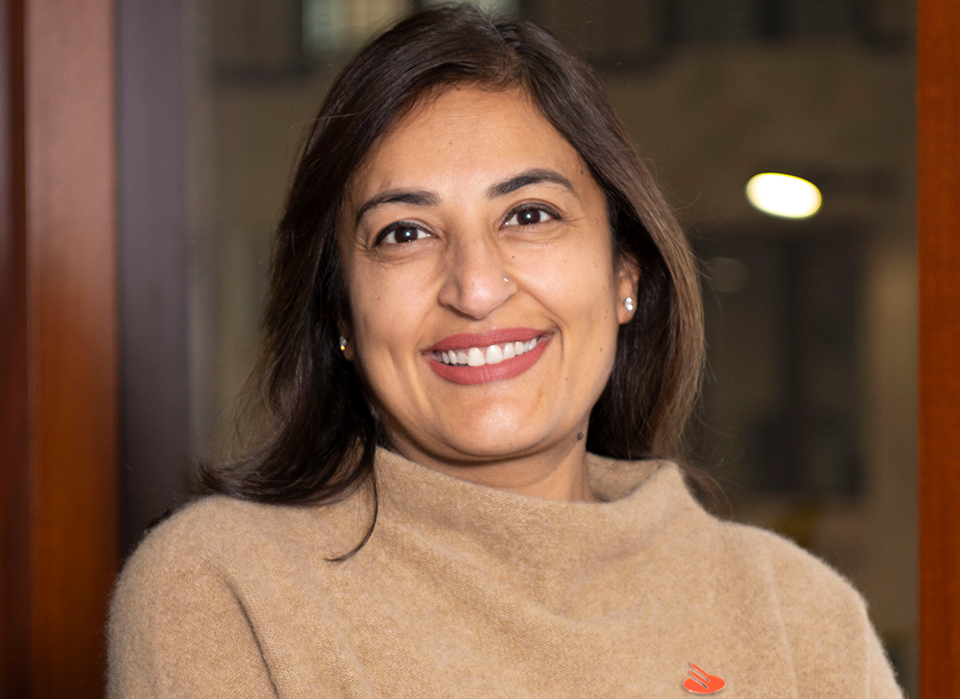
Swati Bhatia, Santander Bank’s head of retail banking and transformation, expects the group’s global platforms to save up to 80% of the foundational work for Openbank to launch daily banking products in the US, such as checking accounts and cards.
“Openbank’s greatest strength is the group’s DNA in consumer banking,” she says. “If we were launching Openbank on a standalone basis, we would have to pay a core banking platform vendor and build the products and the front-end user experience, rather than just adapt those components to US regulation and customer expectations.”
As elsewhere in the group, the branch remains important, even for Openbank, which opened its first physical location in Miami this May. “We’re blending relationship banking with a great digital experience, and a lean back-office operation: resulting in a lower cost to serve, which we can pass back to the customer,” Bhatia says.
Gravity and OneApp are on track to process 80% of group transactions by the end of 2026. After the launch of Openbank in the US, Gravity went live in Chile earlier this year. Spain followed in June, with Brazil and Mexico next up.

These migrations are allowing Santander to decommission its old mainframe systems after a period of running the two in parallel, with the benefit immediately seen in app response times. The programme it so important that Google Cloud has developed its own service called Dual Run, built on top of Santander’s technology, to help other businesses in finance and other industries migrate off mainframe systems, earning fees for Santander.
Dirk Marzluf, group head of technology and operations, says Gravity is removing between 50% and 60% of Santander’s core-system costs, resulting in a recurring annual cost saving of around €150 million.
“Gravity makes Santander a digital native company, with the agility and capability to provide the best customer experience and the security we’ve always offered,” he says. “The core system is becoming a much smaller part of our overall IT costs, as little as 5%. It’s not a cost driver anymore, which means we can invest more in other capabilities.”