BNP Paribas has rapidly converted a long-standing Nordic footprint into a fully integrated regional franchise. Having branded the Nordics a strategic growth market seven years ago, the bank first doubled revenues within two years and then beat a second growth plan well ahead of schedule.
The bank has now earmarked additional capital through 2030, confident that the region’s high GDP growth, deep pools of private wealth and leadership in sustainability provide an outsized opportunity for its corporate and investment banking arm.
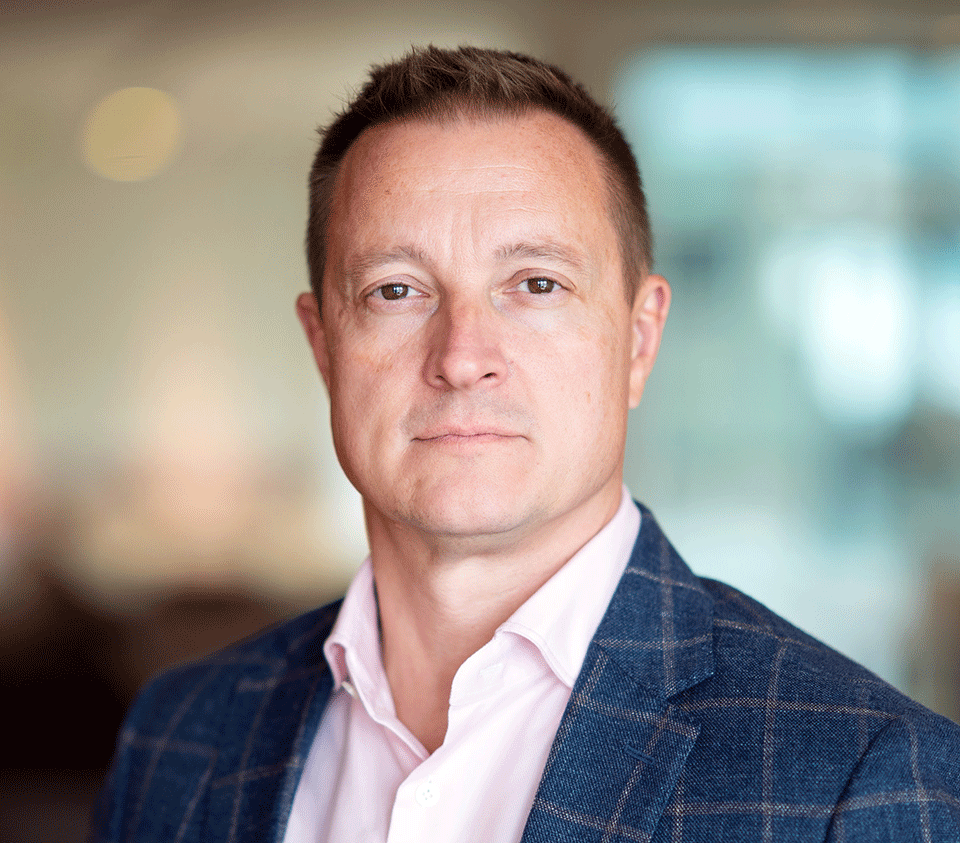
“We have had fantastic momentum, but I still consider these achievements to be baby steps compared to our long-term ambition,” says Eirik Winter, CEO BNP Paribas Group and head of CIB Nordic region.
Much of the progress is structural. Between 2018 and 2024 the headcount expanded by roughly 200-300, to almost 1,000, making BNP Paribas the largest international bank with on-the-ground staff in Sweden, Denmark, Norway and Finland. A 25-plus investment-banking team, complete with locally based heads of ECM and both corporate and institutional DCM, now mirrors the set-ups of US peers.
Senior hires with London pedigrees, such as former Goldman ECM banker Jens Lothe and ex-Citi capital-markets executive Tomas Lundqvist, have added further strength.
“Nordics are probably one of the most competitive markets globally with all top US banks fully present. We want to be the trusted long-term alternative in both good and more challenging times. I’m very proud over what our people have achieved in such a short time space,” Winter notes.
This build-out coincided with the retrenchment of several continental rivals, leaving BNPP as the only AA-rated global European player able to match Nordic multinationals’ demand for cross-border distribution, risk management and advisory work. The combination has translated into double-digit annual revenue growth, about 15% a year since 2018, and today the bank ranks top five overall in regional league tables, the highest of any international house except JPMorgan and the clear number one big European name.
BNP Paribas [is] the largest international bank with on-the-ground staff in Sweden, Denmark, Norway and Finland
Flagship transactions have reinforced that trajectory. In Finland, the bank orchestrated the spin-off of Kalmar from Cargotec, treating the demerger like an IPO and virtually eliminating the usual post-listing share overhang. It also engineered Nokia’s politically sensitive sale of its subsea-cable unit to a French state-backed buyer – an exercise in which BNPP’s dual French-Nordic heritage and long relationship with the telecoms group proved decisive.
Denmark has been equally dynamic. The bank featured on the headline domestic deal in 2024, most notably backing logistics group DSV’s €5 billion ($5.85 billion) accelerated bookbuild that funded the acquisition of Schenker. The block was placed without a discount – unprecedented for an equity raise of that size in the region. BNPP underwrote both the M&A financing and associated hedging.
Record-breaking debt mandates were also completed: a €3.8 billion loan for Carlsberg and a €4.7 billion bridge loan for Novo Nordisk, underscoring the bank’s depth in euro-denominated debt capital markets.
Cross-border connectivity helped differentiate BNPP. When Swedish hygiene producer Essity agreed to sell its 50% holding in Hong Kong-listed Vinda to Singapore’s Royal Golden Eagle, the mandate hinged on seamless cooperation between BNPP’s Stockholm and Asian teams. Similar link-ups with Latin American and Asian desks are feeding a pipeline rich in energy-transition and digitisation themes – the fields where Nordic corporates remain global pace-setters.
With full-service desks now embedded in each mainland Nordic country, a proven ability to deliver multi-product solutions around complex M&A, and a reputation for stepping in during market stress, the bank is already seeing its expanded platform translate into wallet share. Further selective hiring is planned, but management emphasises that the focus has shifted from simply “catching up” to monetising momentum across advisory, capital markets and risk solutions.
“When the world is a bit wobbly or volatile, we tend to win market share – we did it during the pandemic and we’re doing it again now,” says Winter.