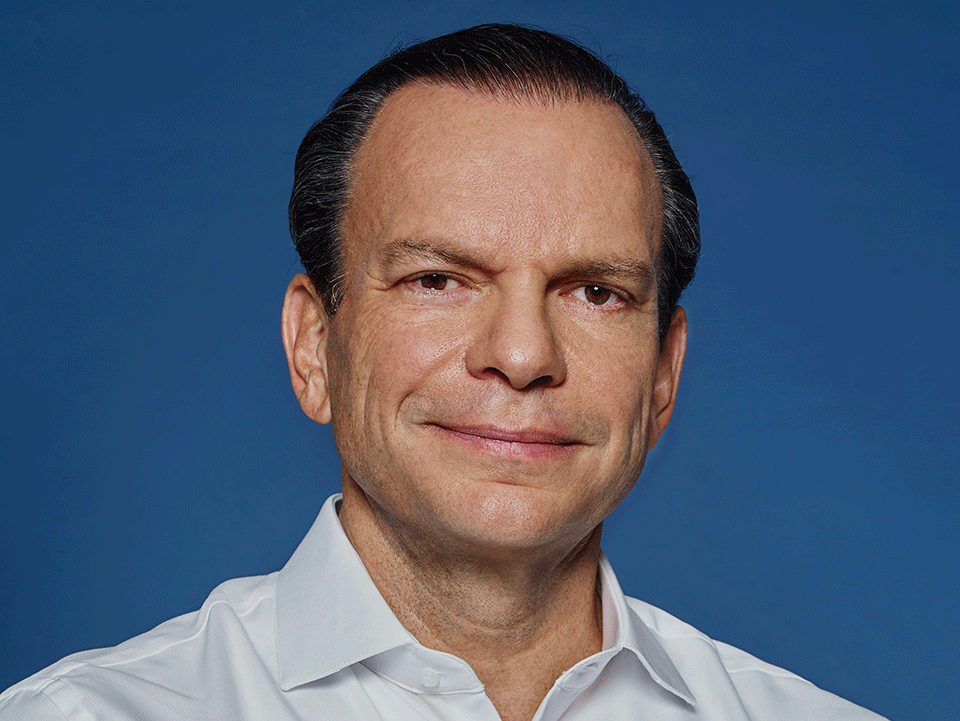
BNP Paribas takes this year’s award on the strength of numbers few peers can match, topping league tables in 2025 globally for all ESG (GSSS) bonds, green bonds, sustainability-linked bonds and loans, and ESG fixed income revenue. For the third consecutive year, BNP Paribas topped Dealogic’s green, sustainable and sustainability-linked bond league tables.
“The league tables are actually a result of what we do. They’re a nice reward for massive engagement with clients. Sometimes we’re one of the only banks to advise not to do a labelled bond — when we feel it’s not the right timing, or the client isn’t best positioned to do so,” says Constance Chalchat, head of sustainability, global markets.
The bank’s success is not just about volume but also about consistency across products and increasingly complex transactions.
Geographic breadth reinforces the position. BNP Paribas has remained active across EMEA, the Americas and Asia-Pacific, leading transactions ranging from Poland’s largest-ever offshore wind €6 billion project financing and Inch Cape’s £2.7 billion Scottish offshore wind deal to CAF’s inaugural sustainability bond in Latin America and the first EMEA sovereign SLB for Slovenia (€1 billion).
“One of our biggest strengths is our cross-border corridors. We’ve always tried to show our European issuers what they can do in the dollar market or Latam names issuing in Swiss francs, for example. There’s a real cross-reference, and an ability to attract investors from one region to another,” says Agnes Gourc, co-head of sustainable capital markets.
It has also been the only bank delivering the first European green bond solutions across every issuer segment — public sector, corporate, financial institution, supranational and sovereign — including Denmark’s inaugural EuGB.

The league tables are actually a result of what we do. They’re a nice reward for massive engagement with clients
Constance Chalchat
A distinguishing feature is how sustainability is wired into the banking model. ESG considerations are embedded from origination through structuring, execution and post-deal monitoring, supported by dedicated advisory, structuring, innovation and transversal teams within the CIB low carbon transition group.
“We were probably the pioneer bank to develop the advisory business, because we quickly realised that structuring and advisory were pieces of the same puzzle. If a labelled product is the best advice, great, but it’s about how we can help clients be better positioned, be it through improving ESG ratings, communicate their strategy, issuing a labelled bond, says Franck Rizzoli, co-head of sustainable capital markets solutions.
The result is tighter alignment between financing activity and measurable outcomes. Around 82% of its energy production credit exposure sits in low-carbon activities, and it tops BloombergNEF’s Energy Supply Banking Ratio at €2.27 of low-carbon financing for every euro of fossil-fuel financing – well above the sector average of 0.89.

One of our biggest strengths is our cross-border corridors. There’s a real cross-reference, and an ability to attract investors from one region to another
Agnes Gourc
The focus has widened beyond climate. BNP Paribas exceeded its €4 billion biodiversity financing target, reaching €5.4 billion by the end of 2024, and helped ICMA publish ‘Sustainable Bonds for Nature: A Practitioner’s Guide’ in 2025. In blue finance it has arranged a run of inaugural transactions – CAF’s €100million blue bond for ecosystem protection in Brazil and Ecuador, BancoEstado’s inaugural Swiss franc blue bond, and Saur’s second €500 million blue bond – reaching €1 billion in funding for the maritime ecological transition.
Innovation runs through the platform. The bank has built sustainability-linked structures tied to demanding KPIs (including SNAM’s $2 billion SLB, the first with a net-zero greenhouse gas target across Scopes 1, 2 and 3) and is investing in data-led advisory, including a proprietary AI-powered ESG Assessment tool used by thousands of relationship managers.
The reach extends beyond institutional clients. Of the €252 billion mobilised since 2022, €47 billion has gone to retail customers to support energy-efficient housing and lower-emission mobility, with targets of 400,000 home renovations and 400,000 leased battery electric vehicles through Arval by the end of 2026.
“On the retail side, we’re discussing with households and SMEs, but we see the same question as on the capital markets side — electrification of mobility, improvement of housing, reducing dependency on the price of energy. It’s the same question, shaped in a different way,” says Nathalie Jaubert, head of group environmental and social engagement.
Client engagement underpins the model. The bank pairs advisory across ESG strategy, ratings, reporting and financing with balance sheet and capital markets execution, backed by a global staff of specialists across the advisory and structuring teams – with 100% of Green Finance Frameworks drafted by BNP Paribas in 2025 rated in the top two categories by second party opinion providers.
BNP Paribas is also active in shaping market infrastructure, coordinating the 2024 to 2025 ICMA Climate Transition Finance Working Group behind the new CTB Guidelines released in November 2025 and sitting on the Strategic Steering Group of the UK’s Transition Finance Council.
“I can tell you exactly why a wording is what it is — I remember the five iterations and why it landed there. Sowhen we come to market with a transaction, we know where the consensus lies and where boundaries still need to be established,” says Gourc.
What sets BNP Paribas apart is not the scale of any single number but the way scale, breadth and execution reinforce each other – league table dominance funded by disciplined portfolio steering, capital markets leadership paired with retail delivery, and a first-mover position in adjacent frontiers such as biodiversity and ocean finance.