European banking’s biggest disadvantage against the US is its fragmented market. The lack of a completed banking union, starkly differing mortgage markets, and other factors, mean pan-European groups don’t work.
UniCredit, especially over the past year, has challenged this perceived notion head on, in part because its existing business across the continent is performing so well.
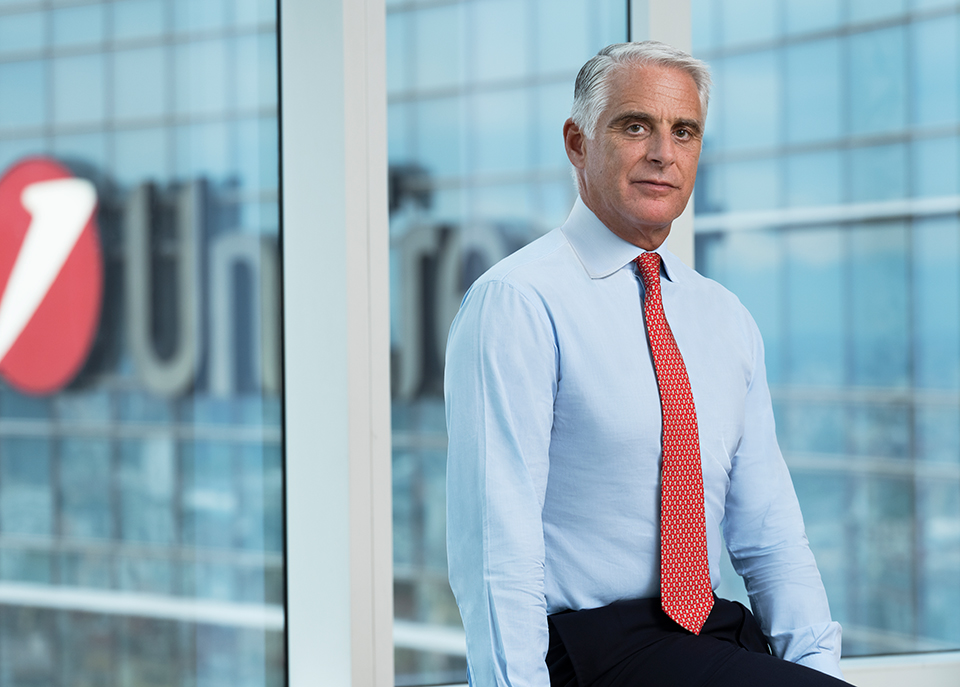
Chief executive Andrea Orcel and his team have simultaneously helped to dismantle the reticence – lingering in European banking since 2008 – about engaging in hostile takeovers and stake-building as a way of forcing through consolidation of Europe’s fragmented banking sector. No one can now accuse Orcel, as some have previously accused European banking leaders, of being insufficiently decisive on that front.
But UniCredit was only able to build up its stakes in Commerzbank so rapidly last year – and later launch a takeover offer for Banco BPM and increase its stake in Greece’s Alpha Bank – because it is in such a strong financial position.
Investors and banks have often struggled to reconcile a focus on shareholder value with being proactive in bank consolidation. UniCredit, by contrast, considers itself the most shareholder-friendly bank in Europe: with some justification, as shareholder distributions rose to €9 billion in 2024.
Numbers that speak for themselves
While European peers have seen a wider rebound in shareholder returns of late, none come close to UniCredit. The bank boasts a total shareholder return over the four years to end-2024 of more than 500%, including share-price appreciation, dividends and buybacks. After 16 consecutive quarters of growth, 2024 was UniCredit’s best-ever year for profitability. Return on equity rose to 17.7% despite carrying €6.5 billion in excess capital.
Contrary to any idea that its success would have simply been down to the interest-rate cycle, revenue growth in 2024 was underpinned by fees – up 8% year-on-year.
Across Europe, the past year has shown that domestic interests remain a challenge to the dream of building bigger European banks to compete with the Americans. On the other hand, if UniCredit can negotiate effectively, that’s largely because it has a strong standalone story. Its investment case does not rely on these deals going through.
“We’re being very disciplined and consistent on M&A because we’re only going to do it if it adds to a base case that is already a high bar,” Orcel tells Euromoney.
A vital part of that standalone story is that it is already fostering greater cross synergies. That involves investing in group-wide product factories in areas such as insurance, asset management, and payments – and working to realise greater pan-European economies of scale in procurement, technology or data.
“We have common factories delivering best-in-class products and services to each one of our banks and partners: using the scale of the whole group to give benefits to each bank and their clients,” Orcel underlines.
Orcel argues that UniCredit can continue to outperform in terms of shareholder returns. First-quarter numbers … suggest he is right
In an age of escalating third-party service costs, notably in IT, procurement should not be sniffed at. “We’re getting a significant cost advantage, as we leverage both our scale and we offer providers reach to customers across Europe,” Orcel says.
UniCredit has also implemented a cards partnership with Mastercard of unprecedented pan-European scope. But the continental scale benefits go much further.
Recently, it has launched a new digital SME lending platform – and rolled out a similar platform for consumers in central and eastern Europe. “It’s a fully digitalised SME lending process, end-to-end, which we are piloting in Italy, and then replicate with minimal additional cost in 13 markets,” Orcel says.
UniCredit’s approach, Orcel makes clear, is not to get rid of its physical branches. Even digital banks know that some national infrastructure is necessary in Europe. Yet continental scale could add to the rationale of a Commerzbank takeover – in addition to the scope to reap domestic synergies UniCredit’s German subsidiary HVB.
In 2024, UniCredit’s cost/income ratio was already only 37.9%. Despite operating in a notoriously inefficient market, HVB’s ratio was barely any higher, at 40.6%.
Bringing back bancassurance
One of the other aspects of UniCredit’s impact, meanwhile, is its move to reinternalise product factories in areas like asset management and insurance.
Asset gathering businesses are often lynchpins of banks’ profitability in Europe, where capital markets are less developed than in the US. They’re also relatively easy to spread across European borders. That’s something UniCredit has shown in its partnership with Alpha Bank as part of a deal including an acquisition of the latter’s Romanian bank, completed in November.
Alpha Bank’s distribution of funds from UniCredit’s onemarkets investment platform is already growing rapidly in Greece. A 51% acquisition of the Greek bank’s life insurance business (focused on unit-linked products) is soon to follow.
UniCredit’s 2016 sale of asset manager Pioneer was one of the most prominent examples of how European banks were forced to sell product factories for state aid or capital reasons. Now, UniCredit looks like a forerunner as banks from France to Greece increasingly invest in asset management and insurance, in some cases after selling for reasons like UniCredit’s years before.
The onemarkets platform, three years after its launch, saw assets under management reach €14.5 billion in 2024, with internally managed funds rising from 14% to 31%.
And in late 2024, in a long-planned move, UniCredit started the process to bring its life bancassurance business in Italy in-house: ending agreements with CNP Assurance and Allianz.
In late 2024, UniCredit’s share valuation still had scope to re-rate against key European peers. Given Italy’s painful past in terms of credit costs, the next challenge is to prove the bank could outperform even in a bear market.
“It’s about dealing with our investors with transparency: not surprising them negatively, and delivering, delivering, delivering,” Orcel says.
How high can you go?
Orcel argues that UniCredit can continue to outperform in terms of shareholder returns. First-quarter numbers, which allowed the bank to upgrade its 2025 profit guidance, suggest he is right.
“Why are we performing better? Number one, because during the last four years, we redesigned the bank and extracted value from the organisation. We have empowered our people, framed by a common vision and culture and supported by redesigned processes and ways of working, such as the rebuild of our technology and data, and our factories. And those investments have yet to fully crystallise their value.
“Number two, we’re still not finished with the transformation. Now we are focused on the front end: integrating and digitalising in full our omnichannel network, retraining our people, and targeting the chosen client segments with the right product and services. We’re making a lot of progress there.”
Over the next three years, UniCredit is investing €2.5 billion in IT. It also recently sealed a 10-year partnership with Google covering cloud migration and AI adoption. In the same period, it aims to bring on an additional 2.5 million customers, notably in Poland, thanks to last year’s €376 million acquisition of banking-as-a-service players Aion Bank and Vodeno.
Cost of risk last year was only 15 basis points. Nevertheless, aside its excess capital war chest, UniCredit’s lines of defence against future shocks include maintaining €1.7 billion in management overlays for credit losses, and frontloading costs associated with its IT transformation.
Orcel says: “We are the only one to have those combined buffers. We are also the only one which is also undergoing the second phase of a successful transformation. It provides a level of protection, and alpha generation, that no one else has.”