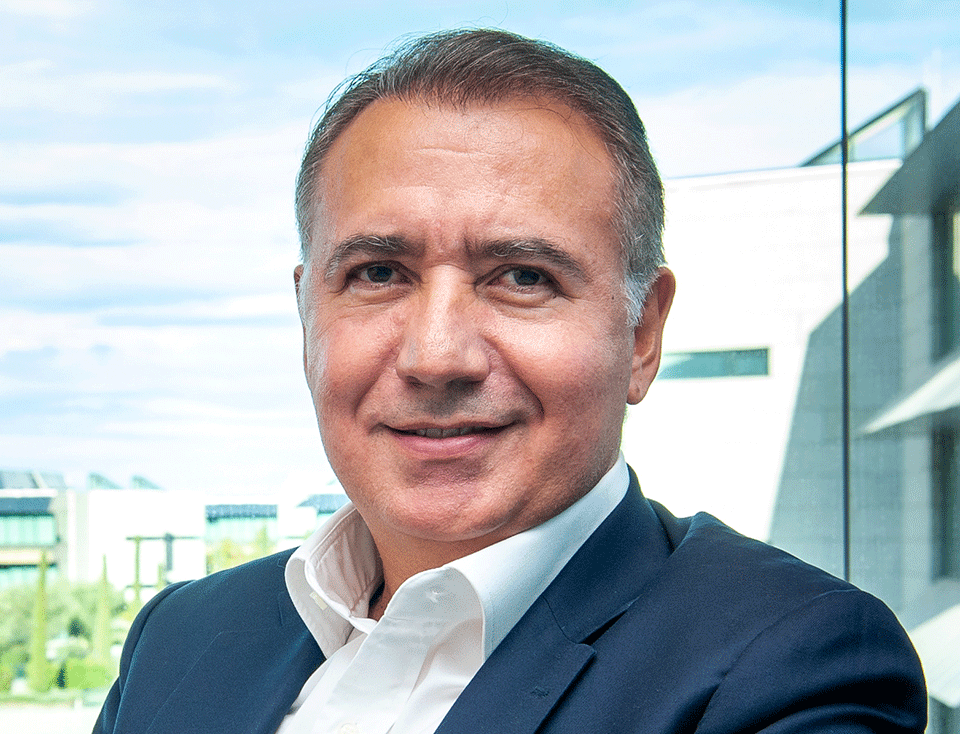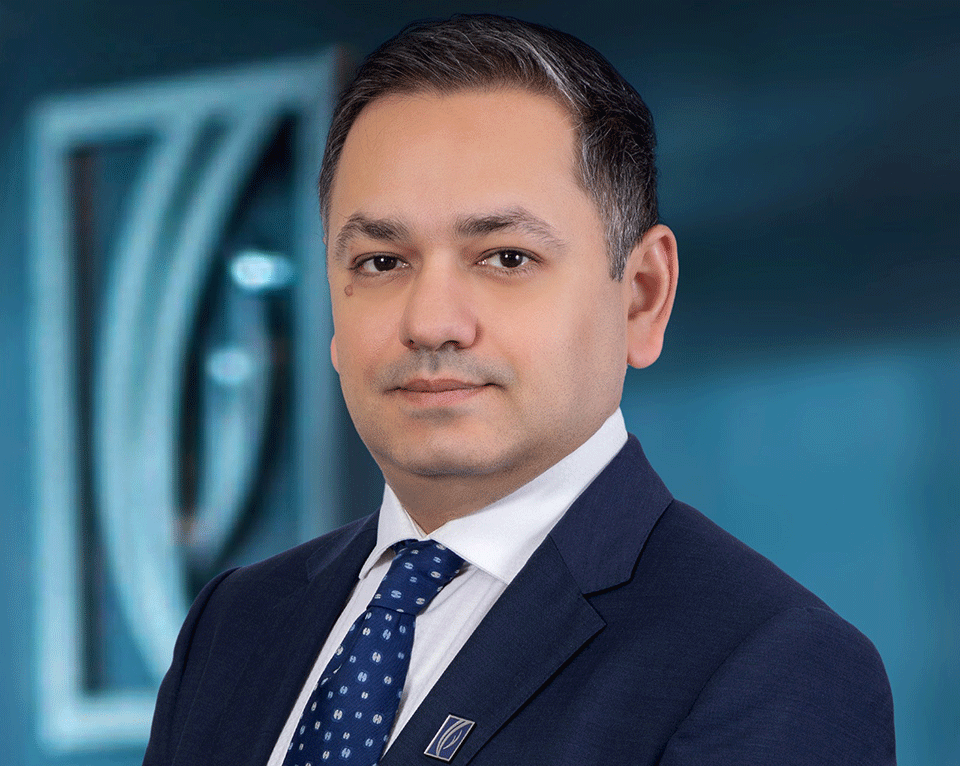
BNY’s ambitions in the treasury services and trade finance sectors are driven by seasoned leaders with deep expertise in global banking.
As head of treasury services for Europe, the Middle East and Africa (EMEA) at BNY, Bana Akkad-Azhari leverages almost two decades of experience at the bank – and nearly 30 years working in international banking – to help corporates move their money securely and efficiently. Joon Kim, BNY’s global head of trade finance, cash management & solution structuring platform group, has spent more than nine years with the company.
Focus on FIs and NBFIs
The EMEA region represents roughly 25% of BNY’s global treasury services business, a sector primarily serving financial institutions (FIs) alongside a growing presence of non-bank clients such as asset managers and broker-dealers.
BNY has developed a portal-based platform that offers banking clients full visibility into our corresponding relationships worldwide
Joon Kim, BNY

BNY’s focus on FIs and non-bank financial institutions (NBFIs) is clear. “This reflects our strategy in the region,” says Akkad-Azhari. “We don’t compete with local and regional banks, but instead operate as an unconflicted provider, maintaining the technology and infrastructure to enable these institutions to focus on their core strategy and client base.”
Kim elaborates on how this approach supports the bank’s ambitions beyond its US stronghold. “Outside of the United States, our primary objective is to become the best trade finance provider for financial institutions worldwide,” he explains.
BNY’s offering, such as Trade Network Access Service, emphasises bank’s commitment to distinguish itself from competitors, reinforcing its role as a dedicated facilitator for FIs. “BNY has developed a portal-based platform that offers banking clients full visibility into our corresponding relationships worldwide,” Kim highlights. “This allows banks to understand where we have partnerships and leverage us as intermediaries to facilitate transaction flows on their behalf.”
Responding to client needs
Solution development is one of BNY’s key differentiators. “One example is our virtual account offering,” says Akkad-Azhari. “We are one of the few banks to offer instant access to robust real-time transaction and balance reporting at an individual virtual account level or perform ACH [automated clearing house] allocations for incoming and origination payments.”
The pace of change in this industry is unprecedented and requires constant improvement. But we also need to find solutions to future challenges as well as addressing current trends
Bana Akkad-Azhari

These products allow FI clients to offer low-touch access to local payment rails to their own clients and enable those outside the US to link their virtual accounts to the Nostro accounts they hold at BNY.
“The pace of change in this industry is unprecedented and requires constant improvement,” says Akkad-Azhari. “But we also need to find solutions to future challenges as well as addressing current trends.”
Technology inevitably plays a key role in this process. From a development and innovation perspective, BNY uses a combination of in-house development and external technology providers depending on the use case.
“We have an active engineering team, so where it makes sense from an economic or security perspective we will develop a solution in-house,” explains Akkad-Azhari. “But we also work in partnership and collaboration with vendors where required. The flexibility of our model enables us to be agile when it comes to innovation.”
Preparing for the future
That agility will play a critical role in addressing the trends impacting the bank’s clients in 2025. The move to a real-time, round-the-clock and fully automated operating model is underpinning many of these trends and increasing demand for instant, transparent and secure payments.
“Importantly, clients want access to improved payment processes without having to overhaul their entire infrastructure, which is prohibitively expensive,” says Akkad-Azhari. “By undertaking extensive research and development work, we can provide access to these processes cost-effectively.”
One of the key payments trends for BNY is the adoption of instant and real-time payments (RTP), which started with RTP in the US and more recently Europe’s Sepa Instant scheme, with similar schemes envisaged across other part of the MENA region.
Akkad-Azhari refers to the importance of not overlooking the issue of security when talking about payment technology and innovation. “This is why we see an emphasis on pre-validation tools and the desire to develop solutions to validate payments that minimise both financial losses and delays,” she says. “Artificial intelligence has a role to play in detecting fraud and improving payment efficiency, as well as optimising liquidity management through predictive analytics.”
Infrastructure upgrades
The move towards ISO 20022 and the transition to T+1 settlement are putting pressure on FIs to invest in upgrading systems and processes, and review how they manage liquidity.
“Banks and other financial institutions are focused on optimising their back-office operations, and leveraging their correspondent banking relationships and networks is key to achieving these improvements – doing it on your own is extremely expensive,” says Akkad-Azhari. “We are there to support our clients’ digital transformation journey.”
BNY-Mizuho strategic collaboration
Announced at Sibos in October, BNY and Mizuho entered a market-first strategic collaboration, where Mizuho Singapore acts as the central hub. “Instead of all Mizuho’s branches acting in a bilateral manner, establishing different types of relationships, Mizuho Singapore becomes the central hub and they will use our access to the trade network access to see where BNY has their relationships spread so they can reach more international without essentially investing in the RMA relationships,” explains BNY’s Joon Kim. “This is a client-centric solution.”
Many treasurers entered 2025 facing increased cost of capital to fund investments required to address changing market dynamics, meet new regulatory requirements or comply with tighter settlement cycles. BNY is determined to help its clients and their treasurers optimise liquidity to meet this challenge, for example through adoption of treasury management systems and AI-driven analytics tools that can help them improve their real-time tracking and enable more agile decision making.
“Our objective is to provide the tools and capabilities to help clients get to where they need to go without having to make uneconomic investments,” says Akkad-Azhari. “This is where an unconflicted correspondent banking partner like BNY plays a vital role, whether supporting them as a bank or providing the right tools for those that have their own in-house bank.”
Giving clients a comprehensive view of their global liquidity pools means they can initiate and reconcile payments instantly. “It is really about access to information,” explains Akkad-Azhari. “The virtual account solutions I mentioned earlier are a powerful tool that enables real-time operations through centralised cash management. Clients can see instantly how much cash is available under each account, and easier access to funds and improved working capital management enables them to take control of their liquidity and deploy it to maximum effect.”