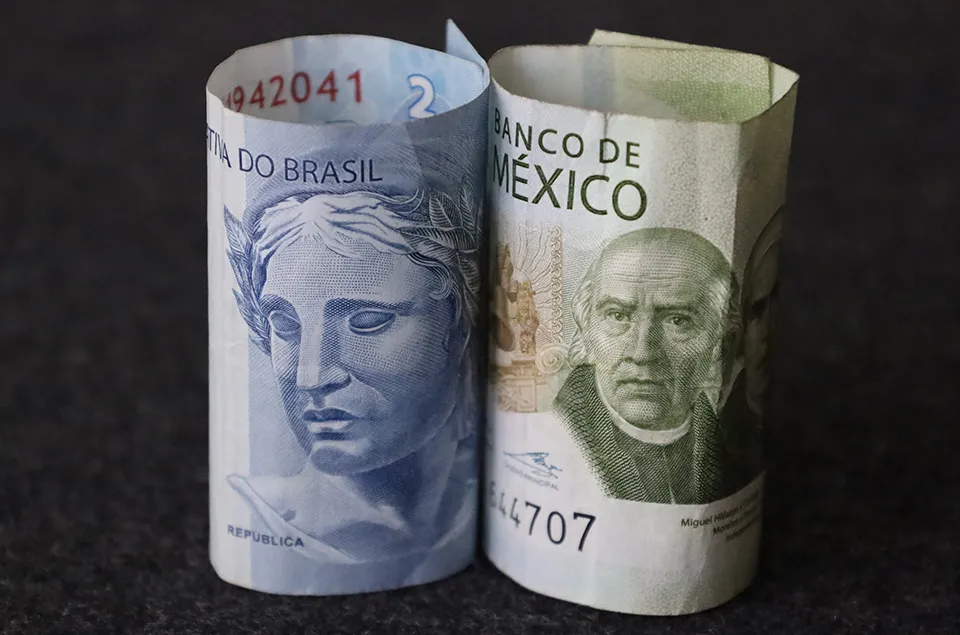
The fall in the value of the dollar over recent months in anticipation of a Federal Reserve rate cut in September might have been expected to benefit the Mexican peso, Brazilian real and Chilean peso. However, both USD/MXN and USD/BRL have experienced rallies in the second half of August.
There are various factors behind this. Pete Mulmat, chief executive of tastyfx, notes that the Mexican peso has seen steep depreciation, with USD/MXN rising over 3% in the past week as a slowdown in production and potential consequences of November’s US elections shake confidence.

Eric Robertsen, head of global research and strategy at Standard Chartered, says: “The market reacted with concern to the Mexican election results as the margin of [incoming president Claudia] Sheinbaum’s victory was not expected and nearly left [political party] Morena with a qualified majority in both chambers.
“In response, locals bought USD and international investors cut their longs.”
The main surprise, which was not priced into the market, came from the composition of congress and the resulting implications for constitutional reform processes, says Daniel Perez Ortega, Colombia-based director of FX trading at Citi.
“The market has picked up this topic again recently, generating further volatility and making MXN underperform emerging market currencies.”
The recent shift in monetary policy by the Bank of Japan has prompted an unwind of carry trade positions.
Local noise
According to Luisa Emilia Valle Fabela, FX & FI Mexico strategy economist at Scotiabank, there are no counterweights that could act in favour of the Mexican peso carry trade.
“We don’t expect monetary policy adjustments to have a major effect on MXN, and the US presidential election result could turn out to be hard on the peso,” she says. “Local noise around judicial reform is also affecting MXN.”
FX traders were encouraged by initial announcements of the Brazilian government’s intention to cut spending, but the follow-through and details of the spending cuts have underwhelmed. More substantial and structural reductions are needed to improve the assessment of fiscal accounts by traders, while expectations are low that meaningful incremental cuts will be announced.
Doubts remain as to whether the government is prepared to cut spending enough to stabilise the debt trajectory, and we would stay bearish unless the government surprises with some fiscal consolidation
Chris Turner, ING
Chris Turner, ING’s global head of markets and regional head of research for UK & CEE, agrees that comments from the Brazilian central bank that it might not deliver on the market’s pricing of rate hikes have been a key driver for the real.
“Doubts remain as to whether the government is prepared to cut spending enough to stabilise the debt trajectory, and we would stay bearish unless the government surprises with some fiscal consolidation,” he says.
Jean Sayegh, FX head trader at Banco Citibank, refers to a trendless market in USD/BRL, with the pair continuing to consolidate between 5.40 and 6.
“FX carry unwinds continue despite softer USD expectations, and any signal of fiscal improvement could start a risk-on move,” he says. “The next big event will be the Copom [monetary policy committee of the Banco Central do Brasil] meeting, where Brazil is on the opposite side of most central banks regarding rate hikes.”
Hiroshi Ogawa, Scotiabank capital markets fixed income, currencies and treasury sales economist, thinks that as JPY carry trade positions target higher returns in assets with higher interest rates than Japan (Brazil and Mexico are the top picks here in addition to the US), any short JPY/long BRL – or MXN – unwinding flow will contribute to undervaluing the BRL.
One of the main drivers of the carry trade in emerging markets has been the strength of US equities, and this correlation has dominated Latin American FX recently, causing currencies to sell-off sharply earlier this month.
At ease
Oliver Harvey, head of CEEMEA and Latam FX research at Deutsche Bank, is less pessimistic than many though, suggesting that with positioning now lightened and US equities bouncing back there is scope for Latin American currencies to recover.
Robertsen at StanChart notes that the early actions of the Mexican administration helped put investor concerns at ease, while naming familiar and more moderate members to key positions reduced the level of policy uncertainty the market needed to price.
“Over the entire global episode of de-risking and re-risking, Latin American currencies have lagged somewhat,” he says. “MXN is one of the few major currencies weaker versus USD since end-July, while BRL and CLP are middle of the pack. Positions are likely even further reduced now, and we expect BRL and MXN to outperform forwards in 2025.”

The key factors driving the Chilean peso this year are copper prices – given more accentuated price swings in 2024 – and the central bank’s policy in light of tight rate spreads with the US.
“Copper prices have stopped falling and the CLP has reacted positively to modest hawkish surprises from the central bank in recent communications,” says Joseph Incalcaterra, head of LatAm FX strategy at HSBC. “The central bank has left rate cuts on the table, but we only see one 25-basis point cut being delivered this year, and only after the Fed, which should support ongoing stabilization in the peso.”
Scotiabank expects a reduction of bets against CLP as the process of rate cuts by the Chilean central bank will conclude around the same time that the Fed starts the process of rate cuts in the US, reducing depreciation pressure.