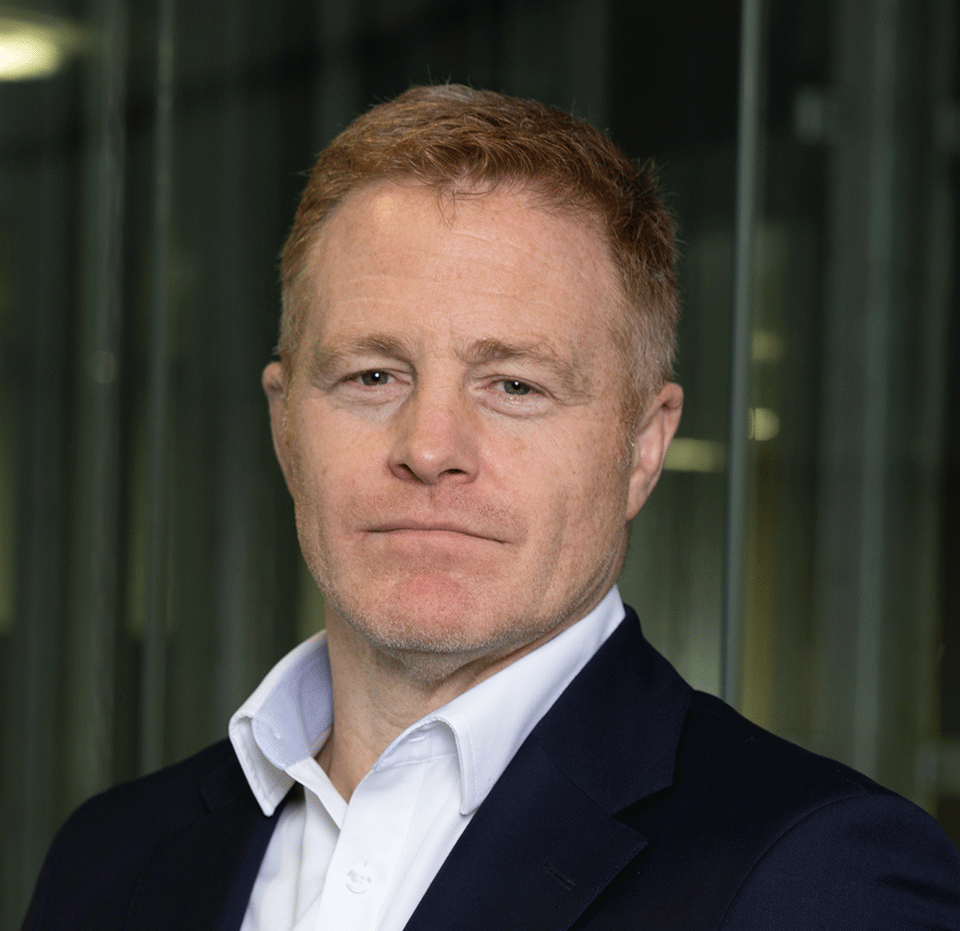
Best bank: UOB
UOB retains the title of Singapore’s best bank, bolstered by resilient financial performance and a strengthened network across southeast Asia. Under the leadership of chief executive Wee Ee Cheong, the bank devised a three-year plan in 2023 to become the foremost bank in southeast Asia, and it is well on its way to delivering on that aim.

In 2023, UOB posted total income of S$13.9 billion ($10.3 billion) and a record net profit of S$5.7 billion. Excluding one-off costs from integrating Citi’s consumer business in Indonesia, Malaysia, Thailand and Vietnam, core net profit reached a record S$6.1 billion, up 26% year on year.
Assets grew by 4% year on year, while return on equity increased by 2.3 percentage points to 14.2%. Net interest income surged 16% and net fee income increased by 4%, driven by higher wealth fees and record credit card fees.
Singapore, UOB’s largest hub, accounted for approximately half of the operating profit and registered growth of 22% year on year, anchored by wider margins from higher interest rates and active balance sheet management.
The bank also grew its retail customer base to more than eight million across the region, following the acquisition of Citi’s consumer banking businesses in four markets.
UOB’s retail banking division saw a surge in credit card applications and spending. A notable highlight was UOB’s role as the official bank and presale partner for the highly anticipated Taylor Swift tour in Singapore last year.
On the small and medium-sized enterprises front, the UOB SME app, which offers insights into cash flow, accounts payable, accounts receivable and crucial business data, saw its user base triple and unique visitors surge by 230%, while reducing transaction times by up to 50%.
Best investment bank: Morgan Stanley
Morgan Stanley stayed on top of its investment banking game in Singapore once again. The bank continues to be the go-to adviser for industry-defining transactions. One of the most notable last year was its role as the exclusive financial adviser to private equity firms TPG and IPGL on the $1.5 billion sale of their combined 43% stake in insurer Singapore Life to Sumitomo Life. This deal represented the largest southeast Asia insurance M&A transaction in the last three years. Morgan Stanley navigated through complex shareholding dynamics and legal intricacies, achieving record valuation levels in a compressed three-month process.
The US firm also acted as the exclusive financial adviser to Commonwealth Bank of Australia (CBA) on the $156 million sale of its Indonesian subsidiary to OCBC NISP, the Indonesian subsidiary of Singaporean bank OCBC. This transaction facilitated a clean exit for CBA in a highly competitive market, aligning with its strategy to streamline its business and focus on its core banking operations in its home market.
In the green energy sector, Morgan Stanley advised InterContinental Energy on securing a $115 million investment from Singapore’s sovereign wealth fund GIC and hydrogen infrastructure fund manager Hy24. This investment reflects Singapore’s interest in the growing green hydrogen sector and its efforts to benefit from the global transition to cleaner energy.
Best international bank: HSBC
HSBC helped Singaporean companies like Next Gen Foods and Multiplier Technologies expand overseas in 2023. It also scaled up its support for local businesses expansion in the region by introducing a $1 billion ASEAN (Association of southeast Asian Nations) growth fund for digital platform businesses and a $150 million venture debt offering aimed at scaling high growth companies.
The bank hosted an Asia day event covering exports to Asian markets, which attracted 220 clients.
It has upgraded its digital platform, Business Go, and introduced a new feature called international navigator. This hosts trade corridor and industry specific content as well as useful business guides.
Best digital bank: OCBC
OCBC wins the award as Singapore’s best digital bank this year for enhancing its digital banking service through a series of initiatives designed to deepen engagement and improve the user experience across its platforms.
Backed by increased investment, these initiatives targeted the key areas of customer onboarding, payments, investing, insurance, rewards and security.
First impressions are critical in digital banking, which is why the onboarding process needs to be smooth, efficient and secure.
OCBC’s digital app achieves this thanks to developments in the onboarding process that use artificial intelligence, data analytics, biometrics, blockchain and cloud technologies, which have all been integrated into the bank’s digitalized know-your-customer process.
This has made it quick and easy for customers from other countries to open a bank account, which otherwise might take weeks. Indeed, OCBC last year became the first bank in Singapore to enable a full digital account opening service for customers from Malaysia, Indonesia, China and Hong Kong.
Supplementing this, OCBC also expanded its digital payment and transfers offerings, adding seven new features on its app to provide a more comprehensive suite of local and cross-border payment and transfer services.
Part of this involved partnering with digital wallets Alipay and UnionPay to support local customer transactions across 47 markets.
Overall, the bank recorded a 700% rise in the number of cross-border transactions last year, and a 500% increase in cross-border transaction volume.
Best bank for SMEs: UOB
UOB invested in its regional payments, trade and cash platforms in 2023. Over the year, the bank committed $800 million to these systems and saw its cross-border income increase by 9% year on year in 2023.
At home, 46,000 small and medium-sized enterprise clients across Singapore are now digitalizing of their business operations through products like UOB BizSmart. The bank claims a 30% to 35% saving on business costs through this feature.
Around 96% of UOB’s SME customer base is now digitally active on its online platforms.
The bank also focused on sustainability last year. In August 2023 it launched a scheme under the government’s productivity solutions grant scheme to assist SMEs in assessing their Scope 1 and 2 emissions. UOB also launched its Sustainability Impact Awards in partnership with the Business Times in 2023. These awards aim to celebrate businesses that made significant contributions to sustainability over the year.
Best bank for ESG: DBS
DBS implemented internal policies that had a direct impact on the sustainability of its own operations in 2023.
DBS’s sustainable financing commitments reached approximately S$70 billion ($51.8 billion) by December 2023, up from S$51 billion in 2022. The bank has maintained its leading position in the Singapore dollar bond markets and worked on close to S$18 billion of environmental, social and governance (ESG) related bond deals, most of which were green and sustainable bonds.
In 2023 the bank partnered with H&M Group to create an innovative green loan programme that facilitates supply chain decarbonization in the apparel sector. Suppliers get access to financing from DBS and technical support from its sustainability consultant, Guidehouse, on upgrading their factories to decrease their climate impact.
The bank launched its upgraded SME Low-Carbon Rewards programme that supports small and medium-sized enterprises in their transition to a low-carbon economy. This also supports the development of local renewable energy and digital payment services adoption.
DBS also introduced its Enhanced ESG Risk Assessment in July 2023. The new ESG risk scoring methodology incorporates sector-level climate risks based on a stress testing exercise, as well as climate and ESG risk assessments based on questionnaire responses.
Best bank for corporate responsibility: Standard Chartered
Standard Chartered ran several important initiatives in 2023 to bolster disability inclusivity in the workplace and invest in young people’s future employment prospects.
The bank worked with disability-inclusive partner organizations to promote career opportunities for disabled candidates. It also launched its disability-confident toolkit, a resource for those looking to bolster their job application skills.
The bank donated $14.6 million through its Futuremakers by Standard Chartered programme, including donations from the group and fundraising of $1.7 million from employees and partners. The programme reached more than one million young people, with initiatives that also provided financial education to 159,190 unbanked or young people.
Standard Chartered sponsored the Sneak Peak programme in 2023, which provided 250 young women aged 15 to 21 from underprivileged backgrounds with corporate job learning opportunities. In addition, the bank hosted 30 girls from the programme for half-day job placements.
Best bank for diversity and inclusion: HSBC
HSBC launched several initiatives in 2023 to bolster diversity and inclusion, both internally and externally, in Singapore. These covered a wide range of themes including maternity leave, empowering those with special education needs and disabilities, and youth employment.
The bank introduced a policy for all their hiring managers to attend mandatory inclusivity hiring training (over 230 managers completed the training in 2023) and introduced tools into the hiring process, like an on-demand video interviewing platform, to ensure candidates’ evaluations are based on the same criteria to maintain objectivity and remove bias. HSBC also held its annual recognition and inclusion week.
To protect career progression for new parents, the bank increased maternity leave to 26 weeks from 16 and paternity leave to 8 weeks from two, and increased adoption leave to 26 weeks from 8 weeks in 2023.
The bank worked with Singapore Enable and local university special education needs departments in 2023 to pilot a programme to offer opportunities for students with disabilities in its private bank, which saw five student hires. The bank also partnered with Cerebral Palsy Alliance Singapore School to offer job shadowing opportunities for its students.
Best bank for corporates: HSBC
HSBC helped local businesses scale up last year by introducing a $1 billion ASEAN (Association of southeast Asian Nations) growth fund for digital platform businesses and a $150 million venture debt offering aimed at scaling high growth companies. The bank also introduced a smart cash pooling solution to address the challenges entailed in a multi-bank, multi-currency notional pool structure.
HSBC launched Univers, which provides energy optimization and carbon management software. It also introduced a sustainability tracker to help customers on their sustainability journey and, in a pilot collaboration between HSBC and Greenly Partners, a carbon calculator tool to measure a company’s CO₂ emissions.
Last year the bank was a lead arranger and joint global coordinator for a S$200 million ($148 million) equity private placement for Mapletree Logistics Trust. It was also lead arranger and bookrunner on the $1.2 billion syndicated term loan facility for SCB X and a joint lead manager and bookrunner for Bayfront Infrastructure’s debut $500 million senior unsecured bond deal.
Rising star: Trust Bank
Trust Bank, which was launched in September 2022, had signed up over 600,000 clients In Singapore by the end of last year.
Its digital onboarding journey uses a customer’s Singpass account. Customers can apply and be approved for an account in minutes and use a digital card instantly.
The Trust card functions as both a credit and debit card and is the first-to-market numberless credit card that allows its customers to choose their own repayment date. The card, which does not levy FX fees, has been used in over 2.1 million foreign currency transactions and, according to Trust Bank, saved its customers more than S$6 million ($4.4 million) compared with cards that charge FX fees.