
Most banks focus their corporate responsibility agendas on environmental, social and governance metrics and the drive to net zero, as well as on diversity and inclusion in terms of their customers and their own workforces. Banco Santander, western Europe’s best bank for corporate responsibility, has for many years looked beyond these core aspects of responsibility and found other ways to contribute to society.
Santander Universities is its flagship community support programme with a longstanding commitment to higher education. Over the past 27 years it has invested €2.3 billion. In 2023, the Spanish bank invested over €105 million and assisted almost half a million people with scholarships, internships and grants through its 1,238 partner universities and academic institutions in 26 countries.
“Our commitment has remained stable over many years, but our approach has changed over time,” says Lara de Mesa, global head of responsible banking at Santander. “We are focusing on education, employability and entrepreneurship, and we have committed to invest another €400 million between 2023 and 2026. We help people in lifelong learning to improve their professional skills and to access job opportunities, also supporting businesses to develop and grow, and universities in their digital transformation and transition towards sustainability. We recognize that the challenges and needs of our communities, universities and labour market are changing fast. To stay relevant and deliver impact, we will need to continue evolving our offering.”

Santander has focused on sustainability for almost as long as education, going back to 2001. It undertakes the classic double materiality assessment to identify the topics that pose the biggest risks and create opportunities for the bank; and the areas where Santander can have the biggest positive impact on society.
It is a big lender to auto manufacturers and to retail customers buying cars. In 2023 Santander set additional decarbonization targets for the automotive sector for 2030: one for the auto manufacturing portfolio – a reduction of 31% in the intensity of finance emissions compared to the baseline in 2020 – and another for the auto lending sector portfolio in Europe – with a range between 35% and 45% for the reduction in intensity of emissions compared to 2022.
Additionally, it keeps expanding the availability of green finance. Santander’s corporate and investment bank raised and facilitated €20.2 billion in green finance in 2023, reaching a total of €114.6 billion since 2019. “Santander has been a leader in financing renewables for the past decade,” says de Mesa. “But this is not just about financing new green technologies. This is also about greening the rest of the economy.”
The momentum behind the drive to net zero in western Europe has faded somewhat as energy security has emerged as a top priority following Russia’s invasion of Ukraine. It has been a reality check for banks championing the cause. “We see the context moving and greater challenges to the sustainability agenda,” says de Mesa. “As an economist I would argue that sustainability is an opportunity for society and for banks to do things better on the basis of informed decisions.”
We are focusing on education, employability and entrepreneurship, and we have committed to invest another €400 million between 2023 and 2026
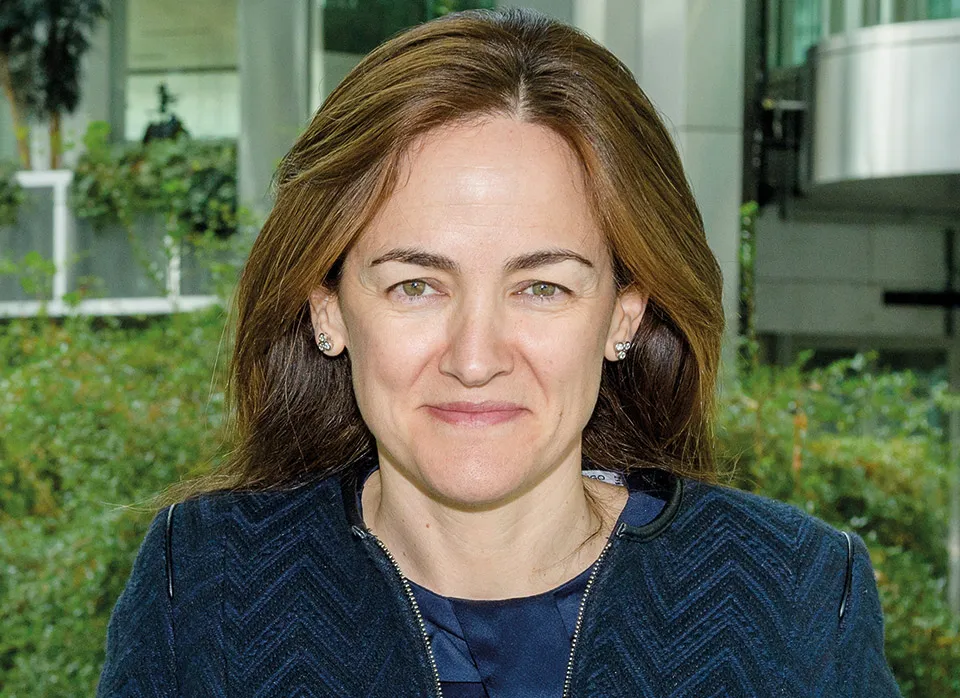
Lara de Mesa
In relation to financial health and inclusion, having already exceeded its target to financially empower 10 million people between 2019 and 2025 – reaching 11.8 million in 2022 – Santander set a new target to financially include five million more between 2023 and 2025. In 2023, the bank financially included one million people through access initiatives and 0.8 million people through finance initiatives.
“An important aspect of financial inclusion is to maintain access to the financial system as it digitizes in Europe, especially for older people. We are mindful of this,” says de Mesa, “as well as of thinking beyond financial inclusion towards supporting people to remain financially healthy.”
Women make up 53% of the workforce at the bank and their presence in senior positions was 31.4% in 2023, up 2.1 percentage points versus 2022. In early 2023, the bank raised its target to have women in at least 35% of its senior executive positions in 2025. In 2023, it closed its equal pay gap – men and women doing the same job are paid the same – ahead of schedule.



