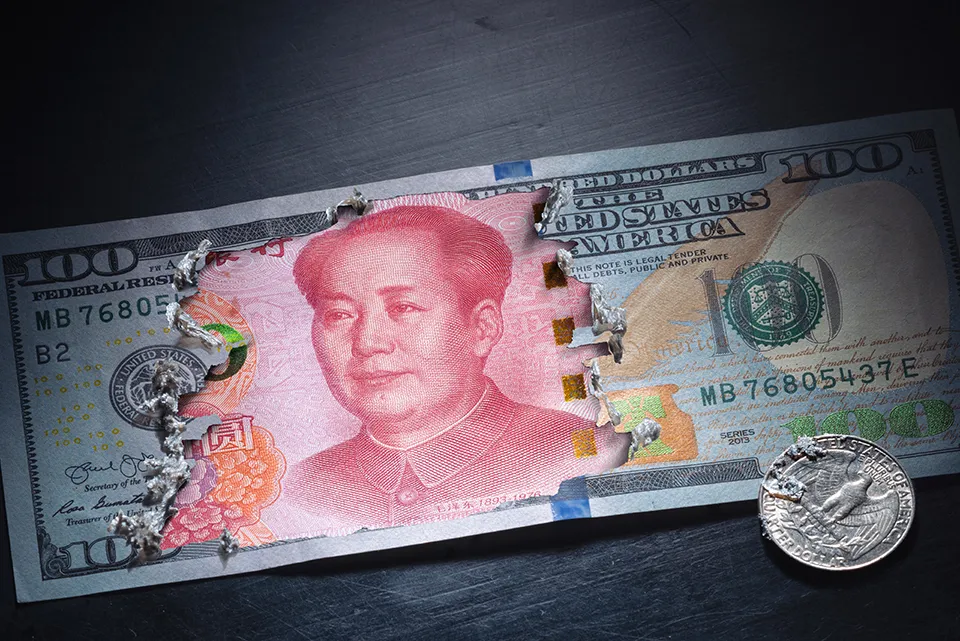
The power and predominance of the US dollar has long been seen, in developed and emerging nations alike, as both a comfort and a threat. Past attempts by other currencies, notably the euro and the yen, to challenge the greenback ultimately fell short.
China’s renminbi (RMB) has been viewed for more than a decade as the coming currency power. Yet for many reasons – capital controls and an onshore 2015 stock market crash – the push by Beijing to internationalize the yuan has promised more than it has delivered.
Now, geopolitical tensions, high US interest rates and Washington’s willingness to use its currency to penalize those with whom it disagrees, have compelled those who dislike the US and resent the power of the dollar to get vocal again.
The most cogent criticism came at a summit of the grouping of Brics nations (Brazil, Russia, India, China and South Africa) in August, when Brazilian president Luiz Inacio Lula da Silva called for the creation of a common currency to facilitate internal trade and investment and reduce vulnerabilities.
Such an outcome seems unlikely, given the distrust that simmers between some Brics states, notably China and India. But could the renminbi offer a viable alternative to the dollar, particularly in the emerging world?
Record highs
Consider two telling statistics. First, the yuan’s share of global payments hit a record high of 3.71% in September, according to data from Swift. The previous month’s share, 3.47%, also marked an all-time high. That marks eight consecutive months of growth, up from 1.91% in January.
Second, its share of global trade finance transaction flows had jumped from 2% before Russia’s invasion of Ukraine and 3.9% at the start of the year to 5.8% at the end of September. That catapulted it into second place, supplanting the euro.
More corporations are actively embracing the renminbi. Several private Chinese firms, exporting to Mexico, have begun to directly convert earned pesos into renminbi, bucking a longstanding practice of first converting them into US dollars.
What does this achieve? In theory, it promises to reduce conversion fees, given that neither party trades in their home market in dollars.
The reality is a little more complicated. If the mainland company in question waited until their pool of pesos reached a certain level – say, the equivalent of $100 million. It would make sense for it to send the Mexican notes back to China for conversion.
But, notes E-May Neoh, Asia head of liquidity and balance sheet at Deutsche Bank, it’s difficult to find individuals and companies in need of such a large chunk of pesos. “It’s manageable for a one-off transaction, but the cost is very high due to the low demand,” she says.
Other negative factors also come into play. The peso is an illiquid and infrequently traded currency. And a trade like this amplifies exchange rate risk, given the dollar’s role as a stabilizing ‘anchor’ in global currency markets. For now, transactions like these are rarely driven by financial logic. Rather, they tend to be helpful educational tools for both sides.
But they are growing in number. In October 2023, Bank of China helped Eldorado Brasil, a Sao Paulo-based paper pulp company, to settle shipments to China in yuan.
It was first deal of this kind in Sino-Brazilian history. Bank of China issued an RMB-denominated letter of credit discount, which was converted into Brazilian reals and deposited in Eldorado’s account, bypassing the dollar completely.
Gaining momentum
Other factors are encouraging sovereigns and corporate and financial institutions to explore payment settlements in non-dollar currencies. The most notable one is Russia’s invasion of Ukraine in early 2022.
“Given the Russia/Ukraine war, there is a lot more focus on what [happens] if sanctions expand and how to move cash in and out,” says Neoh, “Some corporations are reviewing and assessing alternative billing currencies other than US dollars for their international trade.”
Given the Russia/Ukraine war… some corporations are reviewing and assessing alternative billing currencies other than US dollars for their international trade
May-E Neoh, Deutsche Bank

For western states the decision to impose sanctions on Moscow and key Russian corporates and lenders made sense. For many others, notably those dependent on Russian energy, food and mineral imports, it merited exploration of alternatives.
Following the suspension of imports by most western nations, some Indian refiners have capitalized on the opportunity to purchase discounted Russian crude, making India the largest importer of Russian seaborne oil this year.
Imports of Russian oil totalled $38.8 billion in the Indian financial year to the end of March 2023, against $5.25 billion the previous year, according to data from the commerce ministry. A significant share of this was settled in rupees.
For India, this presents a double benefit. It is powering its economy with heavily discounted oil and promoting the wider use of its currency in international trade. For Russia, the allure of a big, reliable, non-European sovereign customer is partially outweighed by it accumulating around $1 billion in rupee-denominated assets a month, much of which its corporates cannot repatriate due to local currency restrictions. A solution would be for the Kremlin to settle oil payments in a third currency, such as the renminbi or the UAE dirham.
It is in this context that renminbi internationalization is gaining momentum. At the end of 2022, invoices in yuan accounted for 20% of all Russian imports, against 3% nine months earlier, according to an October 2023 report by the European Bank for Reconstruction and Development.
Suppliers and clients naturally go for the most efficient currency and the most efficient currency right now continues to be the dollar
Sandip Patil, Citi

Other petro-powered economies are considering a similar move. For nearly two years, Saudi Arabia has been mulling a shift to settle two-way oil trades in renminbi rather than dollars. China accounts for around 26% of Saudi Arabia’s oil exports. For the moment at least Riyadh has chosen to stay loyal to the greenback.
But the momentum extends beyond trade in oil and gas. In February, Iraq’s central bank said it would let private-sector firms settle imports in yuan. Argentina in April said it would start to pay for imports in yuan. And earlier this year, Bangladesh said it would pay for a nuclear plant Russia is building in the country in renminbi.
It all adds up: in the nine months to the end of September 2023, cross-border RMB-denominated receipts and payments totalled Rmb38.9 trillion ($5.3 trillion), up 24% year on year, according to data from the People’s Bank of China (PBoC).
All of which is set against the backdrop of a rapidly changing political world. After decades of steady convergence, the rift between the US and China threatens to become unbridgeable. This is not only visible in geopolitical tensions but also in the interest rate policy pursued by the two countries’ respective central banks.
Shifting landscape
The bifurcation in monetary policy began in March 2022 when the US embarked on an interest rate hike. Since then, its interest rates have soared from 0.25% then to 5.5% today. Over the same period, China has slowly but steadily cut its own lending rate to 3.45% from 3.7%.
This has created a potential opportunity for banks to consider onshore and offshore liquidity as one entity, not two
Krishna Sampath, BNP Paribas

The US’s higher-for-longer rates policy seems here to stay. Whereas China, struggling to reignite an increasingly moribund economy, seems to be heading in the opposite direction. In August, the PBoC surprised global investors by cutting the rate on its one-year medium-term lending facility by 15 basis points to 2.5%.
This reflects growing concern about the state of its economy – but it is also actively reshaping borrowing preferences and fostering new business possibilities for the banking sector.
Global corporates, attracted by the yield gap between onshore and offshore renminbi, are increasingly keen to borrow in the mainland at lower rates while storing offshore yuan, known as ‘CNH’, in Hong Kong to capitalize on higher yields.
“This has created a potential opportunity for banks to consider onshore and offshore liquidity as one entity, not two, and have a proposition that would make sense for the client both onshore and offshore,” says Krishna Sampath, Asia head of liquidity and investment at BNP Paribas. “By accessing corporates’ onshore portal, we can balance both sides of the equation, bringing in a measure of efficiency.”
Furthermore, banks are now helping corporations in restructuring their funding instruments, typically involving a switch from dollar to renminbi funding. This is a substantial shift that overturns the longstanding assumption of the US dollar always being the cheaper funding option.
This has sparked a surge in the issuance of renminbi-priced bonds both onshore and offshore. So-called panda bonds, which let foreign companies raise funds onshore, totalled Rmb21.3 billion, up ninefold on the same period a year before.
Rules ease for cross-border cash pooling
Contrary to the widely held perceptions of China’s tightening capital controls, several bankers tell Euromoney that Chinese regulators have begun to ease rules around cross-border cash pooling. This in theory boosts renminbi-denominated funding overseas, contributing to the steady internationalization of the yuan.
China’s standard strategy when introducing new initiatives typically involves piloting them in specific cities or regions before a wider rollout. This approach was employed when it pioneered the first integrated foreign and domestic currency cash pooling facility in Shenzhen in March 2021. It marked a significant upgrade from the previous renminbi-only or foreign currency-only cash pool. In July 2022, the pilot was expanded for use in five more cities and provinces, including Shanghai, Guangdong and Zhejiang.
The most recent development, unveiled in May 2023, is a series of new pilots in Beijing, Guangdong and Shenzhen, with the aim of streamlining the creation and the usage of cross-border cash pooling.
Eligibility criteria
Regulators have relaxed the eligibility criteria, slashing the entry threshold for enterprises. Any participating company must post annual operating income of Rmb1 billion ($138.6 million), down from Rmb10 billion, and offshore income of at least Rmb200 million, down from Rmb2 billion. The annual international payments threshold has also been reduced tenfold, to Rmb700 million from Rmb7 billion.
Additionally, domestic firms need only comply with one of those two criteria – operating income or the total amount of payments they process internationally each year – rather than both, as was previously the case.
The entry bar for banks has also been lowered, with corporates permitted to set up accounts with multiple banks across multiple cities. This contrasts with the previous setup, where companies were restricted to a single bank and just one cash pool centre. It’s worth observing that the new rules also favour yuan usage through ‘quota tilting’. Corporates that opt for RMB-denominated settlements or fundraising rather than use the US dollar are rewarded with larger quotas for their cash pooling practices.
“The Chinese government has recently implemented a number of bold, new measures, liberalizing this sector,” says Sandip Patil, Citi’s Asia Pacific head of liquidity management solutions. “This move provides greater freedom and flexibility to our multinational clients.
“The government understands the importance of this for clients and their business and for maintaining confidence in the system. As a consequence, RMB is gaining traction and optimism is building in RMB as a global currency in some industries, trade corridors and client segments.”
A key factor in this is the decision by China’s central bank to let foreign issuers repatriate panda bond proceeds overseas. This allows them to raise yuan onshore and then convert it into other currencies for use overseas. This approach generates a typical saving of between 20bp and 100bp, according to Samuel Fischer, Deutsche Bank’s head of China onshore debt capital markets.
Take the example of NWS Holdings. Previously reliant on US dollar funding, the Hong Kong-listed conglomerate said in early November that it had issued Rmb3.5 billion in three-year panda bonds, with the majority of the capital used to repay offshore debts.
Onshore borrowing can also be used for offshore business expansion. A case in point is Deutsche Bank’s issuance of a Rmb400 million cross-border loan for Sao Simao. The Brazilian arm of Beijing-based State Power Investment Corporation will use the funds, raised in the first week of November, to support the construction of a hydroelectric power plant in Brazil. To lock in the exchange rate, the German lender implemented a novel RMB/real cross-currency swap.
This shift is now extending to the cash pooling practices of global firms. Multinationals typically centralize cash management, transferring excess cash between markets. But due to China’s lower-for-longer rates policy, the local arms of multinationals are being asked to borrow from Chinese banks rather than engaging in inter-corporate borrowing or sourcing funds from offshore entities, reckons Deutsche Bank’s Neoh.
“The choice largely depends on the organization’s priorities,” she says. “If the focus is on reducing external debt ratios, they would likely continue borrowing from within the company.”
While lenders are identifying new opportunities in this shifting landscape, no banker interviewed by Euromoney sees the renminbi as a serious contender to the dollar’s global supremacy quite yet. In September 2023, around 85% of trade finance transactions were settled in dollars, according to Swift.
And it’s important to remember that despite hitting a record high that month, the yuan is a long way from being a global payments power. The currency still lags the yen, sterling, euro and, of course, the dollar. If one excludes eurozone region settlements, the RMB ranks sixth in international payments, a shade behind the Canadian dollar.
“Suppliers and clients naturally go for the most efficient currency and the most efficient currency right now continues to be the dollar,” notes Sandip Patil, Citi’s Asia Pacific head of liquidity management solutions. “This is because markets prefer a currency that is liquid, stable, reliable, freely convertible and available across every corner of the world where one needs to operate.”
Geopolitical tensions are set to stay. So too, perhaps, are divergent US and Chinese rates policies. Maybe the renminbi is poised to play a pivotal role in building an alternative payments ecosystem less dependent on the greenback. Or perhaps 2024 will see its allure as an alternative mechanism for raising low-cost funding or paying for Russian oil wane once again.