The crises that bookended this awards year were drivers of securities services revenue as Russian companies cancelled depositary receipt programmes and volatility following the collapse of Silicon Valley Bank created spikes in securities settlements and US repo volumes.
But in a turbulent period that was also characterized by rising interest rates that boosted net interest income, one bank outperformed in the growth of its business, while continuing to display innovation and enviable service quality. Citi is the world’s best bank for securities services.
Comparing securities services businesses requires caveats, since their profiles can be radically different one firm to another. In absolute revenue terms, Citi sits fourth during the Euromoney awards period. But among the bigger franchises, it has easily grown the most over the period, with a revenue increase of 19%.
Shortlisted
- BNP Paribas
Market stress, a drop in valuations and lower investor activity means that securities services client bottom lines are under pressure. Heavy cost structures and high inflation squeeze them from both sides. At the same time, technology investment remains critical to support moves to compress settlement times as well as grapple with digital assets.
The result is that client conversations now are much more about the efficiency of the operating model – about legacy stacks, how to structure data, how to get it on the cloud and how to improve efficiency more broadly.
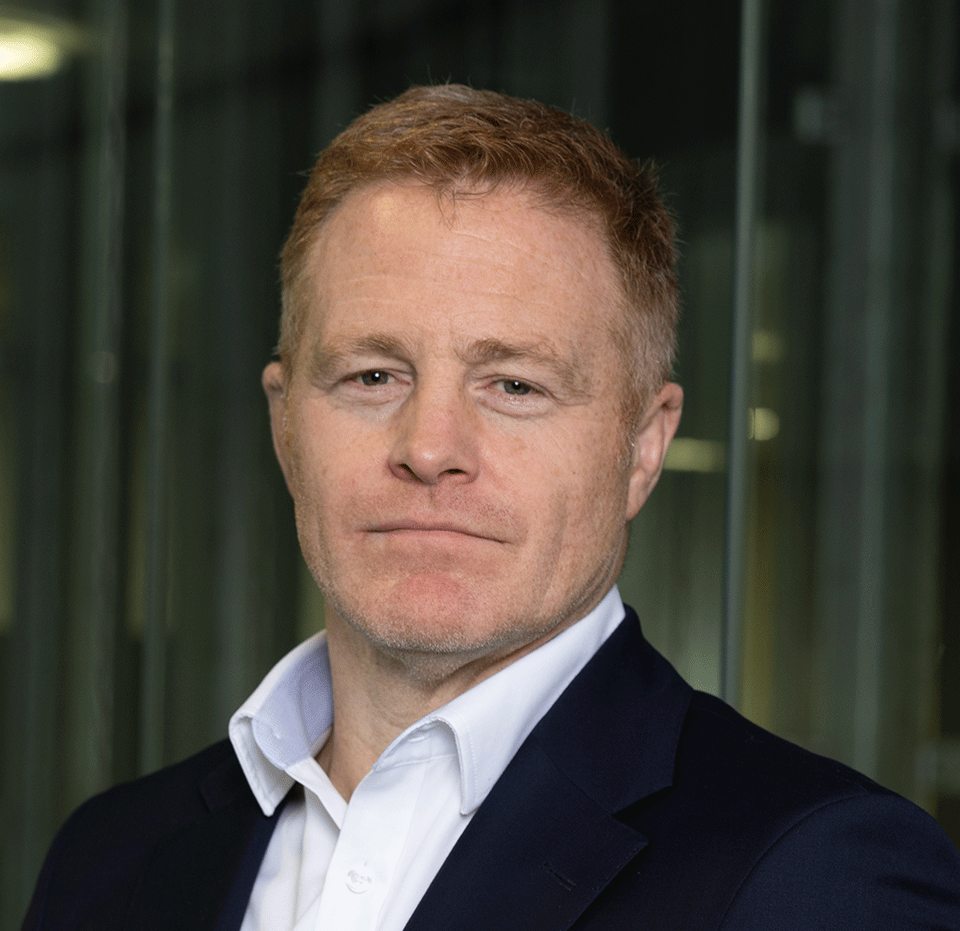
“In the past, not many of our client CEOs would have been deeply involved in the debate around technology and platform strategies,” says Okan Pekin, global head of securities services at Citi. “This would not always be relevant to the top of the house, only to the COO. But now it is a priority for the CEO.”
Digitalization is a big theme in securities services, and Citi is deep in the development of solutions under its own roof, as well as investing in startups such as the Israeli asset servicing platform, FundGuard.
Citi has about $2.1 trillion in assets under administration in its fund accounting and administration business, and won a sizeable mandate from BlackRock. Enhancements made to support the onboading of that are being rolled out to the rest of the bank’s clients.
Clients can also use new derivatives exposure monitoring systems that are designed to comply with new regulatory requirements, a solution that went live well ahead of the regulatory deadline to do so.
In exchange-traded funds, Citi is one of the earliest movers in the full digitization of the ETF primary market lifecycle. Over the course of the year, the bank continued its programme of releases on its Advanced Citi ETF System, many of which involved closer integration with other of the bank’s platforms.
In the middle office, where Citi has some $2 trillion in assets under administration, with 3.2 million trades processed each year, the bank has partnered with BlackRock’s Aladdin to bring the two firms’ combined technology as a package to clients. It saw its first client win in March 2023, with Singlife choosing it from 11 competing options.
In custody FX, the bank unveiled FX Hub, a platform that will execute trades and deliver associated data, with clients being onboarded during 2023. In custody, the bank developed digital asset capabilities, using its own microservice-based system to enable the bank and its clients to connect to distributed-ledger technology networks.
“Our biggest strategic priority is to continue our technology investment programme, provide new solutions to our clients and make the client experience as frictionless as possible,” says Pekin.
There have been senior tech hires in Citi’s securities services unit. In 2022, Joe Bonanno joined from Morgan Stanley as global head of data, digital and innovation. Ken Sansom joined as technology lead in February 2023 from Amazon Web Services, where he was in charge of cloud advisory.
Our global network is unique and extremely hard to replicate… We aim to make ourselves future-proof by adding new technology on top of that network
Okan Pekin
Citi brought in about $1.3 trillion of client assets last year, helping to cushion the business from the drop in valuations due to market movements. But those investor client wins are not the whole story; there has also been growth in the bank’s issuer services business, one of the fastest-growing parts of the industry last year.
The growth in issuer services – primarily the depositary receipt services and agency and trust businesses – might seem counterintuitive given the drop in many areas of capital markets activity. But as Pekin notes, there is still fundraising activity taking place and growth can also be achieved by taking market share from others, which he says the bank has done.
“Our growth is both a function of reasonably healthy market dynamics in issuer services as well as solid market-share gains,” he says. “Financing activity is still running at solid levels.”
Citi’s securities services business is enjoying the renewed focus it has received from chief executive Jane Fraser, who has championed the whole of the bank’s services business – which includes its treasury and trade solutions unit – since she took the helm of the firm in March 2021.
The bank has structural advantages over some peers, not least its global reach; it is present in more than 60 countries, touching about 95% of global market capitalization.
“Our global network is unique and extremely hard to replicate,” says Pekin. “We aim to make ourselves future-proof by adding new technology on top of that network.”