
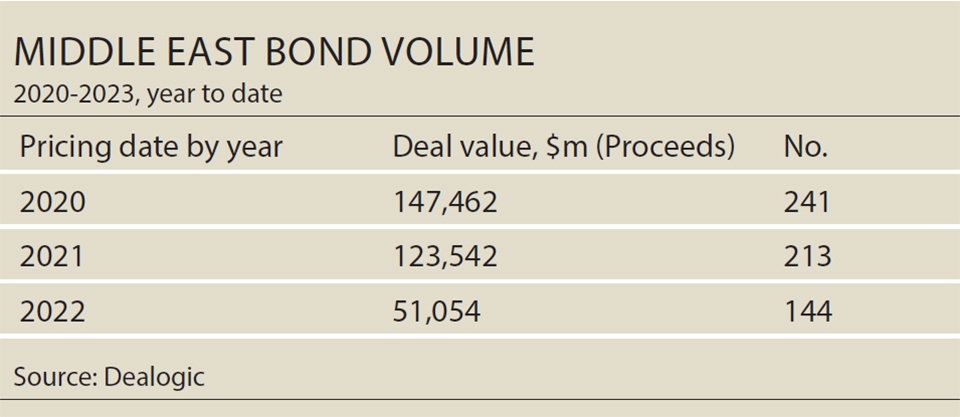
In 2022, Middle East bond issuance dwindled sharply. According to Dealogic, deal volumes shrank 16% between 2020 and 2021, followed by a 59% drop from 2021 to 2022. A combination of lower oil prices, market volatility and high liquidity at banks meant that for regional fundraisers, the easiest and cheapest route was the bank market.
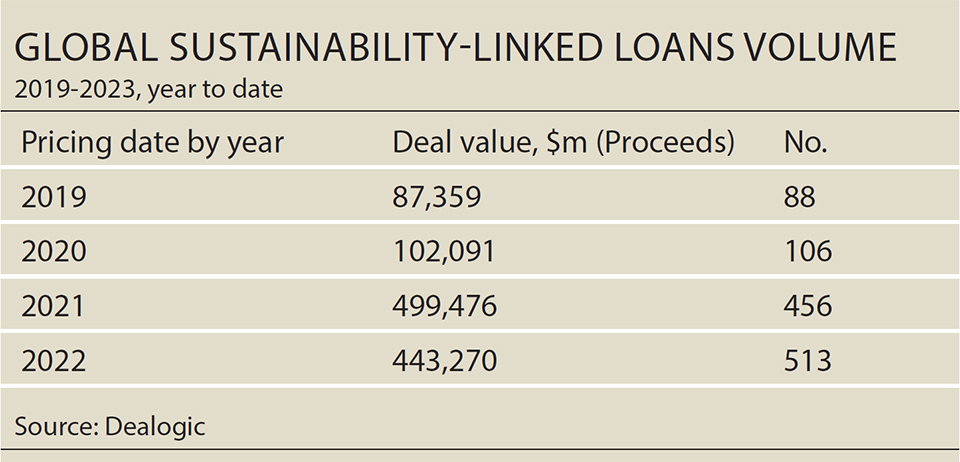
An upshot of this was a rise in regional issuance of sustainability-linked loans (SLLs), and with COP28 around the corner – hosted this year in Dubai – it is no surprise that banks and borrowers alike are taking the opportunity to bolster their environmental, social and governance (ESG) portfolios.
Like sustainability-linked bonds (SLBs), SLL products offer a cost of financing that varies depending on the extent to which the borrower meets pre-set key performance indicators (KPIs) that focus on one or more aspects of sustainability – some structures offer discounts if the KPIs are met, while others provide penalties if they’re not.
Unlike with green loans, the proceeds of an SLL do not have to be put towards a specific green project, and so they provide more options for firms that are looking for a flexible approach to ESG.
“Where previously we had a lot of pure green loans, we’re now starting to see many more SLLs coming through,” says Shargiil Bashir, chief sustainability officer at First Abu Dhabi Bank (FAB).
The product has opened up green financing for a lot more players. Use-of-proceeds green loans have predominantly been used by energy companies looking to finance, for example, a new wind farm. Sustainability-linked facilities, on the other hand, open the way for all sorts of firms who want to work on some part of their ESG agenda – although some of the highest profile deals have still been for energy-related firms.
Landmark deals
Last month, Adnoc Distribution, a service station operator in Abu Dhabi and Sharjah, converted an existing $1.5 billion-equivalent syndicated loan into a sustainability-linked loan. The original loan was through Abu Dhabi Commercial Bank, Bank of China, FAB, Industrial and Commercial Bank of China and Standard Chartered. FAB was sustainability coordinator for the conversion.
The KPIs attached to the financing centre on a promise that the borrower will reduce its carbon intensity by 25% by 2030 through a reduction in scope one and two emissions. Announcing the conversion of the deal, the borrower said that it had agreed to a penalty/incentive structure but did not disclose further details.
UAE-based retail conglomerate Majid Al Futtaim has taken two SLLs. The first, a revolving credit facility of $1.5 billion in August 2021, was one of the first SLLs to be raised in the Middle East and the first with a ‘penalty-only’ structure. Sustainability coordinator was Standard Chartered.
The KPIs focus on gender equality – specifically, a goal to reach 30% women in board and senior management positions within the company (the proportion of women on the board of directors currently stands at less than 10%) – as well as goals to cut CO2 emissions and have its malls certified as ‘gold’ within the Leadership in Energy and Environmental Design (LEED) programme, a US-based green building rating system.
The loan has targets for each year and was the largest deal in the region after the Loan Market Association updated its principles in May 2021 to include a requirement for external verification of performance against KPIs in SLLs.
Where previously we had a lot of pure green loans, we’re now starting to see many more SLLs coming through
Shargiil Bashir, First Abu Dhabi Bank
The LEED certification and the goal to cut scope one and two emissions were also the KPIs on Majid Al Futtaim’s second SLL – a $1.25 billion deal in September 2022 where the sustainability coordinator was FAB.
The ability to tailor the relevant KPIs has proved a big selling point for borrowers, according to FAB’s Bashir. “It gives companies flexibility and allows them to extend the focus of ESG from just environmental activities to the social and governance sides as well.”
The products have even made the transition into Islamic finance. In July last year, Bahrain-based Ahli United Bank concluded the first sustainability-linked dual-tranche murabaha for a financial institution. The three-year loan had KPIs cutting across green financing, social housing financing and ESG governance. The deal, which was initially launched at $750 million and upsized to $1.1 billion, showed the high level of investor demand for these products.
Greenwashing concerns
While interest in SLLs is expected to continue growing in the Middle East, use of the products elsewhere has come in for criticism, particularly in Europe.
A major concern for critics is over SLLs with very low step-ups – sometimes as little as 1 basis point – or no penalty at all if borrowers do not meet their KPIs, just a discount if they do. Even for deals with harsher penalties, the KPIs have often only targeted a small part of the companies’ CO2 emissions.
As there is significant variation in the levels of disclosure of ESG-linked loans contracts, it can be difficult to scrutinize the robustness of the ESG efforts attached to the financing and the penalties applicable if they are missed.
On the other side of the table, banks issuing the loans have also faced scrutiny, specifically because lending banks stand to earn more if a borrower fails to meet a loan’s KPIs. Even if banks providing SLLs are not routinely hoping that borrowers fail to meet their KPIs, it’s not surprising that eyebrows are raised at that dynamic.
As the SLLs taken out by first movers in the Middle East begin to mature over the next few years, all eyes will be on how well their KPIs have been met – and the extent to which that can be determined. If they stand scrutiny, they might open the door to a broader definition of sustainability in the region. If not, the inevitable criticism will be that SLLs do little more than ride the green bandwagon.


