There is a chart in SoftBank’s latest earnings presentation that, in its sharp rise and lurching fall, brings to mind the straight flanks of Mount Fuji, only considerably steeper. One finds this massif in a chart called ‘Gain/loss on investments (cumulative), Vision Funds’.
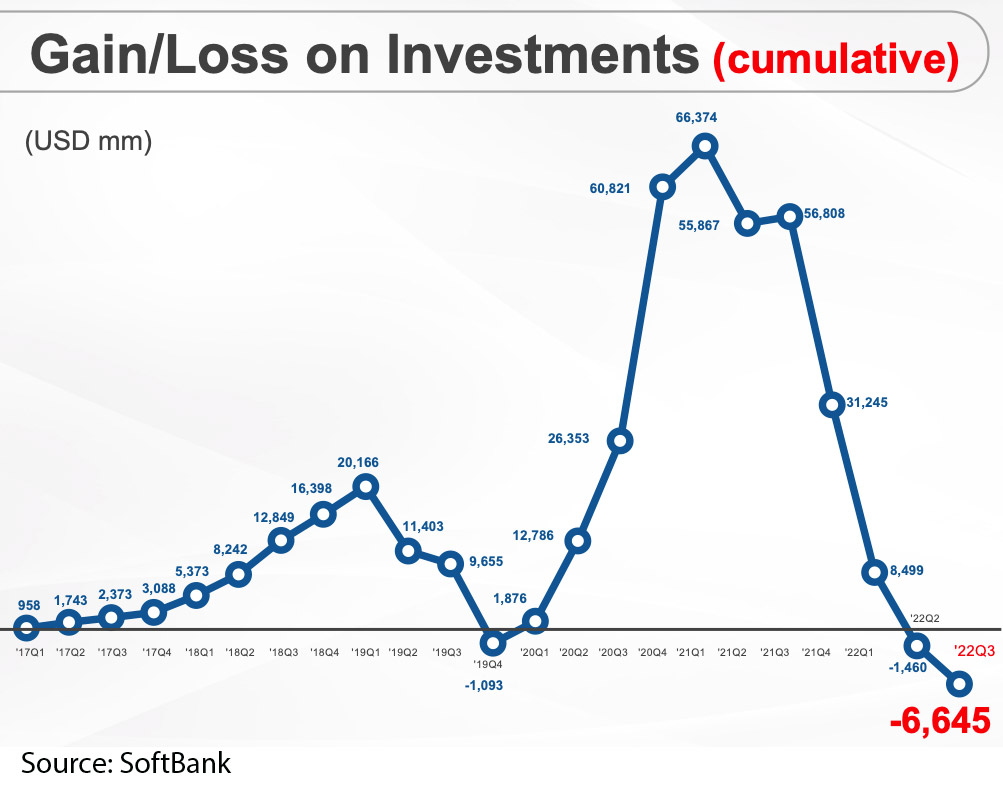
This week [results were published February 7] showed a $5.2 billion loss on investments for the Vision Funds for the quarter, the misery of which is only alleviated by the fact that it is not as bad as any of the previous three. Here are the Vision Fund’s last six quarterly figures starting from Q2 2021: $10.5 billion loss; $941 million gain; $25.6 billion loss; $22.7 billion loss; $9.9 billion loss; and now $5.2 billion loss.
A sense is growing in the investment community that Masayoshi Son has achieved something truly remarkable here, a sort of anti-Midas touch: everything he goes near turns to, if you’ll excuse the profanity, a hissing stream of WeWorks.
Is this fair? The Vision Fund venture capital unit has stakes in 472 companies, and they haven’t all turned to ordure; plus, it’s important to recall that the gruesome decline in large part reverses previous gains rather than being a destruction of the value that existed when the fund set up. Tech stocks go up too much and then they fall too much. As recently as the fourth quarter of 2020, Vision Funds logged a quarterly gain of $34.5 billion, thanks to a gain on Coupang, pushing group profit to $45.88 billion in the year ended March 2020, the biggest profit in the history of corporate Japan.
It’s also fair to say that SoftBank and the Vision Fund’s fortunes should be improved by the reopening in China: SoftBank was one of the earliest investors in Alibaba – though it cut its stake considerably in August, booking a $34.1 billion gain – and has a range of exposures to China that were hammered by a pandemic nobody could reasonably have seen coming.
IB impact
Still, the Vision Fund’s travails tell us something that applies on a broader canvas: the impact of tech stock reversals on investment banking.
For the Vision Fund, and SoftBank more broadly, to regain momentum and confidence, it needs to invest anew in businesses that fit a dramatically altered world. But it can’t do that, because so many of its investments are underwater. It can list something, and Arm is the one that’s under way – a whopper that is expecting to value the company at $40 billion when it comes.

But that’s not going to be any time soon. Chief financial officer Yoshimitsu Goto, who fronted this year’s investor presentation instead of Son in a considerable and rather symbolic break from decades of tradition, says Arm is on track to list in the 2023-24 fiscal year – this is what Son’s apparently working on – but that depends very much on market conditions, which have been far from helpful during the past 12 months.
The predicament is mirrored all over the tech world and is bad news for banks that have spent heavily on building tech presences, running the gamut from venture-capital advice through listings to M&A advisory, all over the world.
Asia-Pacific tech deals have been important earners for some of the world’s biggest banks: Morgan Stanley and JPMorgan on Grab; Credit Suisse, Morgan Stanley, Citi and BofA Securities on Zomato; Goldman Sachs plus JPMorgan, Morgan Stanley and Citi on Paytm, for example. Two of those three deals are considered duds, given their aftermarket performance, but the bigger problem for the banks involved is the evaporation of fees in the deals that might have followed.
According to data compiled for Euromoney by Dealogic, deal volumes on Asia tech new listings more than halved in 2021 over 2022, from $76.1 billion to $36.6 billion.
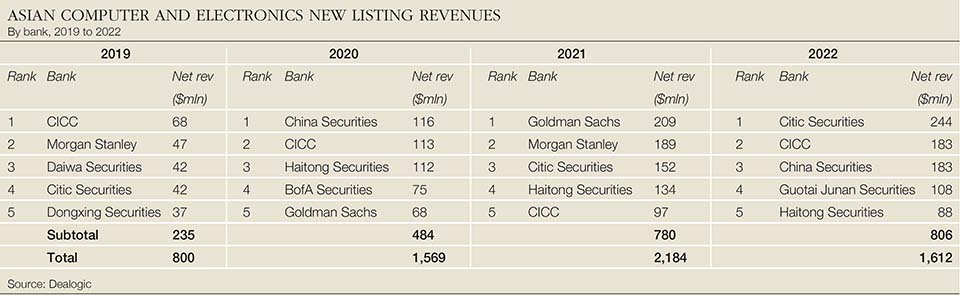
Moreover, whereas 2021 saw Goldman Sachs and Morgan Stanley at the top of the pile by deal volume in Asia tech new listings, in 2022 the top five were all Chinese or China-backed houses, suggesting the international banks saw an even more bleak reversal than the overall volume figures would suggest.
ECM spur
While the first six weeks of 2023 have been a bounty for debt capital markets bankers, their ECM counterparts are having a less productive time: deal volumes in the year to February 9 in tech were just $1.44 billion, which, if extrapolated for a full year, would equate to just $13.2 billion, barely one sixth of the 2022 figure.
But hopefully it won’t pan out that way. And it’s just possible that the deal that marked the end of the golden times in Chinese tech – the abandonment of the Ant Group IPO in late 2020 – might yet be the spur to get things rolling again.
Few were more disgruntled than Citi, JPMorgan, CICC and Morgan Stanley, the joint sponsors on the Hong Kong side of that deal – Credit Suisse was a level down with CCB International – when it was axed. At least one of the banks was expecting to get $75 million to $80 million from that deal, including incentives and ancillary earnings such as brokerage.
Through much of last year, there was a sense that it was gone forever. But since the start of the year, the market has started to speak of it again, feeling that the Chinese state has made its point about tech-preneurial upstarts, has cemented its interests by taking a golden share in Alibaba and Tencent, and is keen to see China’s economy and markets grow again.
In this respect, the listing of Hesai Technology on Wednesday on Nasdaq was significant, raising $190 million from investors in the biggest Chinese public listing in the US in 18 months – and the biggest Chinese tech listing in New York since the ill-fated Didi IPO. Nasdaq’s Asia-Pacific chair Bob McCooey called it a “seminal” deal, and argued that recent improvements in sentiment had “cleared the dark clouds… over the US capital markets for Chinese companies”. Goldman, Morgan Stanley and Credit Suisse were all on the deal.
As for SoftBank, another slide in the latest results deck says: “When do we start playing offense?” Bankers will be hoping it can arrest the falls of the Vision Funds and start raising capital again, and that the industry takes the same course.