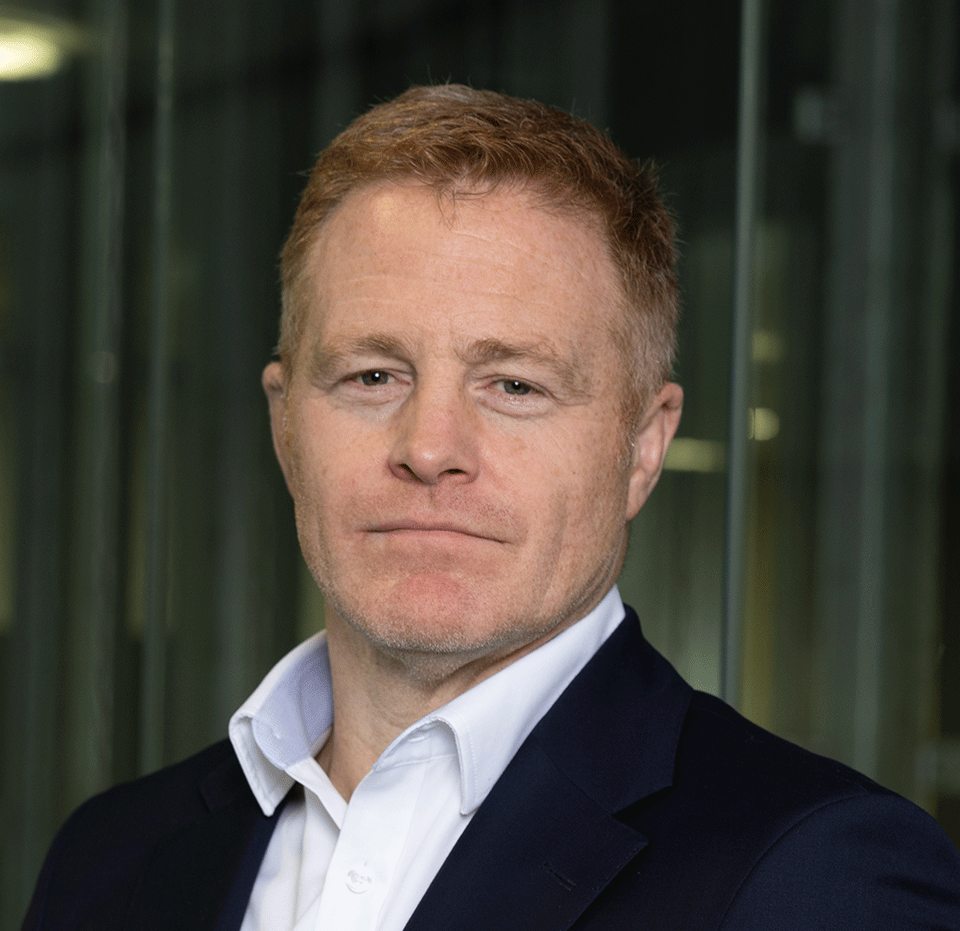
UK prime ministerial hopeful Rishi Sunak doesn’t stress his years as a junior banker at Goldman Sachs when he pitches for votes. Sunak’s political enemies work hard to portray him as an out-of-touch elitist, a campaign that was helped by leaks earlier this year about his wife’s non-domestic tax status in the UK and media articles stressing the enormous wealth generated by her stake in Infosys.
Sunak arguably did well to emerge as one of the two final candidates to succeed prime minister Boris Johnson after this onslaught and will now campaign for the votes of Conservative party members on a platform of competence, not opulence.
Mario Draghi rarely dwells on his own years at Goldman either, where he overlapped with Sunak between 2002 and 2004, though they were at different stages of their careers, given an age gap of 33 years.
German chancellor Olaf Scholz would be the only head of a top four economy in Europe to have taken power without a stint at an investment bank
Sunak was effectively ticking some boxes at Goldman before he joined a hedge fund, while Draghi was filling in time between running the Italian Treasury and returning to Rome to become governor of the Bank of Italy in 2006.
Draghi is now the grand old man of Italian politics and on July 20 he effectively told members of his coalition that he would be willing to remain as prime minister on condition that they behave themselves.
Remarkably, some of them did not take well to this admonition, and Draghi seemed poised to submit another resignation by July 21.
Italian political life is nothing if not fluid, however, and there is a chance that Draghi will be persuaded to remain in post until September, which is when Sunak will become UK prime minister if he prevails in his contest with rival candidate Liz Truss.
That scenario would mean that two of Europe’s four biggest economies were governed by alumni of Goldman, while a third was headed by a former banker at Rothschild, French president Emmanuel Macron.
German chancellor Olaf Scholz would be the only head of a top four economy in Europe to have taken power without a stint at an investment bank.
The right ties
If Sunak becomes prime minister, he is likely to offer a senior job to Sajid Javid, his former colleague in investment banking and partner in the recent dual resignation from government that signalled the end of Johnson’s time in power.
Javid referred to his career in banking during his resignation speech in parliament on July 6, in a farewell made from the benches behind a visibly uncomfortable Johnson.
Javid’s banking reference wasn’t a fond reminiscence about the good old days when he was a highly paid member of the credit derivatives structuring team at Deutsche Bank, however.
Instead, he recalled the obstacles he faced as a junior banker: “I didn’t quit when old-school bankers said I didn’t have the right school ties.”
It is certainly true that Javid did not have as privileged an upbringing as Sunak, who seemed to glide from Winchester College to Oxford University, then to Goldman and hedge fund trading, before his rapid political rise.
And Javid may well have faced prejudice early in his banking career, though that is not how it seemed to Deutsche colleagues as he prospered in the credit trading group that was one of the main profit engines at the firm ahead of the 2008 financial crisis.
The credit business, which was a leader in creating collateralised debt obligations, was run by a diverse team of bankers under Rajeev Misra (later of SoftBank’s Vision Fund) where drive and a flexible approach to structuring details mattered more than old school ties.
Still, if Javid does take up a senior role in a Sunak government, perhaps in another run as chancellor of the exchequer, he will come across plenty of fellow former bankers among political leaders in Europe. They can compare notes.