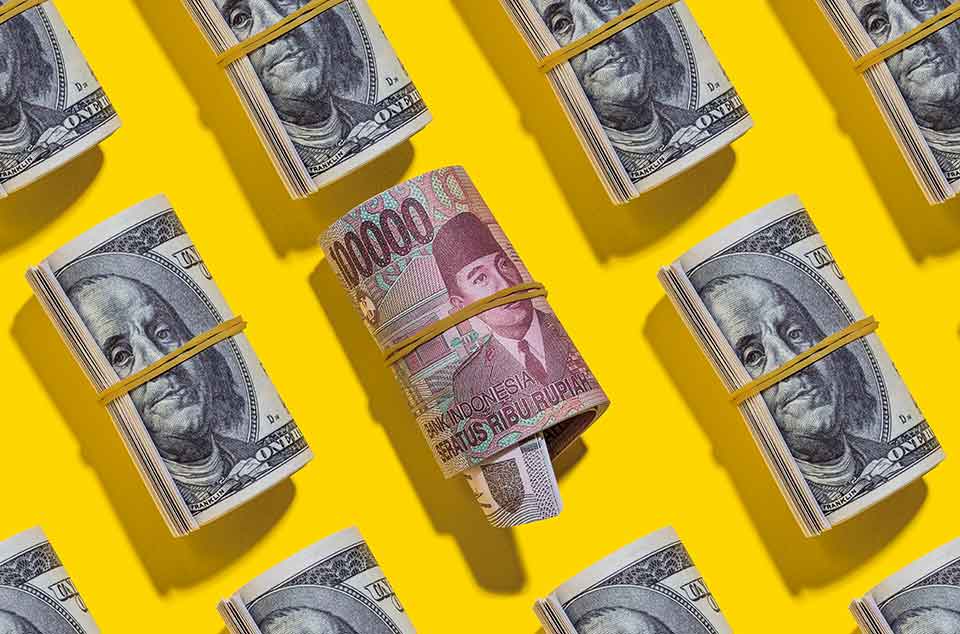
As central banks begin to swing into tightening mode, attention in Asia is turning to how currencies will perform. One area of focus is the 10 states that make up the Association of Southeast Asian Nations (Asean).
The fact that almost half of the Asean currencies – Lao kip, Vietnamese dong, Cambodian riel, Myanmar kyat – are not freely tradeable means regional analysis tends to focus on the Indonesian rupiah (IDR), Malaysian ringgit (MYR), Philippine peso (PHP), Singapore dollar (SGD) and Thai baht (THB).

The obvious factor influencing IDR, MYR, PHP, SGD and THB – commonly referred to as the Asean-5 – is Federal Reserve strategy. As BNY Mellon Markets senior market strategist for Apac Chong Wee Khoon notes, US policy tightening and the overall withdrawal of liquidity in the financial system are likely to exert negative pressure on emerging markets.
Abbas Keshvani, emerging markets FX analyst at JPMorgan, says the region’s sensitivity to the US is a continuing factor. “For Asean in particular, we find that currencies remain vulnerable to higher US yields, with most currencies’ sensitivity to US real yields higher or around the same level compared to this time last year,” he says.
Less hawkish regional central banks will provide less of a compelling reason for international investors to harvest carry from currencies as they gradually ease into tightening (in the case of Singapore, Philippines, Indonesia) or stay on hold (Malaysia, Thailand) for the majority of 2022, suggests Galvin Chia, emerging markets strategist at NatWest Markets.

UOB expects the Fed’s tapering to end in March, followed by interest-rate hikes in June, September and December. Any acceleration of this schedule or additional rate hikes could spur capital flight from Asean economies, further weighing on the currencies according to the bank’s senior FX strategist, Peter Chia.
“Another trend to watch is if inflation spikes further in the Asean economies as it did in developed markets last year,” he says. “If this happens, we expect sentiment on regional fixed-income markets to worsen.”
Kiyong Seong, lead Asia macro strategist at Societe Generale, agrees that the pace of the Fed’s monetary policy normalization pace compared with that of Asean central banks is an important factor, but suggests that it will not explain every market move.

“Evidence of this can be seen in the performance of the Korean won, which continues to weaken despite Bank of Korea being the most aggressive central bank in Asia in terms of monetary policy normalization,” he says.
Societe Generale expects the Monetary Authority of Singapore (MAS) to tighten again in April and believes the THB has the potential to reverse its poor performance in 2021, given its profile as a holiday-destination currency.
Gaurav Garg, head of emerging markets FX and rates strategy for Asia at Citi, also identifies SGD and THB as currencies likely to perform well in 2022, while warning that MYR is likely to be uninspiring, with high oil prices and economic recovery offset by weak portfolio inflows and lingering political uncertainty.
“Low levels of foreign ownership for local currency bonds and healthy current accounts from a historical standpoint lower the overall vulnerability of Asean FX to tightening of global financial conditions,” he adds.
NatWest Markets’ Chia observes that as the regional recovery progresses, waning tailwinds from the boost in trade surpluses as domestic demand picks up and as commodity prices ease from their rapid rises will mean less support from trade flows.
“This is already evident in trade balances in Thailand and the Philippines,” he says. “Similarly, a less robust recovery in aggregate compared to a fairly upbeat US economy will mean lower financial flows into local markets. Inbound emerging market portfolio flows have been subdued since Q4 2020, providing fewer tailwinds for local currencies.”
The Fed’s hawkish pivot seems to be largely priced in, but it is harder to ascertain if the market is prepared for Asian central banks to also commence policy normalization in 2022. That is the view of Joey Chew, senior Asia FX strategist at HSBC, who says she is confident about SGD’s appreciation prospects this year, since the MAS uses the nominal exchange rate to control core inflation.

“We also think Indonesia can attract sufficient foreign direct investment (FDI) and portfolio inflows to fund its current-account deficit, such that its currency can remain stable and potentially even strengthen slightly,” she adds.
“MYR can still benefit from a strong exports outlook and for THB we take comfort that its current-account deficit is very unlikely to deteriorate further, since tourism income cannot possibly fall from the negligible level it is currently at.”
HSBC is forecasting modest depreciation for PHP on the back of a widening of the Philippines’ trade deficit, political uncertainty and a sluggish Covid vaccination programme.
Khoon at BNY Mellon Markets expects IDR and MYR to hold their own this year with the former’s susceptibility to global risk sentiment offset by its high real government bond yield, and loose fiscal discipline a continued negative factor for the latter, despite high crude and palm-oil prices.
The global economic backdrop does not bode well for Asia FX in general, notes JPMorgan’s Keshvani. “Growth is expected to slow in both developed and emerging markets with the latter’s growth advantage expected to narrow,” he concludes. “Meanwhile, global inflation is expected to remain relatively elevated. This sort of stagflationary environment has historically been the least favourable backdrop for IDR, MYR, and PHP.”
NatWest Markets’ Chia broadly agrees, while hinting that Asean countries may benefit from investors seeking value in cheaper currencies in the second half of 2022.