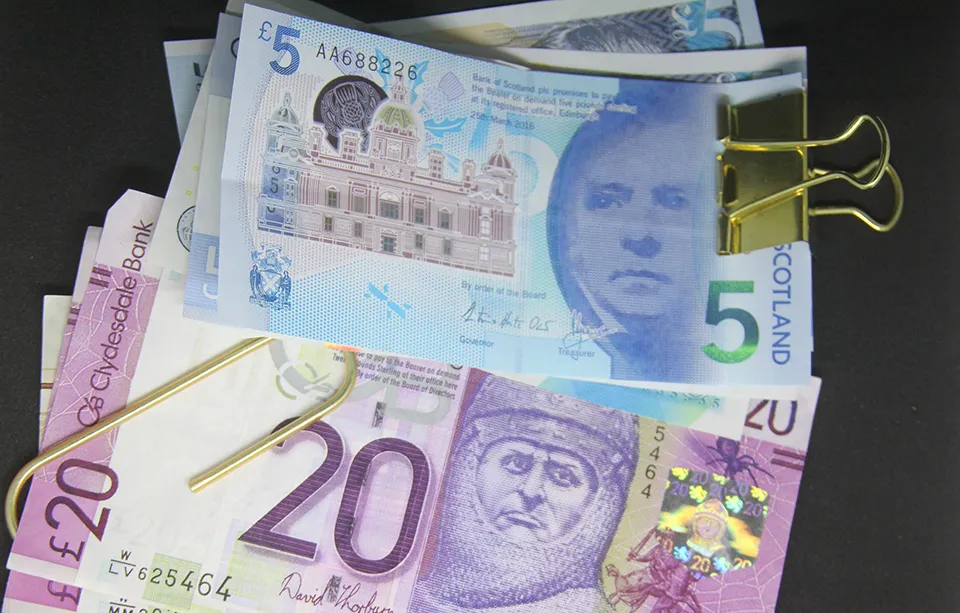
More than 20 years ago, Alex Salmond – then leader of the Scottish National Party (SNP) and later Scotland’s first minister from 2007 to 2014 – described the pound as a “millstone round Scotland’s neck”. Despite this, in the lead-up to the 2014 referendum on Scotland’s independence from the United Kingdom, he seemed confident that Scotland could remain part of the currency union if the ‘yes’ vote won.
Current Scottish government currency policy is based on a 2018 report by the Sustainable Growth Commission, which suggested keeping the pound (a process known as ‘sterlingization’) for around a decade after independence.
And despite the passing of a resolution at the November 2021 party conference of the SNP – which remained by far the largest party in government after a May 2021 general election, despite not gaining an absolute majority – calling for the issuing of a Scottish currency as soon as possible after a yes vote in any future second referendum, the strategy of retaining the pound for a longer period has some support.
Professor John Kay, emeritus research fellow at St Johns College, Oxford, describes continued use of sterling as Scotland’s unit of account as a prudent and feasible approach. And some 54% of respondents to a late 2020 poll conducted on behalf of research firm Progress Scotland said they would prefer keeping the pound in the long term.
However, a few financial experts north of the border have poured scorn on a plan they variously describe as ‘unviable’ and ‘disastrous’, and which they claim is likely to lead to savage austerity measures.
Regimes
Supporters of sterlingization fail to realise that the currency issue is about much more than the denomination of notes and coins in circulation in an independent Scotland, notes Ronald MacDonald, research professor of macroeconomics and international finance at Glasgow University’s Adam Smith Business School. It is about the currency regime itself, he says.

“Specifically, is the adopted regime fixed or flexible? And how does it sit with respect to the underlying macroeconomic fundamentals?” he says. “Sterlingization is a form of fixed exchange rate, and this is incompatible with Scotland’s historically high balance of payments deficit. The latter implies that Scotland would have to move to a separate currency at a sharply devalued rate, which I have estimated to be in the region of 20% to 30%.”
According to MacDonald, financial markets would require any expected devaluation to be factored into borrowing rates, and the induced capital flight and draining of liquidity out of the banking sector would be a classic recipe for a speculative attack.
“Given the forward-looking nature of financial markets, this will happen soon after independence, if not before, ruling out the prolonged use of sterling in any transition period,” he adds.
Sterlingization means the Scottish government would need to absorb movements between the two currencies to ensure a continuing smooth flow, effectively insuring households and businesses against exchange-rate shocks. But the cost of acting as a shock absorber is likely to run into billions of pounds and would be at the cost of public services, which would be a brave decision for any administration to make.
Sterlingization is a form of fixed exchange rate, and this is incompatible with Scotland’s historically high balance of payments deficit
Ronald MacDonald, Adam Smith Business School
Richard Marsh, an economist at 4-consulting, reckons no credible economist would advocate sterlingization as the policy of choice for an independent Scotland.
“This would effectively involve Scotland accepting monetary policy as set by the Bank of England, including interest rates,” he says. “The Bank of England currently takes Scotland’s economy into account when adjusting monetary policy, but it would no longer have to do this if Scotland opted to use the pound outside of a formal currency union.”
Union
Tim Rideout is convener of the Scottish Currency Group, which describes itself as a group of people working towards the introduction of a Scottish currency “as soon as practicable” after independence.
He points out that no bank domiciled outside the UK has either a Bank of England reserve account or full access.

“Sterlingization assumes the Bank of England will make an exception for Scotland, but the UK has been quite clear that it will not do so,” he says. “It assumes what is in effect a currency union and is also not viable because it turns the Scottish government into a county council as opposed to a state with a currency as it would not have access to a central bank that it could instruct to make payments.”
Kit Juckes, chief global foreign exchange strategist at Societe Generale, observes that there are several examples of countries that have ‘dollarized’ on an informal basis, but says this creates issues around debt and tax.
“If Scotland issued sterling debt, it would be like the UK issuing dollar debt – they wouldn’t be in control of the money they borrow in,” he explains. “Do they then simply raise sterling taxes? That means they can service sterling debt with sterling revenues, but they aren’t in control of the value of sterling or the level of interest rates, so it is a pretty temporary fix.”
The vast majority of dollarized countries are very small compared with their host currency, whereas Scotland makes up about 10% of the ‘sterling zone’, observes Craig Dalzell, head of policy and research at Scottish independence research firm Common Weal.
Linked currencies tend to act to harmonize the economies of the linked countries, which does not bode well for any independence strategy
Craig Dalzell, Common Weal
“This means there is a risk for the Bank of England removing Scotland from its remit as would be the case with sterlingization,” he says. “There is also a problem in that linked currencies tend to act to harmonize the economies of the linked countries, which does not bode well for any independence strategy based on the idea that Scotland should diverge its political and economic direction from the UK.”
John Ferry, finance spokesperson of the Scottish Liberal Democrats, describes the SNP’s currency policy as a mess, suggesting they want a simple message for people on the doorstep that will mislead them into believing there would be a straightforward, risk-free transition out of the UK.
“The SNP simply refuses to engage with the reality of sterlingization, which is that it would almost certainly lead to an economic emergency in the new state,” he says. “They also want to placate a loud faction within the party that recognizes the danger of sterlingization and is pushing for a new currency policy by trying to say the right things about the possibility of launching a new currency without actually committing to it.”
The SNP did not respond to Euromoney’s requests for comment.