The world seemed like a very uncertain place for financial institutions in April last year. Corporate borrowers were drawing down credit lines in unprecedented volumes. Insurers faced Covid-19 losses of tens of billions of dollars, perhaps more.
The subsequent desire by some clients to bolster their capital played to Morgan Stanley’s equity capital markets strength. In those early days of the pandemic, in May 2020, a $13.3 billion secondary follow-on offering of PNC’s stake in BlackRock bolstered the lender’s balance sheet and gave PNC more firepower to take advantage of strategic acquisition opportunities. Morgan Stanley was lead-left bookrunner and stabilization agent.
The firm was also lead-left bookrunner and stabilization agent in a $1 billion follow-on offering for Renaissance Re. With the market reacting positively to Renaissance Re’s offering, UK insurer Lancashire came out a few days later with a £277 million primary accelerated bookbuild offering. Morgan Stanley was sole global coordinator on that deal.
Shortlisted
- Goldman Sachs
- JPMorgan
Before long, the focus switched from helping clients fortify their balance sheets to advising on M&A.
After completing its work with Swiss Re on a £3.3 billion sale of ReAssure to Phoenix Group, one of the team’s first entirely remote M&A deals was advising Zurich on its $3.9 billion acquisition of MetLife US property and casualty business with Farmers Exchanges. Months of negotiation by video call culminated in an agreement in December and the clients finally got to meet in person when the deal closed in April, once vaccination rates were higher.
In the asset and wealth management sector, M&A deals included advising Australia’s NAB on its $1.1 billion sale of MLC Wealth to IOOF in August 2020 and advising Canada’s BMO on the £615 million sale of its European asset management business to Ameriprise Financial in April this year.

Morgan Stanley was adviser to CaixaBank on its $16 billion merger with Bankia, announced in September and closed in late March; the merger was Euromoney’s pick for the world’s best bank transformation this year. The firm’s other bank M&A deals included advising Intesa Sanpaolo on its $3.3 billion takeover of UBI Banca, closing in July last year, and advising Samba Financial Group on its $34 billion merger with National Commercial Bank, creating Saudi National Bank on April 1, 2021.
More recently, Morgan Stanley advised Permanent TSB on its acquisition of Ulster Bank from NatWest. And in the US, the accelerated shift from branches is spurring smaller regional banks to seek scale through mergers. The firm advised Citizens Financial Group on its acquisition of Investors Bancorp, and Flagstar Bancorp on its acquisition by New York Bancorp – mandates reflecting Morgan Stanley’s efforts to bolster coverage of US mid-tier banks.
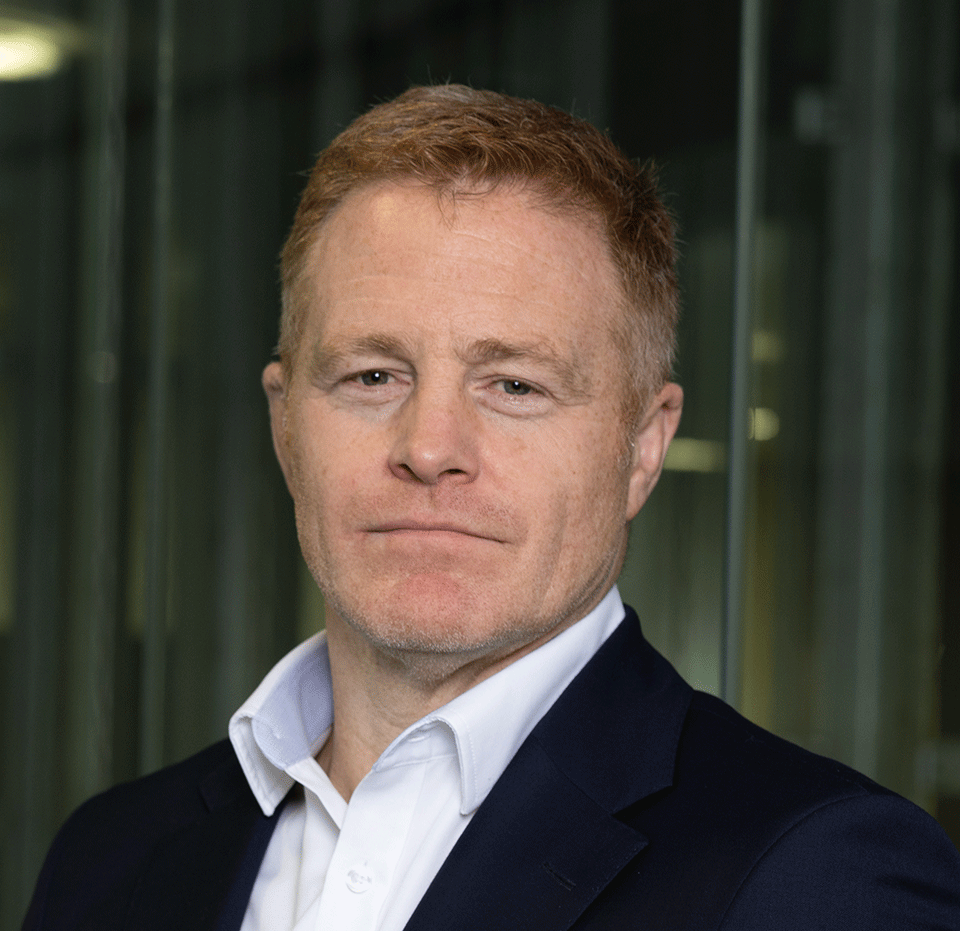
“The backdrop is still really challenging for banks,” says John Esposito, global head of financial institutions at Morgan Stanley. “Rates are near zero and there’s so much liquidity that they can’t grow loans because no one is borrowing money. With margins compressing and not being able to grow the balance sheet, it’s a tough time. Many smaller banks are looking for partners to take out costs and generate some growth in earnings.”
Meanwhile, the link to Morgan Stanley’s highly regarded technology division puts the financial institutions group (FIG) team in good stead as the flow of private and public capital into financial technology increases.
“We spend a lot of time coordinating and delivering a joint coverage effort between FIG bankers and tech bankers,” says Esposito. “Some fintech companies, two years ago, had very small valuations and now they’re multi-billion-dollar companies. Everyone, across the FIG group, has had to retool their skill set to cover and understand some of the trends going on in fintech.”
Everyone, across the FIG group, has had to retool their skill set to cover and understand some of the trends going on in fintech
John Esposito
In the public markets Morgan Stanley has raised a particularly large amount of capital for insurance technology companies in the US – leading the IPOs of Select Quote, Lemonade, GoHealth and Root. It was financial adviser and private investment in public equity placement agent in Hippo’s $780 million special purpose acquisition company (Spac) merger in March, following advice to earlier Spac mergers, including a $16 billion deal for United Wholesale Mortgage in January.
Among a range of financial technology and payments M&A during the awards period, Morgan Stanley advised Optimal Blue on its $1.8 billion sale to Black Knight and Nordic Capital on its $2.5 billion sale of Itiviti to Broadridge. It also advised Worldline on its €9.9 billion acquisition of Ingenico.
Finally, London Stock Exchange Group’s £27 billion acquisition of Refinitiv triggered more consolidation in the exchanges and market data sector, much of it involving Morgan Stanley. The firm was sole financial adviser to Bolsas y Mercados Españoles on its €2.8 billion all-cash voluntary tender offer from SIX Group; adviser to LSEG on its €4.3 billion sale of Borsa Italiana to Euronext; and adviser to IHS Markit on its $44 billion sale to S&P Global.