
With a balance sheet over $2 trillion, Sumitomo Mitsui Banking Corp is one of the world’s biggest commercial lenders, usually ranking between 12 and 14 among the world’s largest banks, close to Citigroup and Wells Fargo.
It has ambitions to grow again outside its home market, targeting Asia, particularly Indonesia, the Philippines, Vietnam and India, as well as the US.
In March, it paid $384 million for 4.9% of Ares, a large non-bank lender that finances mid-sized US companies. In May, SMBC announced its aim to grow share in US investment-grade bond underwriting and to climb from its present spot at 15 in the league tables into the top 10.
However, this looks like a bad time to expand lending in overseas markets.
Even a determined fiscal and monetary policy response and good news on vaccines still leaves open the possibility of permanent damage to many sectors and businesses, more defaults to come and likely lower recovery rates.
There was no model for such a sudden and complete disruption
Sean Hunter, OakNorth

Lenders keen to grow always face the risk of negative selection: that they will win all the new customers that the local banks – who know the territory much better – won’t lend to.
So, in late November, SMBC spent another $30 million and announced the licensing of a key piece of technology to enable this growth: the credit intelligence software of OakNorth, a UK bank focused on small and medium-sized enterprise (SME) lending.
OakNorth Bank may be small – it has lent £4.6 billion to 750 businesses since 2016 – but it has grown fast and profitably in the underserved SME segment in the UK, while avoiding loan losses thanks to a cutting-edge credit underwriting and monitoring system.
The bank is just the testing ground for this. OakNorth’s real business is selling the software.
Large lenders have been reluctant to acknowledge that they are using someone else’s systems to underwrite and monitor loans, that being such a core part of banking. Dutch bank NIBC was one of the few to disclose taking OakNorth’s service.
However, over the summer, PNC, the large US regional bank with national ambitions, made the same disclosure. Now SMBC adds its endorsement.
Something new is happening here.
Cutting edge
Sean Hunter, CIO at OakNorth, tells Euromoney: “Banks used to jealously guard their IT systems as a key part of their competitive edge, but increasingly leading bankers see they can build banks not as monoliths but as ecosystems, bringing in the best outside providers, even of core services.”
While OakNorth still employs human underwriters, it equips them with systems that quickly pull in and crunch a wide array of publicly available data, including alternative data sets, to inform swift loan decisions.
It’s all the cutting-edge stuff: big data, artificial intelligence (AI), machine learning.
Then it takes a new approach to monitoring individual credits. Instead of sitting back, taking in borrowers’ audited financials every six months and paying no attention as long as they stay current on loan servicing, OakNorth constantly reviews borrowers’ performance against a peer group of companies in the same sector and same geography.
This is more like the behaviour of an equity owner than a lender.
Hunter says: “It is the right approach to individual credit and portfolio monitoring. Banks would have loved to be able to do this, but didn’t have the systems to access timely data.”
The Covid pandemic has proved its value. OakNorth has lent £1.35 billion since March 23, with just £520 million of that covered by partial government guarantees. Much of its own-risk lending is going to medium-sized companies that the big banks are now stepping away from.
It’s no mystery why they are reluctant to lend without government guarantees.
Hunter says: “The key vulnerability the Covid crisis exposed in bank’s traditional credit underwriting process was the assumption that you can take historic reported financials and model likely future outcomes in cyclical downturns.
“But there was no model for such a sudden and complete disruption and a 100% fall in revenue, for example at hotels and restaurants.”
We are further harnessing the power of AI through big data and machine learning
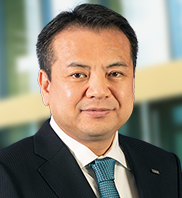
Toru Nakashima, SMBC
Because its credit system is designed for constant rather than periodic monitoring of borrowers and for incorporating non-financial data, OakNorth’s adapted fast.
Hunter says: “Even five months after the lockdowns, banks could still be struggling to fill in the gaps in their understanding of the outlook for borrowers, because of the lag in what was showing up in audited financials.
“But alternative data that updates much more frequently can provide proxies for revenue, such as data from OpenTable on restaurant reservations that can be combined with average spend per meal.”
It’s intriguing how fast PNC moved on this in June.
“We had our first conversation with PNC on a Thursday,” recalls Hunter. “On the Saturday, we met the CEO, the CFO, the head of risk, the head of commercial lending.
“They realized they needed more insights into the impact of Covid across their loan portfolios and we could provide that quickly. By the next Wednesday, we had delivered the system.”
That’s one more reason why PNC is the bank to watch.
Hunter says: “PNC is a huge bank and these are very smart people. They could have built their own system. But the time that would have taken was a massive opportunity cost. We could deliver it rapidly and help them save some businesses that might otherwise have gone under.”
He says: “Our system often shows up companies that look like they are struggling now but still have debt capacity and might thrive in future. It also often reveals a subset of loans where borrowers that are still current today might well be heading for difficulty.”
Sector models
The OakNorth system sets up sector models and analyses not just its own borrowers but their competitors in the same sector and other borrowers in the same location, taking inputs such as customer reviews, footfall and product pricing.
Hunter says: “There are massive differences in how lockdown affected businesses in the same sector. Think of a high-end wedding dress designer that also fits customers for red-carpet events. Its revenues collapsed.
“Then think of a yoga-pants maker selling direct to consumer. Its business has boomed. But most bank credit systems would bucket them together as retail clothing.”
There’s an obvious application here for lenders aiming to challenge in new markets.
“Banks looking to expand into new geographies don’t have large stores of historic proprietary data, so our sector and peer comparisons can be highly beneficial,” Hunter says.
SMBC liked the system so much it also invested $30 million in OakNorth equity through a private secondary sale.
Toru Nakashima, group CFO and CSO, commented when unveiling the deal: “SMBC Group announced in its new medium-term management plan that it would increase profit through ‘transformation’ – the comprehensive optimization and remodeling of its businesses – and ‘growth’ – the pursuit of new growth opportunities.
“Through this investment and the upcoming business alliance with OakNorth, SMBC strives to create new added value by bringing a high level of sophistication to its corporate lending platforms.”
Nakashima added: “We are further harnessing the power of AI through big data and machine learning across our strategic markets in southeast Asia, such as Indonesia.”
Shift in attitude
This is a new type of lending and credit monitoring that more smart banks will likely embrace.
It may require a bigger shift in attitude from borrowers towards feeding the system with more frequent data rather than just submitting financials on set dates.
Borrowers might get two things in return: first, a warning from an engaged lender that their competitors might be changing their pricing or product offering; second, instead of standardized loans on terms and repayment schedules that suit the banks, more customized credits that suit borrowers’ cash flows.