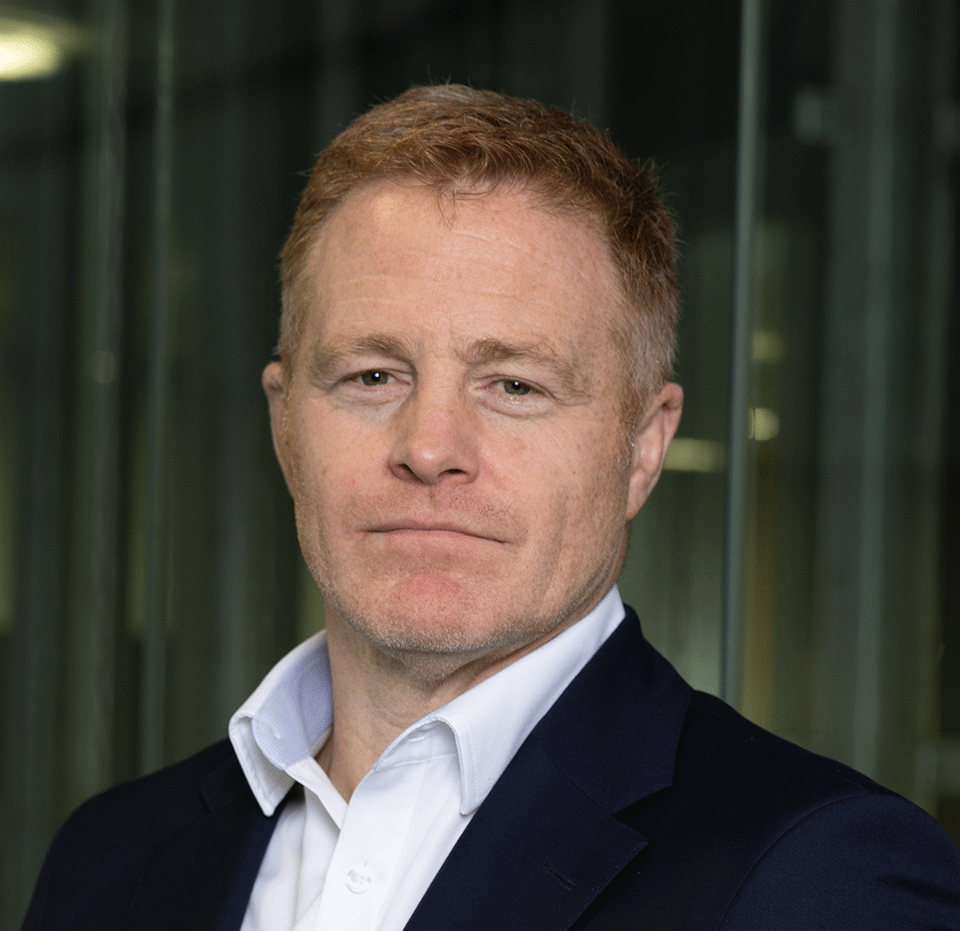
Aditya Puri’s success since building HDFC Bank in 1994 can be measured, in part, by the quality of its absences: the absence of scandal, the absence of any credit bust and the absence of drama. Indian banking generally is not short of any of these things, lurching between dismal creditor catastrophes amid cycles of bailouts and occasional fraud-related arrests, but HDFC Bank has done nothing but grow.
And that’s the remarkable achievement: HDFC Bank under Puri has mastered the exceptionally difficult double act of having prudent risk management and routinely achieving 20% annual profit growth, as it did in the 2019/2020 financial year (24.6% in the year to March 31).
It has avoided the low-hanging fruit of lucrative but perilous lending to unsteady conglomerates, letting others take the short-term spoils and the long-term consequences, but while doing so it has somehow grown to be the biggest bank by market capitalization in the country, twice the size of State Bank of India. By 2012 investors were so enamoured with the bank that it had the highest price-to-book ratio, not just in India but the world.
Puri joined HDFC after a storied career at Citi, serving as chief executive of Citibank Malaysia in the early 1990s. He could have stayed at Citi and risen through the ranks indefinitely, but he saw an opportunity as India began to open up competition to its public-sector banks.
“When we looked at it dispassionately, the scenario had three components,” Puri says. One was that India was a remarkably underpenetrated financial market. The second was the competitive environment.
“The foreign banks had the customer focus but neither the funding capability, nor the distribution network,” he says. “The nationalized public-sector banks had the distribution and the funding capability but not the products or the customer focus that was required.”
The third was that, with the right team, a bank could be built with international standards on a vast Indian canvas. “We thought we could create a world-class Indian bank, including scale.” And they did.
Evolution
The initial premise – a decent corporate bank with a focus on treasury – was not what the bank would eventually become. In the following years it evolved into retail, attaching itself to the tech revolution in India, first through the explosive growth in telecommunications and later through digital innovation. The shift from his corporate banking background to serving a grass-roots national population did not prove problematic.
“I’ve always been a very customer-focused guy,” Puri says. “My only question is: what does the customer want and how do we deliver it? That applied in corporate banking and it applied in spades in retail.”
I have an opportunity in a market I understand where people know me and we’ve got the distribution
Aditya Puri
One of Puri’s distinct skills is that he can see the very big picture while leaving the detail to trusted lieutenants. One has to remind oneself, as he talks about digital innovation with all the conviction of his former protégé and now DBS chief executive, Piyush Gupta, that Puri almost never uses a mobile phone.
“I know how to use a phone when I need to,” he smiles. But his skill is in understanding the broader meaning of what technology can bring to banking, not being in thrall to the tech itself. HDFC got itself on the right side of the extraordinary demonetization process of 2016 and will ultimately be seen as one of the winners of that disruption; although Puri was as blind-sided by it as everyone else, today he says: “The digital revolution prime minister Narendra Modi has brought is not understood across the world.”
Distinction
The other distinctive thing about Puri’s 26-year reign at the top of India’s best bank is that he has never been tempted to make a big push overseas. In 2019, the contribution of branches outside India was just 2%. Instead, Puri sees far greater opportunity in the emergence of semi-urban and rural India as a growing, spending constituency, where 60% of India lives.
“I have an opportunity in a market I understand where people know me and we’ve got the distribution,” he says. “In the next three years we have got so much of an opportunity that we are still concentrated here.”
Throughout, Puri has shown clarity of leadership. He leaves his office at a reasonable hour most days, confident in the distinction between what he can do and control, and what he cannot. “To think that life is going to be a bed of roses is stupid,” he says. “It’s going to have ups and downs. There are a few things you can fix and a few things you can’t.”
The skill of HDFC Bank under Puri was to dramatically limit the things that needed to be fixed, while continuing to grow. The bank will be handed over to Sashidhar Jadgishan in great shape.