
When John Waldron told analysts in January 2020 how he and his colleagues were busy making Goldman Sachs’s investment bank into an even more formidable outfit than it already was, the havoc that Covid-19 would soon wreak on the world was, for most people, no more than the worst of worst-case projections.
Kicking off Goldman’s first-ever investor day, chief executive David Solomon had already outlined a root-and-branch rethink of the scope of Goldman’s business – pushing further into areas of consumer finance and wealth management – and how it was putting clients at the heart of everything it did. Part of Waldron’s task was to show how this applied to the firm’s historic engine, its investment bank.
“We didn’t want to be ambiguous about whether we were investing in our core business,” Waldron, Goldman’s chief operating officer, tells Euromoney. “We are diversifying, but it’s not as if we have put our core businesses on autopilot. On the contrary, we said they were strong but could be stronger.”
Key to achieving that is an uncompromising focus on clients in every business line in investment banking and global markets, and approaching each relationship from the perspective of the whole firm. Incentive structures have been overhauled. Individuals’ performance is explicitly measured on the extent to which they contribute to the franchise not just to their own product. Progress is monitored more frequently than ever.
In investment banking, gaps in coverage are being scrutinized and filled. The middle market is now firmly in Goldman’s sights. The launch of a new transaction banking operation is also dovetailing with the investment bank – something that has proved timely as companies sought to draw down facilities at the start of the Covid crisis and then looked to place their spare cash on deposit.
The global markets division – where technology has already driven a ramp-up in electronification and made its industry-leading market insights more widely available than before – is broadening its client profile. Corporates, often so well covered already by the firm’s investment bankers, are now swarmed over by its sales force and traders. Institutional investor clients have greater access to liquidity and financing.
At the investor day, much of this effort was neatly packaged up in the presentation of the firm’s newish ‘One Goldman Sachs’ initiative. But it also goes back further, reflecting work that has been under way since Solomon took the helm of the firm in late 2018.
That work was already bearing fruit, but the coronavirus crisis that quickly enveloped markets in 2020 put it to the test.
It passed that test.
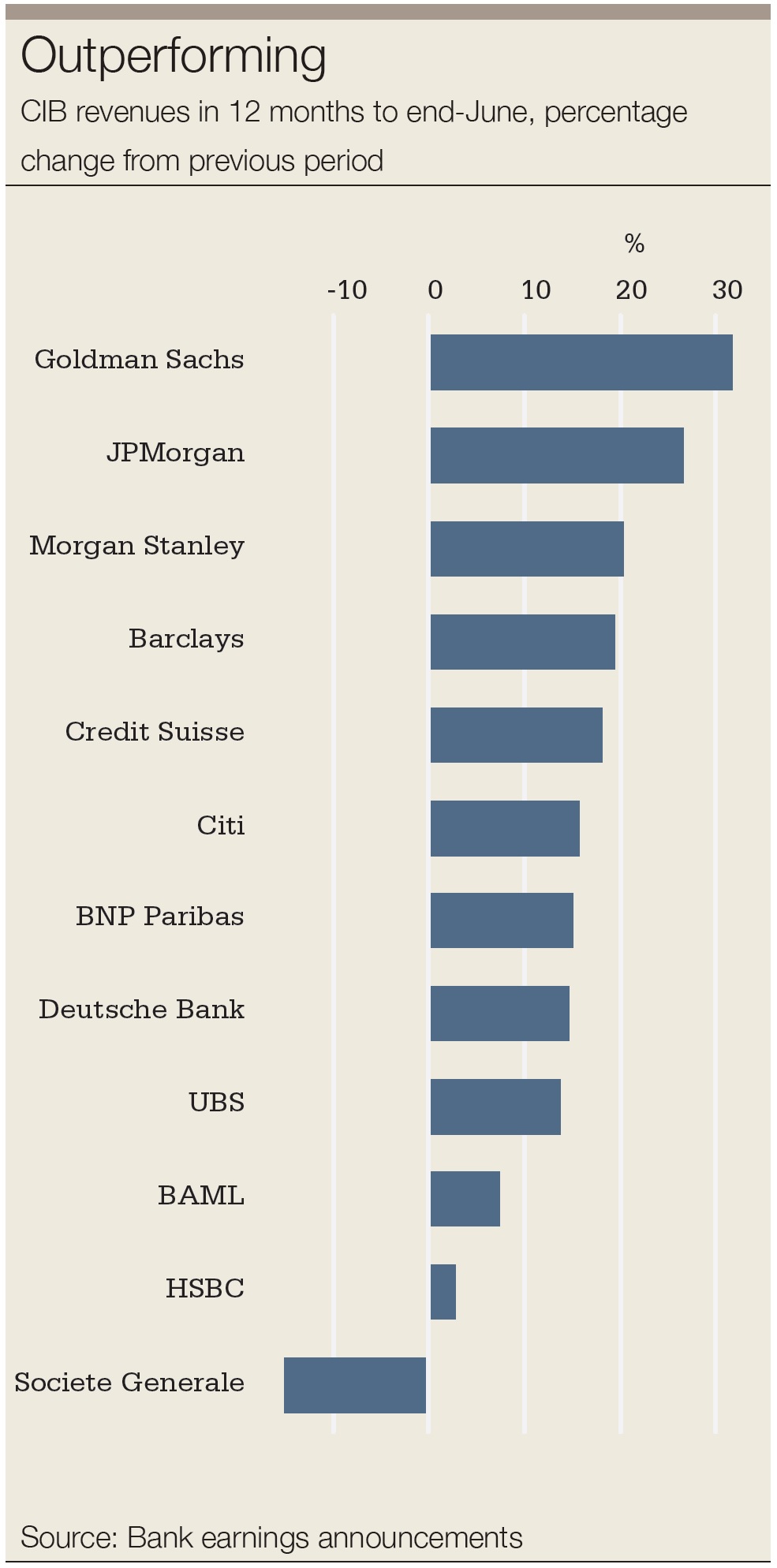
Combined second-quarter revenues in its investment banking and global markets divisions were up 74% year on year, more than any rival. Twelve-month revenues rose 32%, again more than any other.
For the awards period under review, May 1, 2019 to June 30, 2020, Goldman led the Dealogic rankings for global equity capital markets issuance, with a market share of 9.8%. In announced M&A, it led with a 30% share, rising to 34% in completed deals. In global debt capital markets, the business where it has long been selective, it ranked sixth behind the flow monsters. But it plays where it can bring most value – in high yield, it ranked third.
As impressive as those numbers are, they do not tell the whole story of what is happening inside Goldman Sachs. Whether the reset of the firm’s focus marks a return to its heritage or something more newfangled depends on who you ask. What is beyond doubt is that the strategy could not have come at a better time.
Cross-divisional effort
For Waldron, One Goldman Sachs encapsulates everything about the way the firm now approaches its business. The principles that underpin it apply to all client relationships, but the explicit One GS programme was tightly targeted when it kicked off last year.
“We started with 30 clients around the world, ones where we thought there was an opportunity to cover them better,” says Waldron.
By the end of 2020, it will have been applied to at least 100 names.
This target list is where the biggest cross-divisional effort is being applied, but Waldron and his colleagues believe the broader approach to clients is a meaningful factor behind the financial success the firm has seen, both before and during the crisis. And the reason that success stands a good chance of continuing is that the focus comes from the top of the firm.
The very first memo that Solomon put out to staff on becoming chief executive laid out his desire for a reinforced client-centric strategy. For One GS, Waldron personally selected the first 30 clients and spoke to them multiple times.
As the list grows, he approves each addition, as well as the team leaders whose job it is to coordinate the effort on each client. He meets those team leaders every month.
Those running Goldman’s business lines say this commitment from the top is the differentiator. Waldron has been in front of some 500 clients over the last year.
“The leadership of the firm is determined that clients should be at the centre of what we do and that we need to wake up every day trying to service these clients’ needs,” says Jim Esposito, one of three co-heads of Goldman’s global markets division. “David [Solomon] and John [Waldron] have been crystal clear that this is a key strategic initiative.”
We always tell ourselves that we gain market share in a downturn – and that actually happened
Gregg Lemkau
In global markets, for example, one of Goldman’s targets is now to be top three with the top 100 clients. Over the last year it has gone from that position with roughly one third of that group to about one half, Waldron reckons.
He thinks the firm ought to hit that target early next year with perhaps two thirds of the group.
He puts a lot of that progress – and progress across the firm more broadly – down to an ability to mobilize its resources more nimbly than before, something that has been all the more necessary during the Covid crisis, but which has also in some ways been assisted by remote working.
“During the height of the panic, we were able to bring the whole firm to a client’s Zoom,” says Waldron. “We could bring in our head of rates trading and a banker, and then either me or David [Solomon] and talk about what we were seeing and doing. The client could get all of that in one meeting.”
It is clear that Goldman outperforms in crises, never more so than in 2008. Some say that whether through stubbornly marking collateral to market or enforcing its rights, the firm was widely viewed as insular and difficult to deal with. What rivals criticize as a business model that prioritized looking after the firm’s own interests at the expense of clients is what its own bankers have long preferred to describe as being economically rational. But even they concede that there was scope to improve.
“It would be fair to say we did not exit the financial crisis period with a client franchise as strong as it could have or should have been,” says Esposito.
It makes looking at how the firm has addressed the Covid crisis all the more instructive. As Waldron points out: “We didn’t do One GS planning for this crisis, but the crisis has reinforced our reasons for doing it.”
It is reflected throughout the businesses. What Esposito and his global markets co-heads Marc Nachmann and Ashok Varadhan emphasized to staff as the firm entered the crisis was that it should seize it as an opportunity to reinforce the client-centric message. This was the time when all the talk would be tested.
In the worst of the volatility in March, Goldman was making up to 7,000 margin calls every day.
“That’s 7,000 opportunities to act in clients’ best interests or do the opposite,” says Esposito.
While he doesn’t break out that data, the implication is obvious.
“Clients observed a Goldman Sachs acting in a balanced and measured fashion. I’ve been at the firm for 25 years and I don’t recall a time when their feedback has been as positive.”
Market-leading positions
Boasting market-leading positions in a host of products and client segments, Goldman’s investment banking division (IBD), housing its advisory and capital markets businesses, was already in good shape before the latest initiatives.
The one historically weaker area – DCM – has been addressed over a number of years, partly through finding ways to leverage the M&A franchise by pushing more into the buy side, which then opens up opportunities to lead financings.
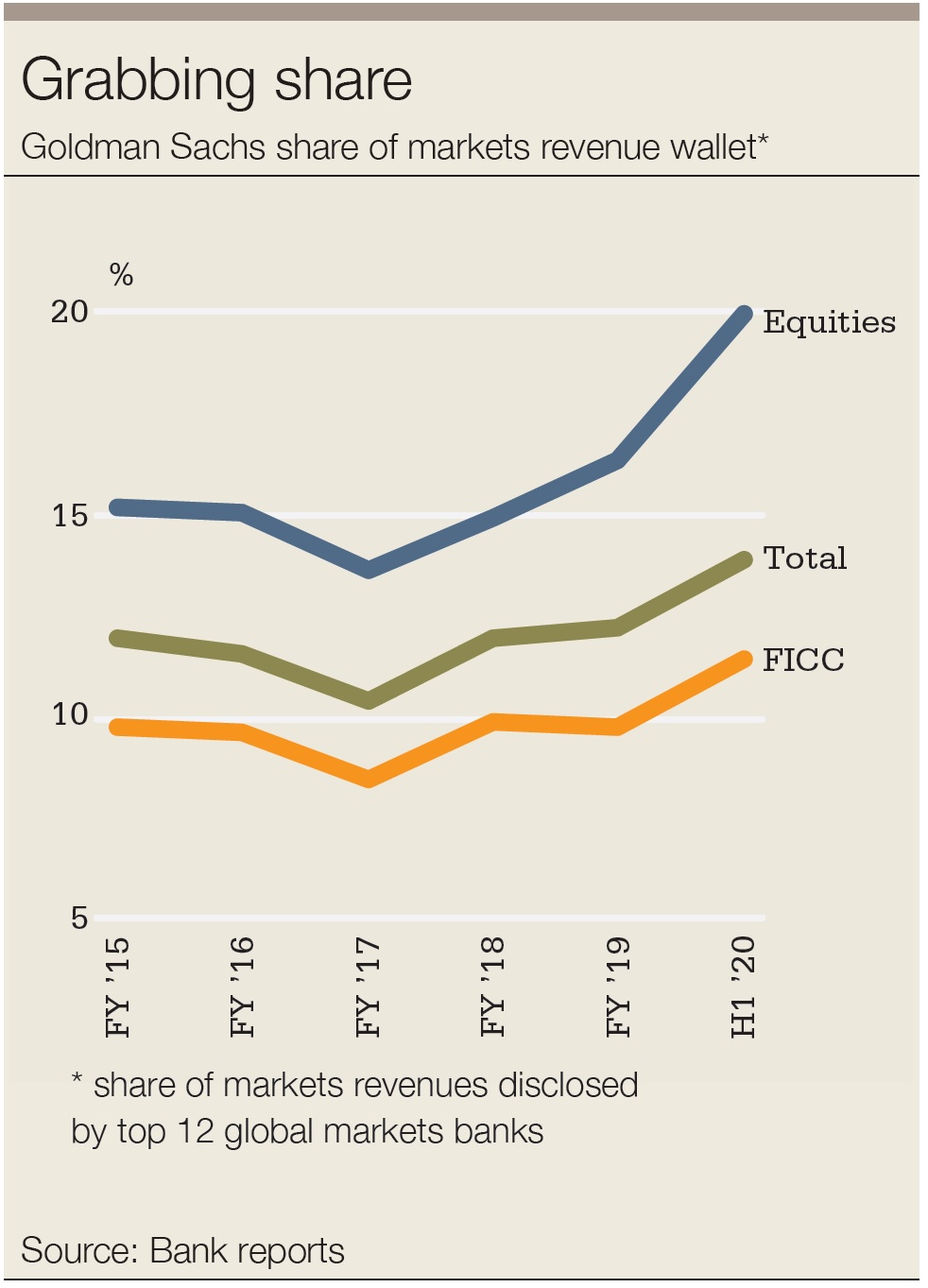
In the 12 months ending June 30, the bank’s ECM revenues jumped 48% to $2.17 billion, giving it a 21% share of wallet among the seven big global investment banks that report asset-class revenues. The $1 billion it reported in the second quarter of 2020 alone was more than any other firm.
Its $3 billion of advisory revenues in the 12 months to June 30 dwarfed any other firm. And the $2.7 billion of DCM revenues over the same period are putting it on track for a record year in 2020. Its first-half results there rose 58% year on year, better than any rival.
“We always tell ourselves that we gain market share in a downturn – and that actually happened,” says Gregg Lemkau, co-head of IBD. “You saw it in our financial results, but our share in all products in financing increased – it did exactly what we thought it would do.”
Lemkau’s co-head, Dan Dees, thinks that part of the reason behind that is Goldman’s reputation for smart thinking when more traditional solutions are not viable.
What we saw [during the Covid-19 crisis] was people turning to their trusted adviser relationships for creative structuring
Dan Dees
“It’s nice when the facts fit the narrative,” he says. “What we saw was people turning to their trusted adviser relationships for creative structuring. It goes back to why firms might achieve incremental market share in a crisis. At some banks it might because they lend more. At Goldman it’s because of our creative structuring and execution excellence.”
Nowhere was that more in evidence than in the deals the bank did in some of the most stressed sectors during the onset of the Covid crisis.
Very early on in the turmoil, United Airlines borrowed $500 million from Goldman through a one-year loan secured on the airline’s spare parts. It followed that up in June with a $6.8 billion bond and loan deal structured by Goldman that saw United pledge its frequent-flyer programme as collateral, after it had scrapped a bond issue in May.
Goldman also led a $2.2 billion capital-raising package for Norwegian Cruise Line, no mean feat for a company whose market cap was about $2.5 billion. The transaction featured common stock, exchangeable bonds, a senior secured bond and a private placement from private equity firm L Catterton.
Goldman bankers think one of the firm’s best attributes is the way in which it can transition seamlessly from one solution to another as conditions change – and it’s the most obvious way in which the One GS principles have already been in place within IBD for years.
“You might start the dialogue in a certain product in a certain format but morph from that entirely as markets open up that weren’t open before,” says Dees. “We can do that because we break down silos, even within investment banking. There’s no sense of: ‘No, my product is X.’”
Deepening the client franchise
If Goldman has had a weak link in its investment bank in recent years, it has been in its markets business.
In its fixed income, currencies and commodities (FICC) business in particular it fell behind in two areas: its client scope failed to reflect the corporate relationships it enjoyed elsewhere and it was too weighted towards intermediation to the detriment of financing.
Solomon’s decree that the bank needed to up its game when it came to the breadth of its relationships with each individual client was especially applicable to the sales and trading business.
“It was a seminal moment,” says Esposito. “Nowhere is the One GS initiative more relevant than in the global markets division. Investment banking was already operating in about as client-centric a fashion as it could, but global markets had scope to deepen its client franchise.”
One of the ways in which it wasn’t doing that was reflected in that balance of intermediation and financing. A typical split at Goldman was 20% of markets revenues coming from financing. At commercial bank peers that could be more like 40%.
Investment banking was already operating in about as client-centric a fashion as it could, but global markets had scope to deepen its client franchise
Jim Esposito
The volatile markets of the crisis period mean that split at Goldman hasn’t shifted yet, because intermediation revenues have soared. But financing in FICC was well up year on year. In the second quarter of 2020, it nearly doubled to $450 million.
If pushing more into financing is such a good idea now, why wasn’t it before?
Esposito concedes that the firm could have moved earlier but also argues that the environment has changed. Those in markets businesses across the Street say that shift is partly down to how electronification is eroding the execution wallet.
“The prior business model was one that was fit for purpose at the time,” says Esposito. “We weren’t big in financing because it wasn’t a big part of the wallet and market intermediation was large and robust. But gradually it became clear that the financing wallet was growing and it was something we were under-represented in.”
Does such a shift carry the danger of taking on too much risk? Esposito thinks not.
“We aren’t in a hurry to grow financing revenues and are mindful of where we are in the credit cycle – a lot of the new lending is secured by a variety of diverse collateral,” he says.
Another problem was a single-minded focus on only the highest margin part of the client wallet, meaning that derivatives took priority over the trading of cash bonds, for example. That is being addressed through rapid development of the bank’s electronic trading business, but the thinking is also playing out in other ways.
Goldman had a rich history in developing risk-management systems that use a wealth of data sources – but chiefly for its own ends. In keeping with its newfound focus on servicing clients better, it needed to open that up.
“We possessed an awesome array of risk-management and analytical tools built up over decades, which we used to manage our own risk, but it was clear that clients wanted access to these same tools,” says Esposito.
Now the firm provides it within its Marquee platform, which Goldman bankers like to describe as its digital store front.
What it all adds up to is a pivot towards a much more balanced approach to client engagement. But it also meant a change of priorities. Traders are hard wired to make money in 10 out of 10 trades; now came the realization that the right ratio might be lower than that.
“It meant doing some trades that might not hurdle,” says Esposito – in other words, no longer looking at exclusively measuring the value of a trade without considering the broader context of a client relationship.
Esposito sums it up.
“Instead of salespeople coming into work saying: ‘What are our traders trying to get done’, they’re now saying: ‘Here’s what our clients are trying to do today’.”
Traders are much more invested in client relationships – some of the biggest trades the bank does now result from a client calling a trader directly.
It is working. The financial results have been shown most starkly through the crisis period, but this has been a multi-year effort. Over four years the firm has gained about 250 basis points of global wallet share across equities and fixed income. With that total wallet standing at about $100 billion, that adds up to about $2.5 billion of incremental annual revenue accruing to the bottom line.
In the first half of the year, global markets revenues rose 59%, more than anyone else on the Street. With $12.34 billion of revenue, Goldman was behind only JPMorgan, which is far ahead of any rival. The leap was driven by FICC, which rose 83%.
Collaborative mindset
Waldron joined Goldman in 2000 – and he thinks the firm is now operating more like it did in the post 9/11 period.
“It feels more cohesive, more joined up,” he says. “It feels more that we are here to serve our clients.”
Euromoney is speaking to him 10 days after the announcement of its $3.9 billion settlement of the 1MDB affair. It was a timely reminder that client-serving and collaborative hasn’t always been the view of Goldman Sachs from the outside – or the reality on the inside.
Waldron must know this, but perhaps it makes One GS all the more rational now.
“There is no question that part of this effort is to convince our clients that we are deadly serious about this, about serving their interests over time, not just thinking about the next transaction,” he says. “That reset is important.”
This doesn’t sound like the Goldman that rivals like to characterize as a tough street fighter, or where single-minded competitiveness is as fierce internally as externally. But Waldron argues that a collaborative mindset has always been at the heart of the firm.
“The biggest hurdle is not culture, it’s behaviour,” he says, choosing his words carefully. “Our culture is to collaborate – that’s what we want to do. But over time, structures and incentives can develop that inhibit that and produce behaviours that are not in line with our culture.”
Part of this effort is to convince our clients that we are deadly serious about serving their interests over time, not just thinking about the next transaction
John Waldron
This shift has needed senior commitment to be effective, but where it really makes the difference, partners argue, is at other levels of the organization.
“Most of the senior leadership group has worked together for 25 years, so I was always less worried about that,” says Esposito, who joined Goldman in 1995 to sell emerging markets debt. “But the groups beneath are also now importantly building those relationships too.”
That matters, because Goldman is a lot bigger now than it was at the time of its IPO in 1999. Back then its headcount was a little over 15,000; now it’s about 39,000.
“If you started after the financial crisis, you wouldn’t have the same depth of cross-divisional relationships,” says Esposito. “That’s where One GS has had a really big impact.”
If in doing all this Goldman is consciously or subconsciously harking back to some historic secret sauce – although its bankers do not tend to characterize the project in quite this way – then what it might be looking to reproduce is the kind of connectivity that emerges naturally in a partnership.
“It’s always been a mantra of the firm,” says Lemkau. “When it was a pure partnership, everyone had an obvious economic stake in that. It has persisted, but over the years it had probably become more divisional.”
Whatever the motivation, bankers say it is working, as demonstrated by the firm’s performance during the coronavirus crisis – not just in the financial results but also in client feedback.
“Clients continue to call on our ability to assemble quickly and efficiently a cross-divisional team to tackle a challenge or an opportunity,” says Esposito. “I like to think Goldman Sachs does that better than others.”
For all its recent forays into new areas that are away from investment banking, Goldman obviously doesn’t face the same exposures as its commercial banking peers. It has – so far – come through the coronavirus crisis with its advisory and capital markets franchises having proved their worth yet again; and with a sales and trading business that looks reinvigorated, and not through luck but judgement.
Its bankers and traders will be called upon to repeat that performance many times before this crisis is over. Waldron seems confident they will do so.
Beyond the crisis, he thinks about longer term, secular issues. He frets about the course of regulation, as do many of his peers. And he recognizes the importance of the firm staying on the balls of its feet on technology.
“That’s not a source of concern, but we have to get it right,” he adds.
Competitors don’t seem to worry him particularly. Is there anything that can throw Goldman off course?
“Getting in our own way.”