Awards for Excellence 2020
|
|

In November 2019, AbbVie priced a $30 billion, 10-tranche bond that was the fourth-largest corporate bond ever. The trade, which backed AbbVie’s acquisition of Allergan, wrapped up an extraordinary financing package by Morgan Stanley.
In a year of startling success, it is just the most striking reason why the firm is North America’s best bank for financing.
The AbbVie bond priced just eight days before the formal completion of another mega-deal, the $74 billion acquisition of Celgene by Bristol-Myers Squibb, the biggest M&A deal ever in the healthcare sector.
Morgan Stanley, as Celgene’s adviser, had put together an equally remarkable package that started back in January with a $33.5 billion bridge loan with joint venture partner MUFG, the biggest-ever single commitment on a deal. That came alongside the syndication of an $8 billion term loan and the refinancing of an existing $2 billion revolver.
The take-out came in May 2019 and comprised a $19 billion, nine-tranche bond alongside an exchange offer for nearly $20 billion of Celgene bonds. Morgan Stanley was lead left bookrunner on the bond and lead dealer manager on the exchange.
|
|
|
Mo Assomull, |

It was in June that AbbVie announced that it was acquiring Allergan. Up stepped Morgan Stanley again; this time underwriting an even bigger $38 billion bridge alongside MUFG, with an additional $6 billion term loan syndication and $4 billion revolver.
The $30 billion 10-tranche take-out came on November 12. It was the fourth-largest corporate bond ever, and the bridge had been the biggest of the year.
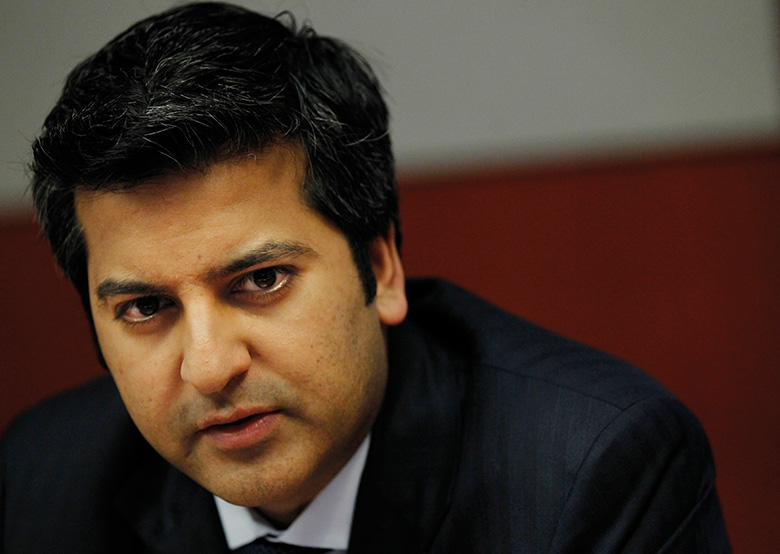
For Mo Assomull, Morgan Stanley’s global head of capital markets, deals like this illustrate one of the bank’s greatest strengths.
“Our ability to provide both unmatched size and an integrated solution to our most important clients is highlighted by the AbbVie and Bristol-Myers advisory and acquisition financing assignments,” he says.
Both deals are also examples of the continuing closer alignment across the bank’s securities businesses that it has been developing for years. Most banks claim holistic solutions – Morgan Stanley is one of the few with an unarguable ability to deliver them.
There were plenty of other transactions, however. The bank racked up just over 1,000 bond issues in the region, some 150 more than in the previous year, and it rose two places to fifth in the volume rankings, making it the top firm outside the money centre flow machines.
It can do innovation too. In its ECM franchise, having led the direct listing of Spotify in 2018, it followed up with the same structure for Slack in June 2019. The day-one spread of just 0.5% between open and close was testament to smooth execution.
And in terms of Covid-19 crisis response, the bank was able to shepherd its clients to market by identifying short windows, even in panicked conditions. Cigna’s $3.5 billion bond on March 4 was a perfect example. It had to navigate a virtual shutdown of the market, but was able to price off the back of an intraday rally in equities and treasuries to achieve historically tight all-in funding costs.