
Illustration: Simon Prades
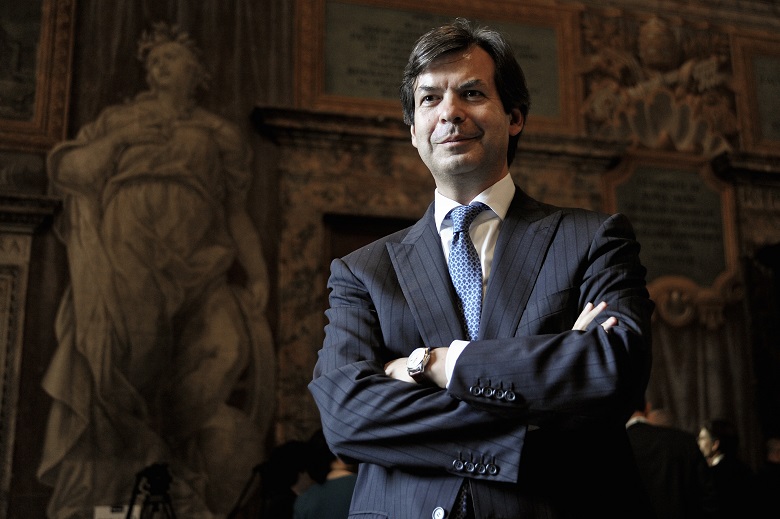
Sitting back after his lunch with Euromoney, Intesa Sanpaolo chief executive Carlo Messina points at the European bank chief executives pictured on Euromoney’s November cover. With some satisfaction, he reels off each one’s market capitalization. They all lead banks that are more international but valued lower, on a price-to-book basis, than Intesa.
His greatest pleasure surely comes when he points at Jean Pierre Mustier, chief executive of UniCredit – still the biggest Italian bank by assets but with a market cap of €26 billion, well below Intesa’s €36 billion.
The battle between Messina and Mustier is more heated than ever, not least because of different attitudes towards their home country, and because UniCredit is catching up with Intesa, especially in terms of its shareholder remuneration.
Unlike Mustier, who is French and has only worked at UniCredit since 2011 (and even then with an 18-month break until he rejoined the bank as CEO in June 2016), Messina was born in Rome and has worked at Intesa Sanpaolo and its predecessor institutions for a quarter of a century. He has been the chief financial officer, chief risk officer and head of Intesa’s locally-dominant retail network, Banca dei Territori.
Intesa focuses almost entirely on its domestic market, while UniCredit under Mustier is more than ever defined by its desire to move beyond Italy, in particular with its commitment to a large business in Germany.
Mustier has fuelled talk of big cross-border mergers on the continent and is now president of the European Banking Federation. Few in the industry outside Italy would immediately think of Messina as a flag bearer for European banking. However, as chief executive, Messina has sought to convince his various stakeholders that Intesa can and should be in the top-tier of European banks.
There’s little disputing, for now, Intesa’s leadership in Italy in terms of domestic market share. And as the European Central Bank cut rates in September, just after Italy’s populist coalition collapsed in August – forcing the Five Star Movement to govern with the more pro-European socialist party – spreads between Italian and German government debt have halved.
“We are one of the few banks in Europe that can continue to deliver very good results on the revenues side” – Carlo Messina, Intesa Sanpaolo
Italian banks’ share prices, including Intesa, then markedly outperformed their peers across Europe in 2019, not least because of the accompanying boost to their local government debt holdings.
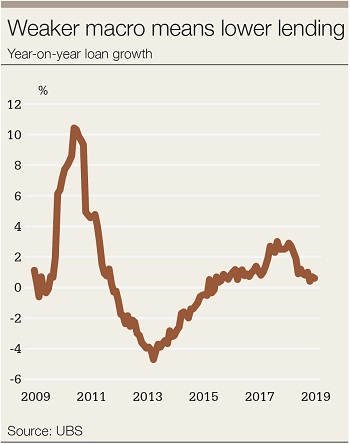
Slower growth and deeper negative rates at the ECB are seriously detrimental to the credit volumes and margins of Intesa and other Italian banks. But it is not as damaging as in Germany, despite German banks’ cost of equity being slightly lower. Moreover, Messina says Intesa’s efforts to be more of a wealth manager than a deposit gatherer and lender become much easier at a time of falling Italian sovereign spreads.
“In an environment of very low interest rates, we are one of the few banks in Europe that can continue to deliver very good results on the revenues side,” he asserts. “Our net interest income is affected, but we can have significant benefits in terms of fees and commissions.”
Intesa has grown fee income faster than other Italian banks over the past five years by getting its customer base – the biggest in Italy – to switch to its investment products, including mutual funds and life insurance.
Peers say Intesa’s salespeople have been better at nudging clients into wealth and asset management products when they have a government bond coming to maturity or a lot of money in cash deposits. This is largely thanks to its large and relatively old private-banking arm, Fideuram.
“Our main job of the past few years has been to create a top-class wealth management company,” says Messina. He says the group is now much more weighted towards the wealth it manages, about €1 trillion, than its roughly €400 billion in loans. “Our business model is to manage wealth of a volume that is a multiple of our lending.”
He even makes UBS sound like his closest peer. Although Intesa’s business is much less international and less about the super-rich, it is not far off UBS in terms of net income, at around €4 billion in 2018.
Messina says the shift to wealth management speeds up when rich Italians are more confident about the local stock market – and especially when they have no mark-to-market losses on their government debt portfolios.
“In this phase of the market – as in the last quarter – the growth of our commissions accelerates,” he says. “It’s the result of a very effective machine for converting deposits and assets under administration into assets under management in market conditions when there’s a contraction of the BTP-bund spread… When the BTP-bund spread increases, we see a reduction of wealth-management growth. There’s growth in deposits instead.”
|
|
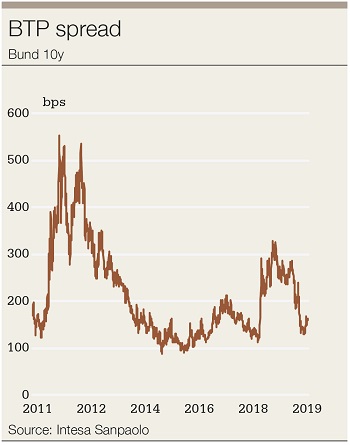
Over the past decade, Italian government bonds have seen their perceived risk rise but their yield fall. Domestic government bond investors, having enjoyed mid-single-digit returns at the end of the last century, now barely earn 1%. That’s forcing them to change their habits, as the owners of wealth in Italy tend to be relatively old, mostly over 60, so they depend on their investments for their income.
The cost to savers of leaving hundreds of thousands of euros on deposit is now rising further, as banks (including UniCredit) are starting to charge negative rates. Italian banks, including Intesa, are already charging higher fees on current accounts to offset negative ECB rates.
Better starting point
All this is crucial for Messina’s efforts to prove that an Italian bank, or at least an Italian wealth manager, is a relatively attractive investment, especially if it’s strong in northern Italy. Italy has a similar level of household financial wealth to France and Germany, according to Allianz, although on a GDP-per-capita basis it’s much closer to Spain.
Italian family wealth amounts to about €10 trillion, of which €4 trillion is in financial assets, mostly concentrated in the north of the country. Messina notes, Italian savers have not turned as much to wealth and asset management products as their counterparts in the UK and even France. “Italy has one of the lowest levels in Europe of assets under management compared to family wealth, so there is room to grow, including at Intesa Sanpaolo,” he says.
According to Messina, foreign ignorance of the latent advantages of Italy and of Intesa meant few outsiders thought he could achieve the dividend payouts he promised five years ago when he became chief executive. Although there’s some debate (especially by rivals) about how much it has been able to afford it thanks to one-off sales of various non-core businesses, the bank has paid out more than €3 billion in dividends in each of the past three years, while it has offloaded about €30 billion of non-performing loans.
“Italy is not a weak country; it has a lot of public sector debt but a lot of assets and wealth,” Messina argues. “When you work with the triple-A part of Italy, an area that’s comparable to the best parts of Germany, you can create something that’s really special for international investors.”
|
|
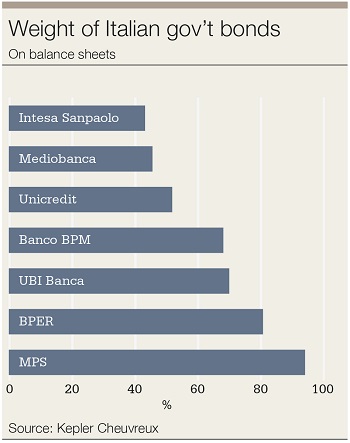
Warming to his theme of how an Italian bank can surpass and equal its peers, he points to Intesa’s better performance than other big European banks in European Banking Authority stress tests, demonstrating the relative strength of its capital. Crucially, he adds that Intesa’s securities book is much less complex than banks with bigger international capital markets businesses. Domestic sovereign debt makes up about 40% of Intesa’s government bond portfolio, but this is not particularly out of sync with other eurozone banks and relatively low in Italy according to Kepler Cheuvreux.
Much of Intesa’s success, he admits, is down to a better starting point. Of the two big bank mergers in Italy in the middle of the last decade, Banca Intesa’s merger with Sanpaolo IMI in 2006 arguably created a better franchise and loan book in terms of its geographic distribution than UniCredit’s acquisition of Rome-based Capitalia a year later. “We are the combination of a number of very good banks in Italy,” says Messina. One legacy is a better reputation as a credit underwriter among some analysts, even today.
Intesa Sanpaolo avoided the worst excesses of international acquisitions going into the 2008 crisis. By contrast, UniCredit’s purchase of Kazakh lender ATF for $2.1 billion in 2007, sold for €500 million in 2013, was particularly notorious. That has contributed to its relative freedom from the intense constraints that other Italian banks have suffered, including UniCredit.
Messina was in right place at right time when the Italian government was desperate for a white knight to take over Veneto Banca and Banca Popolare di Vicenza two years ago; eventually paying Intesa Sanpaolo €5.2 billion to take over the best parts of the floundering mid-tier banks. While other Italian banks would have liked to take Intesa’s place, none of them could elicit enough trust in their financial strength for a takeover at the time.
That deal has given Intesa a much larger share in Italy’s wealthy northeast, adding to its existing strengths in the area around Milan, Lombardy, and so putting it even further ahead of UniCredit in the two most attractive regions in country.
Reliance on acquisitions
The bank’s corporate and investment bank – like its BTP holdings – demonstrates how the focus on Italy only goes so far as is practical. There are concerns about Intesa’s lack of scope for organic growth and therefore the extent that it relies on acquisitions, including loan portfolios.
This is the reason that bearish analysts at Berenberg use to explain Intesa’s purchase of a €900 million performing mortgage book from Barclays in late October – and the increases in Intesa’s government bond portfolio in 2019. In late 2018, Intesa switched management of its securities portfolio from its treasury division to its investment bank, Banca IMI, and then transferred to it around €20 billion of excess liquidity parked at the ECB.
Messina says its corporate and investment bank can do much more than hope for more trading gains from domestic and international securities. First, there is a rise in the bank financing needs of companies that cater to internal demand in Italy, thanks to a more positive trend in domestic consumption over the past six months. “There’s a reduction in unemployment and an increase in family disposable income in Italy,” he says.
However, export-orientated companies are much more important customers for banks in Italy. Italian bank deposits have risen over the past two years, in large part thanks to corporate clients. Messina says that’s evidence of the health of the sector.
|
|
“Italian companies are probably the best in Europe. They are the survivors of the crisis. They are now top players, especially in the export-related areas; investing in research, in training. In the past five years of crisis, they have changed the financial structures of their balance sheets, increasing equity, increasing medium-term financing. Today if you look at the real economy in Italy, the corporate sector is probably in better shape than in Germany and in France.”
But the increase in deposits also betrays these firms’ worries. “Today these companies are postponing investments until they have a better understanding of what could happen in Italian trade, growth in China, in the US, in Germany,” says Messina. “The majority of Italian companies have excess liquidity, so if you want to increase loans, it is much better to go to good international players than to wait for the Italian situation.”
That’s why he’s investing in debt capital markets and lending with international clients – hiring from rivals to bolster coverage teams outside Italy, with a particular view to scaling up in countries such as Brazil, Turkey and UAE, where it has recently opened branches or subsidiaries. “We will never be Goldman Sachs, JPMorgan or BNP Paribas in terms of relations with big international clients, but moving from zero to €50 million in revenues in this business is important for us,” he says.
“We use the relationships we have through our branches outside Italy, but our main strength is Italian companies that are working outside of Italy. In a strongly export-orientated country, many companies have international suppliers, an international network. We are leveraging on the Italian companies that work outside Italy and the major clients of these companies. It is a realistic approach.”
More competition
In Italy, to the extent that the local banking sector is no longer in crisis and banks have made progress on cleaning up their balance sheets, Intesa might not have the same free run it has enjoyed over the past five years in the competition for clients and investors.
Mustier has given UniCredit a new lease of life after a €13 billion capital raising in 2017, cutting costs and risks faster than anyone thought possible. Despite the impact on revenues of a slowing economy and lower interest rates, tighter BTP spreads could also allow other Italian banks to bridge the gap to Intesa’s 80% pay-out ratio. In December Mustier announced his intension to launch UniCredit’s first share buy-back in over a decade. Banco BPM, Italy’s third-largest bank, also revealed its hopes to pay a dividend for 2019, the first since its formation two years ago.
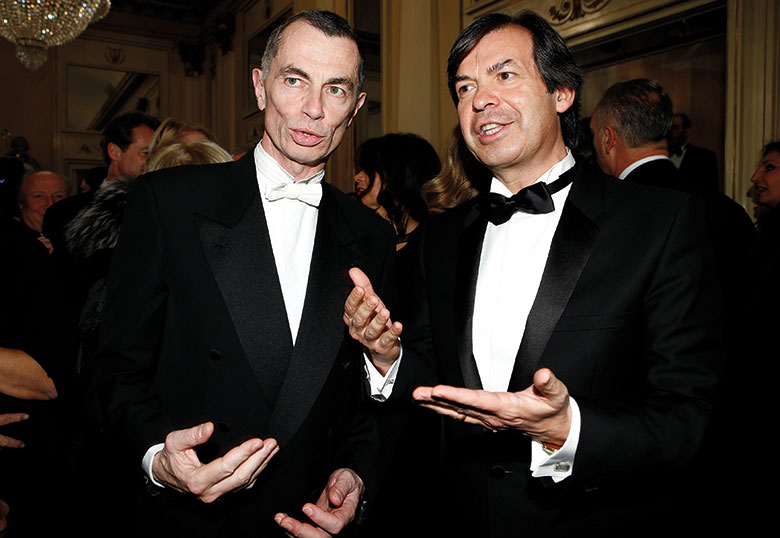
Messina and Jean Pierre Mustier, head of UniCredit, are battling to be seen as Italy’s leading bank
Across Italy’s financial sector, the hope is that Matteo Salvini has fallen out so definitively with the Five Star Movement that his Northern League party will need to partner with the centre right if he returns to government, while the Five Star Movement will still depend on the Europhile centre-left.
Partly because of its high level of household wealth, Italy is now becoming similar to Japan, in Messina’s view. The economy won’t grow by more than about 1% and it won’t fall much either in the absence of a politically driven sovereign debt blow-up.
“Italy is probably more resilient today than other core European countries,” he says. “We have limited optionality for growth, but in a negative scenario there is a significant resilience in the country. If you compare the GDP of Italy and Germany in the last two or three years, growth Germany was 2%, 2.5%, Italy was 1%, so a gap of 1.5%. Today Germany was at 0.5% in the last quarter. Italy was 0.2%, 0.3%. It was not minus 1%, minus 1.5%.”
Claiming similarity to Japan is not much of a boast. Yet it is important as Messina thinks a downturn will not lead to the kind of bad debt mountain created in Italy earlier this decade – unless there is a very deep recession – despite the much longer time it still takes to realize collateral in Italy compared with the rest of Europe.
“We would not have the dramatic situation of the past,” he says. “It would be very difficult to return to the situation of 2011. At the time, corporate liabilities to the banks were mainly short term and the companies were less diversified. Today most companies are well diversified and the composition of their financing is much more towards equity and medium-term financing.”
Intesa has reduced its NPL book by about €20 billion over the past two years, largely helped by the past year’s €14 billion of private equity disposals and servicing agreements. However, the proliferation of these deals in Italy since 2017 has also allowed UniCredit, Banco BPM and the smaller mid-tier lenders to get ahead with their cleanups. That could facilitate more consolidation in the sector, especially if the EU green lights a planned state-backed NPL disposal by Banca Monte dei Paschi di Siena.
“There will be more concentration in the asset management sector. Over the next five years, only the big players can be sure to be winners.” – Carlo Messina, Intesa Sanpaolo
Italy is supposed to be handing back Monte dei Paschi to the private sector by 2021, after its 2017 nationalization. A combination with UBI Banca, the most likely merger candidate, would create the third biggest bank in Italy, with a bigger market share in the north than UniCredit and a relatively strong franchise in wealth management and insurance distribution. “They could invest to become new Intesa,” says a financial institutions investment banker.
That’s a distant threat. In any case, aside market share, Messina and indeed many of his rivals point to another fundamental advantage in Intesa’s ownership of its insurance and asset management product factories. This is in contrast to those banks that have sold them to raise capital – for example, the 2017 sales of UniCredit asset manager Pioneer to Crédit Agricole’s Amundi and Banco BPM’s Aletti to local fund house Anima.
However, as their NPL problems become less pressing, other Italian banks should have more time and money to develop their wealth management businesses. At the higher end, Italy is also an enticing market for foreign private banks. BNP Paribas, which owns Italy’s sixth biggest bank, announced a new wealth management growth strategy in Italy in October, seeking to join the rush after what it said is already a 60% growth in assets under management nationwide since 2012.

Meanwhile, local platforms combining advisory networks with online banking and brokerage services are gaining market share in Italian wealth management and attracting more investment from their shareholders. Notable among these are Azimut, Banca Generali, Mediobanca’s CheBanca! and FinecoBank (the latter is now fully independent after a market sell-down by UniCredit in May). UBI and Monte dei Paschi own similar platforms, IWBank and Widiba, respectively.
One thing in Intesa’s favour is that bank clients in the mass market, especially the older generation, are slow to change their counterparties. There are longer-term doubts, however, about the competitiveness of Intesa’s in-house factories, especially as it becomes easier for clients to access better value and more varied products from international players with greater economies of scale. That’s why Messina started to look in 2018 for a partner for Intesa’s asset manager, Eurizon, although rumours of a tie-up between Eurizon and BlackRock have come to nothing.
Hopes for partnerships with other asset managers in Europe have also resulted in stalemate, due to a common desire for control.
“There will be more concentration in the asset management sector. You need to reduce prices and give the best performance to your clients. Over the next five years, only the big players can be sure to be winners. We decided to play a part in this, as a leader, but you need a counterparty and today everyone wants to be in a leading position… Targets are limited and prices are high. Other players are reluctant to make disposals, because they also consider these businesses strategic,” says Messina.
Staying with Italy
Intesa Sanpaolo’s nationality will always be a comfort for its appeal as a guardian of Italian wealth and as a partner for Italian business, according to Messina.
“We carry the Italian flag. For Italian clients staying with Intesa Sanpaolo means staying with Italy. It’s the main factor differentiating the bank from competitors, whether they’re from inside or outside Italy. Our clients can feel proud to have money with Intesa Sanpaolo.”
This is why he thinks Intesa’s corporate social responsibility activities are so important, particularly in a country where the public sector is so stretched, where there is so much old art to maintain and where the decline in real incomes has pushed millions of working people into poverty, fuelling populism. As part of its emergency aid programme in Italy, for instance, the bank has handed out more than six million free meals since early 2018. It also put its own vast art collection at the centre of a new public exhibition and restoration programme last year.
“We are, by definition, a national champion; we are a pillar of the real economy and society in Italy,” says Messina. “Our corporate social responsibility plan has reinforced the reputation of the bank among the Italian people.”
 |
| “Italy is not a weak country; it has a lot of public sector debt but a lot of assets and wealth” – Carlo Messina, Intesa Sanpaolo |
Similar comments by the bank at the time of the Veneto and Vicenza takeover further illustrate the importance of its image as a defender of Italian interests. Intesa said at the time it saved “serious social consequences” from a compulsory wind-down of the banks.
“This intervention will safeguard the jobs at the banks involved, the savings of around two million households, the activities of around 200,000 businesses financially supported and, therefore, the jobs of three million people in the areas which record the country’s highest economic growth rate,” it said.
Intesa’s image as a good Italian could be even more important if it reconsidered an acquisition of Generali – Italy’s biggest insurer and one of the jewels of its financial sector alongside UniCredit and Mediobanca. A merger didn’t get off the ground when Intesa considered it in early 2017 as the bank couldn’t justify the benefit to shareholders, but the interest was serious enough for Generali to take a 3% stake in Intesa as a defensive measure.
Since then, their share prices have gone in opposite directions and not in Intesa’s favour. Nevertheless, some investment bankers think they might have another shot at selling the deal, as billionaire Leonardo Del Vecchio’s arrival as the biggest shareholder in Mediobanca could encourage a shift in the latter’s attitude to its stake in Generali, in which it is the biggest shareholder with 13% and in which Del Vecchio is another major shareholder, with 5%.
“We are, by definition, a national champion; we are a pillar of the real economy and society in Italy” – Carlo Messina, Intesa Sanpaolo
In 2017, analysts pointed to potential anti-trust concerns over a Generali-Intesa deal in the relatively concentrated Italian life insurance sector. A deal would be more feasible if Generali were broken up. Intesa’s involvement could then be vital for the Italian state’s buy-in, notes one investment banker, as the government could be persuaded Italy was keeping hold of another national champion, one that is also a large subscriber to government debt, if the bank bought hold of the lion’s share of the insurer.
Messina has already opened up insurance as a new front in his fee-generating drive, to get Italians to do more with their money. Intesa is close to Generali’s leading share of life insurance but not in property and casualty insurance. Alongside wealth management, this is one of the most important revenue-growth engines of his 2021 strategic plan.
Intesa has already moved from zero to 9% penetration of its clients in property and casualty insurance, making it the ninth-largest provider of this product in Italy. He thinks the bank can reach the top quartile in two or three years, as it moves closer to 20% penetration. If it got to 30%, it would be the biggest in the country, surpassing Generali. “We are accelerating our penetration with clients and more than doubling premiums every year,” he says. “In the property and casualty sector, we can become a leader and we are becoming a leader, as we are increasing penetration.”
The key lies in exploiting Intesa’s client base and distribution channels, including more than 20,000 relationship managers. Unlike life insurance, where banks dominate distribution, agents have previously tended to distribute property and casualty insurance in Italy. The logic of Intesa’s growth in insurance is to change that dynamic, which limits the potential synergies with Generali. This way round, Messina insists, bancassurance can work.
“You can be a pure insurer, like Axa or Generali, or a player that leverages on your network and relationships with your clients, to offer them insurance. You can create a strong insurance company in the bancassurance model when you have strong distribution power and a strong network, and strong relations with clients.”
That also means there would be less sense trying to grow as an insurer in France or Germany, or anywhere except Italy and the odd central and eastern Europe country where it owns banks of local importance. “We can become the number one insurance company in Italy – but not outside of Italy,” he says. “Insurance is a business of scale, but it depends on your scheme of distribution… Acquiring an insurance company outside Italy cannot bring us value in places where we don’t already have a network.”
Is there any chance of Intesa acquiring an insurance company? “An acquisition would be to fill a gap on the product side. Today we are investing a lot in our product factory and in training our people, so we don’t need an acquisition to grow.”
And there’s no possibility, he says, of a Generali acquisition. “We are working to create the strongest competitor to Generali in property and casualty insurance. We are investing a lot in this. We are doing it by ourselves. We decided it would be better for our shareholders to invest in our ability to leverage the distribution of Intesa Sanpaolo, adding our own factory for property and casualty products.”
A leader in Europe
Even if Intesa doesn’t need to be a national champion so the state looks more favourably upon any future designs it might have on Generali, it is still useful to be seen as defender of the domestic economy, business and society.
Being an object of national pride, for Messina, clearly makes business sense. “When I became chief executive, I promoted the idea that we could become a leader in Europe, to demonstrate that Italians can be leaders in Europe,” he says. “We are outperforming not only Italian banks but also most European banks… We have become not only one of the strongest banks but also one of the strongest insurers and probably the leading player in corporate social responsibility in Italy.”
Italy’s banking foundations remain big shareholders in Intesa and those foundations’ status as charities – funding emotive regional projects – adds regional political clout. Two such bodies, Compagnia di San Paolo in Turin, with a 6.8% stake and Cariplo in Lombardy, with 4.4%, are still important power brokers at Intesa Sanpaolo.
Their holdings have remained more stable than at UniCredit, whose repeated rights issues have diluted the foundations’ stakes. Nevertheless, international institutions (notably BlackRock) have risen up the shareholder lists of both banks this decade.
Messina is therefore eager to stress that the bank’s own corporate social responsibility agenda is a by-product of its financial returns.
“When we were preparing the business plan in 2017, we asked ourselves what could be the difference between Intesa Sanpaolo and other players in the market,” he says. “A lot of our international shareholders asked for us to look at this area, as one of the very important jobs of a company. Provided that you can create value for shareholders, you can also look at how you can add value to the community.”