In July, even before US steel tariffs had sparked the sharp sell-off in Turkish lira that then spread its tremors across emerging markets (EMs) and risk assets from commodities to equities, strategists at Bank of America Merrill Lynch (BAML) were pondering potential winners from rising political populism.
They suggested that the inability of monetary and fiscal policy, global synchronized recovery and record corporate profits to create sustained wage growth means investors must discount more protectionism, redistribution and ultimately debt monetization via central banks in coming years, trends that a recession would dramatically accelerate.
And where should we put our money, then?
“Gold is the secular beneficiary of the war on inequality,” suggest the BAML strategists, noting it would be one big winner from the ultimate act of political populism – at least as it impacts financial markets – namely ending central-bank independence.
The topic of investing in gold has always evoked unusually strong emotions and strident views both among promoters and sceptics.
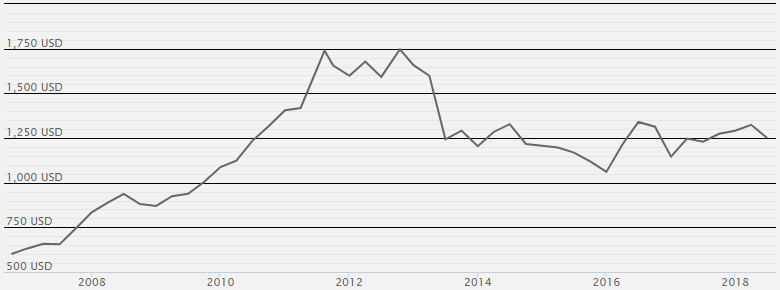
Gold price (USD)
Source: World Gold Council
Gold performed strongly in 2008, rising 4.3% in a year when the S&P 500 fell 37%, EM equities fell by 53%, investment-grade bonds fell by 8.3% and high-yield bonds by 28%. It also outperformed developed market and EM equities in 2010 and 2011 when the financial crisis spread to eurozone sovereigns.
More recently, it has underperformed, being down in the first seven months of 2018 on an annualized basis by 11.2%, worse even the MSCI EMs, which were down 11% while the S&P 500 was up 11%.
Bank of America notes that gold had fallen by mid-summer 2018 to its lowest level versus the S&P 500 since 2002.
Does that signal a cheap entry point for the traditional hedge against financial market crises or, as those who denigrate gold as an investment argue, has it lost that role and begun to behave like a poorly performing risk asset itself?
|
|
|
Sylvia Carrasco, |

“Gold will prove itself again,” says Sylvia Carrasco, founder and chief executive of Goldex, a mobile phone-based app for retail customers to buy and sell small amounts of physical gold while achieving best execution.
Carrasco is a City veteran who began her career trading convertible bonds at Credit Suisse in London in 2000 before joining its first electronic equities trading desk and then going on to develop trade-execution algorithms to split customer orders between different liquidity pools so as to achieve best volume-weighted average price.
Carrasco worked on the FIX protocol and went on to Man Financial, before leaving MF Global, as it was by then known, in 2009 to set up Alion Partners, the first FCA-regulated company advising institutional investors and banks on electronic and algorithmic trading and best-execution rules brought in by Mifid.
Long before Mifid II came in at the start of this year and even while Alion Partners thrived, Carrasco was already looking for her next challenge.
Opaque
Together with co-founder Fernando Ripolles, a veteran of electronic and algorithmic trading at UBS and Nomura, Carrasco saw a chance in 2015 to bring these modern trading approaches to the opaque market in gold – a market where none of the investor protection rules familiar in equities and bonds applies and the traditional intermediaries display a marked agent and principal conflict when executing customer orders.
Carrasco tells Euromoney: “I began trading gold for my own account and was very surprised at what I found. You can go online and buy gold. But the model of all bullion providers is – to date – that of trading as principals and market makers.
“I don’t have an issue dealing with market makers in a regulated environment, but in an OTC and unregulated market, this potentially opens the door for customers to suffer investment abuse.”
Carrasco explains: “The absence of a regulator watching over their trading activities means that bullion providers don’t have to abide by Mifid European directives. A clear example is how all financial institutions in regulated asset classes must provide best-execution prices when they execute orders on behalf of their customers.
“When buying physical gold, by contrast, bullion providers are free to execute at whichever price, to modify prices as they have visibility on their customers’ orders and basically front run their flows. There is no regulation that requires their own and customers’ flows to be separated. There are no Chinese walls.
She adds: “Most of them would also be unclear about their quoted prices. I would ask them: ’What is this price you’re giving me?’ Sometimes, I would be told: ‘It’s the mid-price.’ But when I wanted to know the bid-offer spread they would not be able to give me an answer.”
It’s a pretty damning description. “I call that opacity at its very best,” says Carrasco.
Would I put some of my mothers’ life-time savings into cryptos? No, I wouldn’t. But I did put some of her savings into gold… and I consider myself to be a good daughter – Sylvia Carrasco
And it’s not just retail buyers that face this. She continues: “I have sat in the office of a big institutional investor wanting to deal in gold, who had to pick up the phone and ask around for a spread on a 10kg physical gold buy order. It’s like dealing in equities 30 years ago when we all had to pick up the phone to buy shares in a FTSE 100-listed company.”
How do you bring customer protections and best-execution methods familiar in equity, fixed income and now foreign exchange to an unregulated investment market?
One way would have been to set up an exchange-like venue, perhaps buying the underlying technology stack off the shelf. But who would provide the liquidity?
Liquidity
“We could build a beautiful football stadium,” Carrasco says. “But what’s the use of that if there are no players on the pitch? I have seen first-hand how long it takes to develop and attract liquidity in equities and in other asset classes, so we began looking for providers out there that might already have peer-to-peer exchanges.”
 |
|
Fernando Ripolles, Goldex |
Carrasco and Ripolles set out to build an agency-only broker that would apply the skills and technology they had developed in regulated markets to offer best execution to app users, across the five major gold liquidity pools seizing the best price or splitting orders between London, Zurich, New York, Singapore and Toronto.
Goldex was set up with around £800,000 of angel investment, some from former colleagues in the City, and launched its app in July.
Confident in their trading algorithms, Carrasco and Ripolles have made a big effort on the user experience, initially targeting retail investors.
Carrasco says: “With the coming of Brexit and the rise of Trump, we are seeing independent financial advisers in the UK increasingly coming to the view that clients should hold from 5% to 10% of their assets in gold. That is one reason why gold providers are enjoying strong results.”
Users download the app and transfer a certain amount of cash into a segregated Goldex client account, undergoing know-your-customer verification in the process.
The price of gold is usually quoted in ounces. It stood at $1,179.65 per ounce on August 16, or $37.93 per gram. Often quoted in dollars, the spot price of gold will therefore typically show an inverse relationship to the US currency.
Goldex, for now operating in London, quotes in sterling for amounts of gold down to the microgram.
If an investor wants to buy £100-worth of gold, they can enter a so-called smart buy. The app will scour the main markets and buy the most gold it can for that sum either from one centre or, by splitting the order, between several, depending on available liquidity. It’s all done in the blink of an eye.
Goldex charges a 75 basis point commission. Because it deals in physical gold, not exchange-traded funds or contracts for differences, investors must also pay a vaulting and insurance charge to hold gold securely of 2bp per month, subject to a minimum of £3.75.
Say the investor buys gold at £31.20 per gram and ends up owning 3.205 grams. A week later the investor enters a smart sell order. The app raises the most money it can by splitting that sell to the markets showing the best price.
 |
| Goldex logo |
Carrasco tells Euromoney: “When I meet my old friends from the equities markets and tell them I’m building an agency-only broker, the typical reaction is: ‘Is that it?’
“They don’t realize how revolutionary it is in gold to have an agency broker that doesn’t own gold, doesn’t impact the price, isn’t conflicted, that strictly segregates client money and orders. And then when we bring the algorithms and best execution as well, that offers real value.”
Euromoney meets Carrasco in between calls and presentations with venture capitalists as Goldex seeks external funding to build out the business further. She explains the comparable experience she has just been through with one venture capitalist looking at a traditional gold provider.
“I wanted to buy £100 of gold. The first thing this provider told me was I would have to spend a minimum of £124.60; I could not just spend £100. Their best-value package was showing a price of £34.07 per gram buying a three-gram bar. At the same time, Goldex was showing prices of £30.35 per gram.
“Using that dealer forced me not only to have to spend more than I originally wanted – at Goldex we will deal in micrograms and investors are not required a minimum size to invest, as we go down to the penny – but I was paying a hefty premium of £3.72 more per gram of gold purchased.”
She adds: “Let’s do the math: I was paying £11.16 more for the gold and an enormous commission of £22.39. At Goldex our commission would have been just 68p. I would have bought the same three grams of gold for an all-in price of £91.73 instead of £124.60. That’s enough difference to get an extra gram for free.”
Our goal is to become the first provider that generates alpha automatically for its customers just by using our smart technology – Sylvia Carrasco
Gold is usually marketed as a strategic allocation, a hedge either against inflation or financial market crisis that it makes sense to buy and hold for the long term.
That’s certainly part of the traditional pitch to retail buyers, but Carrasco also has an eye on the institutional investment market, on short-term traders and the opportunity identified by modern-age trade execution algorithms to arbitrage away sometimes glaring inefficiencies in a market with such an old-fashioned infrastructure.
There are times today when you could buy at £30.12 in one market and instantly sell at £30.13 in another.
“Gold has not yet developed its potential as a speculative asset class for all type of investors,” Carrasco says. “But now that we are bringing algorithmic trading tools for the first time to this market, our customers will be able to benefit from arbitrage opportunities.
“Our goal is to become the first provider that generates alpha automatically for its customers just by using our smart technology.”
Growth
If the long-term aim is to target institutional investors in gold, the immediate next phase of Goldex is to grow in two ways: by adding features and going into new geographies in Europe and beyond, one obvious possibility being India.
The firm now provides third-party trade recommendations, research from leading commodities advisory firms such as CPM Group and news feeds from 350 sources reporting on gold. It allows users to let limit orders rest to buy or sell at a certain price for a set time, so they can act on these trade recommendations or have them executed smartly when the limit price is hit.
It is also set to provide a pre-paid card which will let customers use the value of gold and cash in their accounts to buy stuff at the shops, using the firm’s algorithms to secure from the least amount of gold possible the funds needed to make a purchase.
Carrasco suggests that this is the clear evidence that gold can be a practical and instant medium of exchange.
“The rise of cryptocurrencies has shown the extraordinary hunger for alternative assets,” Carrasco says. “And gold is the ultimate cryptocurrency. It is decentralized. The price is not set by central banks and nor can they print it. More gold can be mined, of course, but it has been a store of value for thousands of years. It will never go to zero.
“I am not sure I share the same views about cryptocurrencies especially when it comes to wealth protection qualities. Would I put some of my mothers’ life-time savings into cryptos? No, I wouldn’t. But I did put some of her savings into gold… and I consider myself to be a good daughter.”
If gold remains one of the places investors run when a crisis hits, it remains to be seen when the next spike will come and what will trigger it.
“I’m an equites person,” says Carrasco. “If you don’t think equities are set to correct, I have plenty of former colleagues I can introduce you to who will share their view off the record.”
Carrasco is Spanish. She has made her home and career in London and Euromoney meets her in a typical fintech office close to Old Street roundabout.
She asks: “Do you know what the most Googled query was in the UK, on the day of the Brexit vote?” Unfortunately, Euromoney does know all too well. It was: “What is the European union?”
Carrasco ignores our embarrassment and continues: “Now, do you know what the second most Googled question was?” We don’t.
She answers for us. “It was: ‘How do I buy gold?’”