Awards for Excellence 2018
|
|
|
|

Mutual banks and publicly owned savings banks continue to dominate much of Europe’s SME banking sector. What makes Crédit Agricole stand out is not just its deep presence in this market but also its success plugging regional businesses into specialized product factories at the centre. Crédit Agricole is France’s biggest bank brand for SMEs, but unlike other big operators in this sector such as BPCE, the Crédit Mutual network or Germany’s Sparkasse, it has the benefit of better integration between the group’s components.
Banking SMEs is a key pillar of Crédit Agricole’s 2016 to 2020 medium-term plan. As the French economy picked up, Crédit Agricole’s lending to these clients – approaching €100 billion for the group – saw strong growth from the second half of 2017, especially at LCL (formerly Crédit Lyonnais), reaching about 8% growth group-wide. Its highly profitable Italian bank also has more than €4 billion in SME loans.
 |
|
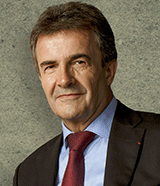
Philippe Brassac, CEO of Crédit Agricole SA |
This is not just about the size of the network and the balance sheet, however. Particularly since Philippe Brassac’s appointment as chief executive of Crédit Agricole SA in 2015, better cooperation within the group has helped advance its status as a digital bank (it now has more web and app users than any other French bank). Cash in Time, for example, launched late last year by Crédit Agricole Leasing & Factoring, offers mobile invoice financing within 12 hours for clients of the regional mutual banks and LCL. Crédit Agricole corporate and investment bank also pays more attention than most of its peers to SMEs and mid-caps. It is top of the euro private placement ranking, according to Dealogic. There is also Sodica, the group’s corporate finance specialist for SMEs and mid-caps. Sodica’s deals during the awards period included the acquisition by industrial group Hiolle of Ocam, a cable supplier to the likes of Safran and Dassault; the entry of ink firm Encres Dubuit to the Euronext Growth market; and a private equity financing for holiday homes company Nemea – all companies with turnovers in the low tens of millions of euros.
Crédit Agricole’s deployment of equity capital for SMEs is well established, and this year it allocated another €300 million for such financing, under Crédit Agricole Régions Développement. Separately, Crédit Agricole arranged a new €1.1 billion agreement with the European Investment Bank group, including an €830 million synthetic securitization and a guarantee facility for equipment leasing.




