The last five years have seen a lot of change at Renaissance Capital. Since the departure of its legendary founder, Stephen Jennings, Russia’s best-known investment bank has had its headcount slashed, shuttered a clutch of global offices and opened a few new ones, and cycled through senior management at a dizzying pace – all against a backdrop of sanctions and recession in its home market.
What has emerged is a smaller, more modest business than either the emerging markets giant envisaged by Jennings or the emerging Europe, Middle East and Africa specialist proposed by Mikhail Prokhorov’s investment vehicle Onexim when it took over Renaissance in late 2012. Operations in Asia have long since been abandoned, while a more recent push into the Middle East appears to have fizzled out.
Even on its home turf, Renaissance has lost ground. Once the go-to house for Russian equity placements, the firm managed to secure just a handful of the dozens of mandates that emerged last year on the back of an improving economy and rising oil prices. Similarly, a once-mighty M&A franchise has all but disappeared.
Some things, however, do not change. Despite setbacks on the continent, Africa remains as much of a priority for Renaissance today as it was in Jennings’ time. Outposts in unlikely markets such as Zimbabwe and Ghana may have been axed in the name of cost-cutting and common sense, but the African growth story is still central to the firm’s business model.
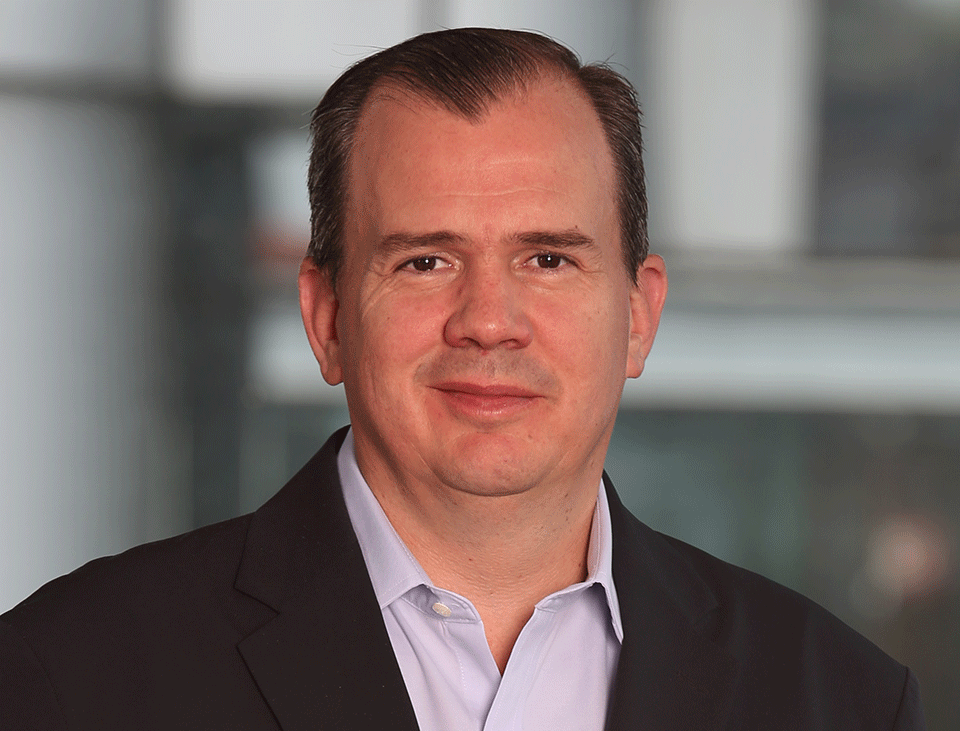
“It’s just a question of demographics – at the end of the day it’s all about consumerism, how quickly purchasing power will grow,” says Ruslan Babaev, one of Renaissance’s two new chief executives.
![]() |
| Anna Vyshlova |
His co-CEO, Anna Vyshlova, is equally enthusiastic. Asked about Renaissance’s international operations, she names Nigeria as the firm’s most important market outside Russia – despite the almost total shutdown of that country’s capital markets from late 2015 through to early last year.
“Nigeria was not actively trading at the start of 2017, but it’s getting much better now,” she says. “We still believe it’s one of the core countries for us, both in itself and as a hub for west Africa. We are also focusing on Kenya, which serves as a hub for east Africa, as well as our long-standing operation in South Africa.”
Babaev and Vyshlova gave an early demonstration of their commitment to the continent with the announcement in April, shortly after their appointment as joint chief executives, of plans to launch an investment banking arm in Egypt. The operation – Renaissance’s first in north Africa – received a licence from the local regulator late last year.
“We saw that the political change in Egypt was creating market opportunities, so we decided to open an office there,” says Babaev. “We have already gained a good position in trading Egyptian securities, and are working on several investment banking mandates. We expect to see strong growth in this market.”
While the move into Egypt was not a new idea – it was first mooted by Jennings in 2011 just after the Arab Spring – it did mark a shift in strategy for Renaissance. Three years earlier Egypt was just one of several markets to be targeted as part of a big push into the Middle East and north Africa.
The real focus back then was Saudi Arabia, which Renaissance planned to cover from a newly opened office in Dubai that was staffed with a clutch of senior bankers. So enthusiastic was former CEO Igor Vayn about the project that in mid 2015 he mooted relocating the firm’s headquarters to the UAE.
Like others before them, however, Renaissance’s management found the Middle East much tougher to crack than they had anticipated.
“It’s very hard to compete against established players in the region such as HSBC and Morgan Stanley,” says Babaev, who at the time was the firm’s chief business officer.
Saudi Arabia in particular is “a super-competitive and challenging market”, he adds. “Even with big balance sheets, lots of players have tried on numerous occasions to operate there and failed.”
Turkey fate
Renaissance suffered a similar fate in Turkey, a market that was touted as a potential source of much-needed profits as the firm struggled to recover from the global financial crisis. Initial indications were promising. In 2010, Renaissance advised catering company Do & Co on its Istanbul re-IPO. Two years later, the bank bought a local brokerage and made a number of senior hires.
It quickly became apparent, however, that Turkey had little to offer Renaissance, either as a brokerage house or an investment bank.
“The commission pool in the equity markets is very low,” says Babaev. “Local players charge one to two basis points; so, given the exchange fees, there’s no real profitability there – and for M&A or capital markets transactions, local firms are generally looking for a global bulge-bracket name.”
In 2016, research and trading coverage of Turkey transferred to London and the Istanbul operation was subsequently closed. The Dubai office has been kept open, however, both as a base for Renaissance’s remaining activities in the Middle East and as a jumping-off point for renewed expansion if circumstances change.
![]() |
| Ruslan Babaev |
“The region has been super-volatile recently, so we will wait to see how things turn out,” says Babaev. “The strength of our business model is that we can react rapidly to opportunities when they come around, as we have done in Egypt.”
This flexibility is partly a function of Renaissance’s size. As with most smaller independent players, decision-making tends to be a more streamlined process than at global banking groups. A swingeing efficiency drive has also given the firm more room for manoeuvre.
Since the departure of the famously free-spending Jennings, Renaissance has cut costs to the bone. This has been achieved partly through overdue technology updates but mainly via substantial reductions in headcount. Today, Renaissance has just 450 staff worldwide, compared with more than 1,200 in late 2012.
An initial round of cost cutting in 2013 was followed by a still more painful adjustment as Russian capital markets all but shut down in the wake of the annexation of Crimea and the imposition of Western sanctions.
Vyshlova, a 20-year Renaissance veteran who has been in charge of operations since 2006, notes that the investment bank’s annual cost of operations has been cut by more than a third to just under $100 million over the last three years.
“We are particularly proud of that,” she says.
The primary reason for cutting costs was clearly to bolster Renaissance’s profitability, which plummeted after the financial crisis and took another hit after 2014. A secondary goal, however, was to enable the firm to maintain the core of its international network even in times of crisis.
“Diversification is one of the core elements of our operational platform,” says Vyshlova. “We don’t expect every region to perform exceptionally every year. It’s important to ensure that each office is cost-effective, enabling us to maintain and selectively expand our footprint.”
This is crucial not only from a risk perspective, says Babaev, but also because Renaissance’s key selling point is its unique geographical and product coverage. At present, no other house can match the firm’s international footprint, or its offering of brokerage and investment banking services across Russia, CIS and Africa.
Of its Russian rivals, BCS is dominant in domestic retail brokerage but has a more limited international presence and has only recently begun to build up an investment banking business. VTB Capital covers the Middle East and Africa but focuses primarily on investment banking and bilateral lending.
Meanwhile, the global banks active in Russia have largely pulled back from Africa as part of a broader retrenchment from frontier markets since the financial crisis.
Breadth of coverage
Both CEOs stress repeatedly that Renaissance’s breadth of coverage is essential for retaining the international institutional investors that make up the vast majority of their firm’s client base.
“It’s important to be able to offer these clients a full-scale service and a combination of different markets,” says Vyshlova.
Babaev cites his experience at Otkritie, where he spent two years at the start of the decade – between spells at Renaissance – as head of equities.
“We were looking to build out a capital markets platform, but when we spoke to major international investors, the feedback was always the same: ‘We can’t pay you for one-country coverage’,” he says.
He adds that even Renaissance’s current coverage may not be sufficient to ensure the bank remains competitive.
“In three to five years’ time, we will clearly need to provide a bigger platform,” he says. “Given how quickly everything is developing, you either stay as a niche player in a few specific markets or you develop and become a big player. Our idea is to grow and expand.”
For Renaissance’s CEOs, that means both bulking up coverage of the firm’s current markets and extending its reach into new countries.
“We want to be the strongest player across our emerging and frontier regions,” says Babaev.
He and Vyshlova have already taken steps in that direction. As well as opening the Cairo office, last year they hired Peter Bartlett, one of the founders of frontier boutique Exotix, as head of sales for sub-Saharan Africa and frontier markets. They have also bulked up the bank’s teams in London and New York in both equities and fixed income.
We have to accept there are some things we can’t do and some deals we can’t win. We have to pick our battles – Ruslan Babaev
Meanwhile, Renaissance continues to cement its leading position in frontier markets across the former Communist bloc. Last year, the bank acted as bookrunner on four equity placements in Georgia and the Budapest IPO of Hungarian transportation firm Waberer’s, as well as on Eurobonds from borrowers in Kazakhstan, Belarus and Bulgaria.
Further debt and equity issuance from Kazakhstan is likely this year, according to Babaev, although he declines to be drawn on whether or not Renaissance has been tapped to lead the first IPOs in the country’s much-touted privatization programme.
Overall, however, primary-market activity across the CIS looks set to remain at best sporadic.
“The challenge with the region is lack of deal flow,” says Vyshlova. “We are assessing every opportunity – but unfortunately there aren’t very many of them at the moment.”
This partly explains why Renaissance’s new management is setting its sights on an altogether more ambitious target.
“If we could add Asia to our offering, we could become a much more powerful player,” says Babaev. “At the moment, we only cover 25% to 30% of emerging and frontier markets – with Asia it would be 70% to 75%.”
Eastward expansion
It would not be the first time Renaissance has tried to break into the region. In 2010, following the IPO of aluminium producer Rusal in Hong Kong, the firm set up a full-service branch there to take advantage of an expected wave of Russian companies tapping Asian capital markets.
As with several of Jennings’ more grandiose schemes, no expense was spared. Dozens of bankers were hired and tens of millions of dollars spent – but all to no avail, as the Rusal listing proved to be a one-off.
“That doesn’t really count as a push into Asia,” says Babaev.
This time, he adds, the approach will be very different. In the short term, Renaissance’s eastward expansion will likely be limited to enhancing coverage of countries such as Pakistan and Bangladesh. Longer term, Babaev is keen to push further into Asia, but, unlike Jennings, he has no intention of going it alone.
“We realize that for Renaissance to really enter the region and be successful we need a partner or an investor,” he says. “We can’t just go by ourselves and become the biggest player.”
Ultimately, Renaissance is looking to boost the proportion of revenues derived from its international operations to 80% to 85%, according to Babaev. He notes, however, that for that to happen the firm’s weak capital base will need strengthening – something Onexim has promised to do within the next six to nine months.
In the meantime, Russia remains – as ever – the firm’s main earner. Last year, it accounted for more than 60% of investment banking income. Nearly all of Renaissance’s derivatives business is Russia-based, while around 70% of fixed income revenues come from the firm’s home market.
Traditionally strong in Russian domestic bonds, Renaissance has also recently emerged as a rising player in the Eurobond market. Until 2016, the firm rarely figured in the list of bookrunners for global bonds, except as one of a crowd on Russian sovereign deals.
Over the last two years, however, it has taken full advantage of returning investor appetite for Russian Eurobonds. Last year, according to Dealogic, Renaissance acted on eight dollar deals for Russian private sector borrowers including Rusal, Koks, GTLK and Promsvyazbank.
The bank’s equity capital markets franchise also showed signs of revival in the second half of 2017, with mandates including a $315 million block trade for Rusal and the Moscow IPO of shoe retailer Obuv Rossii.
M&A remains a weak spot. Renaissance’s chiefs are hoping, however, that the appointment in October of Petr Molchanov – formerly of Goldman Sachs and VTB Capital – as head of Russian investment banking will help revitalize the franchise.
“Petr has put a lot of energy into the department,” says Vyshlova. “Our pipeline has grown significantly since his arrival.”
She is well aware, however, that Renaissance’s lack of balance sheet and limited product offering will continue to restrict the firm’s ability to win high-profile investment banking mandates.
“We have to be realistic,” she says. “We do not offer any banking products to corporates; therefore from time-to-time they will obviously choose partners with whom they have much broader relationships in Russia.”
Babaev notes that overheating in the bond market makes it particularly difficult for independent firms to gain traction.
“We are most effective when markets are tougher, when you actually need to get real work done,” he says. “In the current environment, it’s very hard to convince major players that we can add value for them when they know they could pretty much place their bonds themselves.”
Strict cost controls also limit Renaissance’s investment banking capabilities, adds Vyshlova.
“We can’t afford to have a huge number of people covering deals that would bring league table credit but no commission,” she says. “One of the main objectives our shareholder has set us is to keep the investment bank profitable, so we have to be selective on which deals we advise on and how many people work on them.”
Again, Babaev is hoping that in time Renaissance can increase its leverage with clients by expanding its product offering.
“We need to create and grow our ecosystem,” he says. “We want to see if we can at some point build out a merchant banking or asset management operation.”
He is quick to stress, however, that for the moment the focus will be on maintaining Renaissance’s new-found discipline and focusing on its core strengths.
“We have to accept there are some things we can’t do and some deals we can’t win,” he says. “We have to pick our battles.”