Winning this award for a consecutive year, PT Bank Syariah Indonesia (BSI) has used the past 12 months to move well beyond the foundations that earned it the title in 2025.
Where last year’s recognition centred on the launch of Indonesia’s first corporate sustainability sukuk and the establishment of a dedicated environmental, social and governance (ESG) unit, this year’s case rests on what BSI has built on top of that: a second and larger sukuk issuance, a bank-wide digital carbon-tracking system, a green zakat framework with active pilots, and ESG ratings that now place it first among Islamic banks globally on Bloomberg’s ranking.
The sukuk programme remains the most visible thread. BSI’s Phase I issuance in June 2024 raised IDR3 trillion and was oversubscribed three times. In 2025, it returned with a Phase II issuance of IDR5 trillion, oversubscribed 4.4 times. Both instruments are open to retail investors from IDR5 million per unit, and allocate proceeds 30% to 50% to environmental financing and 50% to 70% to social financing.
The framework has a ‘green/sustainable’ opinion from the Sustainable Development Goals (SDGs) Hub at the University of Indonesia, and BSI has since added a collaboration with the Global Green Growth Institute (GGGI) to support further development and progress towards Green Climate Fund (GCF) accreditation.
The broader sustainable financing portfolio reached IDR73.9 trillion by end-2025 – 23% of the total book – up from IDR66.49 trillion a year earlier. Social financing grew 11% year-on-year to IDR58.3 trillion; green financing rose 11% to IDR15.6 trillion, covering renewable energy, sustainable land use, green transportation and eco-efficient buildings. The portfolio has grown every year since 2021, when it stood at IDR46.56 trillion.
On emissions, BSI became the first Shariah bank in Indonesia to implement a fully automated digital carbon-tracking platform
Third-party ratings reflect the direction of travel. On Bloomberg’s Islamic bank ESG ranking, BSI climbed from ninth place in June 2024 to first by December 2025, with a score of 5.56 out of 10 – up from 3.86 at the time of last year’s award. Its S&P Global ESG score reached 33, placing it fifth among Islamic banks globally.
On emissions, BSI became the first Shariah bank in Indonesia to implement a fully automated digital carbon-tracking platform, independently verified by third-party Jejakin. The system covers Scope 1 and Scope 2 emissions across all operational locations and establishes 2024 as the baseline year. Climate risk stress-testing now covers 100% of the financing portfolio, up from 51.63% in 2024.
BSI’s Islamic identity shapes how it approaches the social dimension of ESG. As an Islamic bank, it allocates 2.5% of its income as corporate zakat: IDR250 billion was distributed through the National Zakat Agency (BAZNAZ) in 2025, with total ZISWAF distribution – covering zakat, infaq, sadaqah and waqf – reaching IDR400 billion, up 30.72% year-on-year. Working with the United Nations Development Programme (UNDP) and BAZNAS, BSI launched a Green Zakat Framework that directs zakat funds to environmental programmes, with pilots running at Sanane Island, Makassar and Bantar Gebang, Bekasi.
Mandatory ESG training reached 16,166 employees in 2025, exceeding a 90% awareness target and up from 15,233 the previous year, with coverage extended to the full board of directors, board of commissioners and Shariah supervisory board.
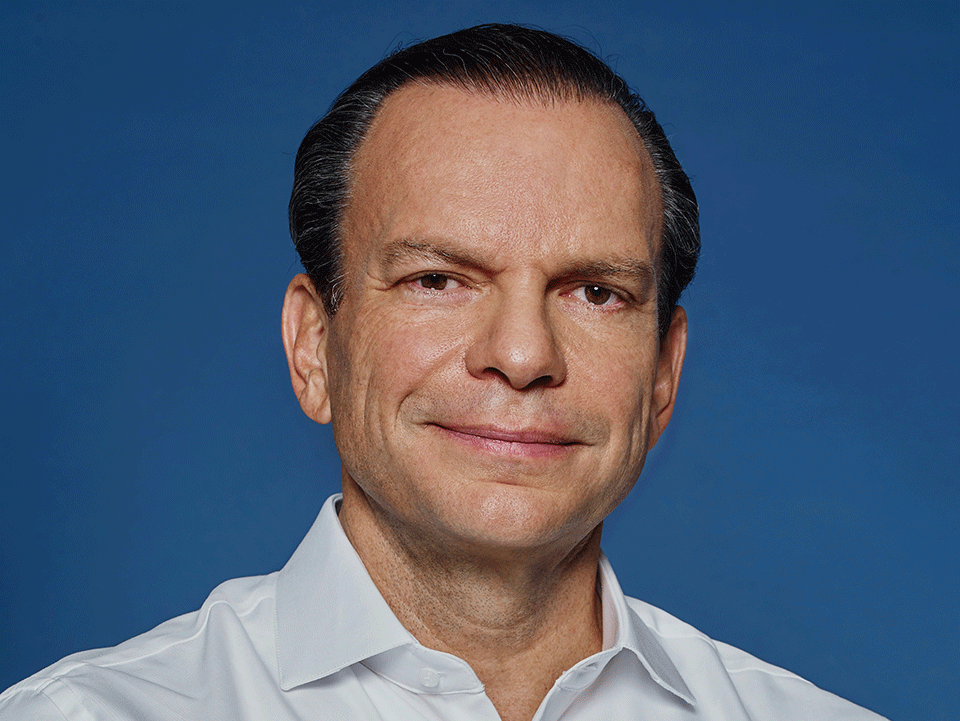
BSI, under CEO Anggoro Eko Cahyo, is a signatory to the UN Principles for Responsible Banking, a member of the United Nations Environment Programme Finance Initiative (UNEP FI), and represented Indonesia at the UN Economic and Social Council Forum on Financing for Development in New York in April 2025, showcasing its leadership in ESG Islamic banking across borders.