
 |
| © 2017 Euromoney |
| Press release |
| Full results |
Awards for Excellence 2017
Not many people would have wanted to run an Italian bank over the last year. Fewer still would have wanted to jump back into one that they had previously quit amid frustration at the direction the firm was travelling in. But Jean Pierre Mustier, who resigned as head of UniCredit’s investment bank in 2014, has had a triumphant return as CEO of the Italian institution since July 2016.
Mustier is too modest to describe himself as the perfect man for the job, but his status as an “insider-outsider”, to use his term, placed him in the unique position of understanding the sprawling firm well enough to know what needed to be done, while giving him the distance needed to execute.
New bank CEOs like to talk of a 100-day period when they evaluate their new firm and decide on the plan. Mustier had no need of that. Even before his official start date of July 12, 2016, he had written a two-page memo to the board detailing precisely what steps he felt the bank needed to take in order to stabilize the firm. Without agreement on those, he knew the job would be impossible.
 |
|
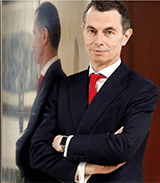
Jean Pierre Mustier, UniCredit |
Board approval was swift, coming on June 30. The subsequent announcement on July 11 of UniCredit’s plans for the months ahead was effectively a condensed form of his manifesto. All the key decisions had been made. The next job was execution of what would be one of the most ambitious sequences of transactions a bank has ever attempted.
What the bank has done in less than a year is nothing short of extraordinary. But Mustier was convinced that speed was crucial in getting the first actions well underway before an investor day in December 2016. This was still to be more marathon than sprint: “Velocità senza precipitazione (more haste less speed),” he says, despite his self-confessed need for Italian lessons.
The first few miles of that marathon have nonetheless been breathless: selling stakes in Bank Pekao, Pioneer Investments and Fineco, putting together an elaborate set of transactions to cut the bank’s exposure to non-performing loans, completing a €13 billion rights issue whose size was decided when the bank’s market capitalization was just €11 billion.
Viewed from the outside, perhaps his most important achievement has been to transform the context in which the firm is now discussed. No longer is it seen as another Italian bank that is buckling under the weight of bad loans and capital pressures. Now it is spoken of in the terms that Mustier himself has defined: a pan-European, simple bank – one that is performing immeasurably better than might have been expected.
To get to that point required an immense effort, led by Mustier, but also reflects the collective skill of his advisers and executives, as he continually emphasizes.
Looking at it from the inside, however, Mustier dwells on other matters, principally the creation of a sense of pride in the institution among its staff. Branding has been an important part of that and one that he takes as seriously as anything he has done to stabilize the bank’s capital base – including the now-famous Elkette, the soft toy elk that Mustier adopted as the bank’s mascot and whose legion of cuddly cousins have been spotted as far afield as Everest base camp. Mustier’s own Elkette even shared the podium with him at the investor day.
It is a very human side to the story that reflects the importance Mustier places on culture. Part of this is informed by his bruising experience during the Jérôme Kerviel trading scandal, when Mustier was running Société Générale’s investment bank in 2008. It carries through into his personal dealings with staff. Whether it is spending his downtime writing notes of thanks to individuals or engaging with junior staff at his ‘one hour with the CEO’ breakfasts, he is constantly finding ways of keeping his feet on the ground.
The manner of Mustier’s departure in 2014 had been in keeping with the man. Unable to agree with his senior management on the strategy for the firm and, in particular, on its capital needs, he chose to leave on a point of principle. It is an illustration of the attitude that has brought him respect across the industry and which he continues to espouse in his current role.
He was the first to recognize the incompatibility of cutting 14,000 jobs while leaving himself unaffected. His 40% cut in salary, the scrapping of his annual bonus now and for the future, the sale of the private jet: all these were moves that reflect his belief that good culture starts at the top.
That jet might have come in handy when he travelled 67,000 miles in 28 days to drum up support for the rights issue, but Mustier prefers to lead by example. He has asked much of his institution in the past year. The fact that it has delivered on the objectives he set is a testament to that example.