| Global Awards for Excellence | ||
| Western Europe Regional Awards of Excellence | ||
| Austria | Belgium | Cyprus |
| France | Germany | Greece |
| Ireland | Italy | Netherlands |
| Portugal | Spain | Switzerland |
| UK | ||
 |
Best Bank: Santander |
Santander lags behind Lloyds Banking Group and Royal Bank of Scotland in its share of customer deposits in the UK and ranks only fourth in its share of lending but all the momentum in UK banking lies with the group the Spanish bank is building on the foundations of Abbey, Alliance & Leicester and Bradford & Bingley.
The latter two acquisitions, secured at the height of the crisis last year, have propelled the bank far ahead of its already ambitious plans to transform Abbey from a conservative mortgage and savings bank into a powerful full-service commercial bank. They helped to grow its deposit base by 80% last year and that in turn allowed it to grow the loan book further, with notably high shares of new SME lending and net new mortgage lending. It now has roughly 11% of the UK banking market, up from 6% in 2007, with a 13% share of mortgage lending. Its stock of mortgage loans is at a 52% loan-to-value ratio.
The bank attracted 500,000 new customers last year. Even as other banks became effectively UK government risk thanks to taxpayer injections of capital, Abbey became a safe haven for depositors looking to spread their bank savings around. So far this year, the bank is on track to acquire 1 million new UK customers in 2009.
 |
|
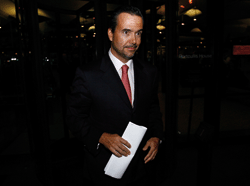
António Horta-Osório, Abbey: expanding market share while increasing profits |
The bank’s UK chief executive, António Horta-Osório, knows that the bank – soon to operate in the UK under the unified Santander brand – is the second bank for many of these new customers. He bristles with plans to make it their primary bank, initially by offering highly competitive rates for their deposits and then by cross-selling. The bank’s efficiency and low cost-to-income ratio enable it to offer such rates without destroying its margins. When it acquired Abbey, the UK bank had a cost-income ratio of close to 70%; today it is at 43% while the industry average is around 50%. Alliance & Leicester and Bradford & Bingley will soon be operating on the bank’s Partenon system. In Bradford & Bingley’s case, that transition should be complete this month, just 10 months after Santander first acquired the group.
Horta-Osório is cautious on the outlook for margins in UK banking. Yes, spreads on the asset side are higher, but so are costs on the wholesale funding side. That’s what made £20 billion in deposit funding from Bradford & Bingley so attractive. It will subsidize his cost of growing the mortgage book for the next three years.
Santander is acquiring market share while still increasing its profits even as other UK banks’ profits collapse. And it hasn’t even sacrificed its prudent risk management to do this, with non-performing loans at just 0.95% of its total for 2008 compared with a UK industry average of twice that.
When the UK Treasury appointed Deutsche Bank as financial adviser on its £37 billion of capital investments in UK banks in October 2008 and on subsequent measures undertaken to stabilize the financial system, it confirmed the bank’s position as the leading investment bank in the UK. Its advice to the UK government was provided by experts in Deutsche’s financial institutions group, M&A businesses, and debt and equity capital markets, as well as in ABS, loans, sales and trading, and pensions.
Deutsche is a leading broker to UK corporates and led many of the rights issues launched to shore up balance sheets in the past 12 months. These include the £608 million offer from Hammerson in February 2009, at the time of launch the largest-ever rights issue by a UK real estate company, and the innovatively structured $5.9 billion Xstrata offer, the largest by a non-financial UK company in the review period.
Deutsche led the UK M&A adviser league tables for the 12 months under review.
It was instrumental in reopening the sterling bond market in September 2008 with a £600 million 15.5-year issue for Imperial Tobacco.


