The US dollar is going to resume its secular decline. Its role as the world’s dominant reserve currency will come under renewed threat over the next decade as export-surplus economies look to diversify their dollar reserves into other currencies.
This will not happen suddenly and there might be upward corrections for the dollar, particularly if markets are disappointed with the failure to achieve a V-shaped global economic recovery and there is a rush back to safe-haven assets.
But the US is undermining its safe-haven status and debasing its currency by trying to sustain a credit-fuelled economy through huge fiscal deficits and the monetization of public debt. That will drive up government bond yields and reduce the willingness of China and other foreign dollar holders to hold US dollar assets.
Over the past decade or so, the global trading system has funnelled more than 80% of all export revenues into dollars, like a torrent emptying into a finite sea. The holding of dollars by exporters, savers and foreign central bankers was voluntary. It was based on the belief that the US economy was stable, despite its now obvious disequilibria of excess consumption, lack of savings, a credit bubble and external deficits.
Dollar nominal effective exchange rate |
1988=100 |
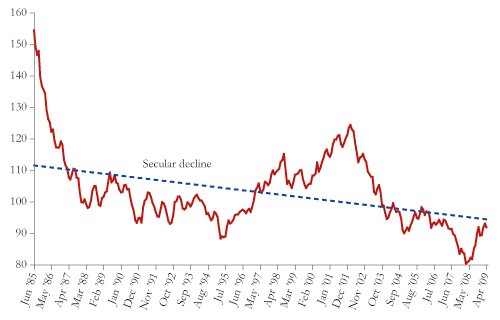 |
Source: Datastream |
The havoc of the credit crisis has undermined that belief in the stability of the US economic paradigm. The free ride for the dollar is over. But this dethroning of the dollar as the international reserve and transaction currency will take time. At the end of 2008, China had $2.92 trillion invested overseas, with about 70% of that in US dollar assets. That compares with China’s annual GDP of $4.3 trillion. Two-thirds of this wealth sits in the central bank, which has one of the largest balance sheets relative to GDP in the world. A 1% loss on the value of China’s dollar assets would wipe out Chinese wealth worth 0.67% of GDP and create a hole in the central bank’s balance sheet equivalent to about 0.5% of GDP.
So the Chinese are hoist with their own petard. They have been sold a pup (a whole economic model based on making and exporting widgets to sate excessive US consumption). They are now stuck with it. This is as much their fault for being duped as it is the fault of the US for failing to diagnose and address its credit and consumption excesses.
No dogs either
But have no doubt in your mind, the Chinese may be stuck with the pup, but they don’t like the dog! They will not repeat the mistake of maintaining their unreserved backing to the dollar because to do so would allow the US to repeat the same mistake of financing growth with leverage as it has done over the past decade.
The smartest thing that the Chinese can do is to sell as big a chunk of their dollar reserves as possible to the IMF in return for SDRs. This would diversify the reserves that they hold by up to two-thirds out of dollars without ever touching an FX market. This is because the SDR has only a 34% weighting in the dollar and 66% in other currencies (yen, euro and sterling). The IMF could invest any dollars it did not need to bail out any emerging economy in difficulty by investing in US treasuries and parking them at the Fed. Then everybody would be smiling, including, for a time, the markets.
The doomsday for the dollar will play out inexorably and gradually, more as a prolonged whimper than a crash. Of course, the dollar could gain for a while if the current risk rally were to reverse and there were a flight to safety again, although the number of investors that believe the US policy of currency debasement is compatible with safety must be falling.
The US trade and current account deficits will both narrow as the US consumer deleverages and spends less. But the US need for credit will not diminish as much as personal consumption does because US government dis-saving will replace it. The US will need more, not less, foreign financing to fund its fiscal deficit. The US must ask foreigners to do the funding. But we doubt they will want to at current yields on Treasuries. The ultimate result will be a much weaker dollar.
David Roche is president of Independent Strategy Ltd, a London-based research firm. www.instrategy.com


