The jumbo rally in risk assets continues. New post-crisis highs in equity and commodity prices are reached every week. It’s blue skies ahead. But I remain in the camp of the worried. This rally is not sustainable. It is driven by expectations of a quick and durable recovery in economic growth and fuelled by government support for asset prices and leverage.
The rally in risk assets is unsustainable because the markets’ view of a V-shaped economic recovery will be disappointed. All the economic growth we are seeing is a supply-side adjustment to boost production to meet low levels of final demand, which is no longer falling off a cliff.
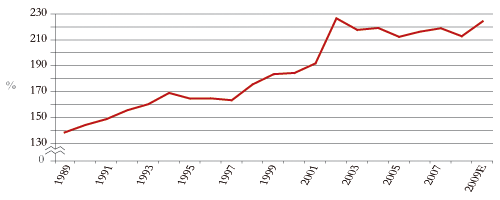
The markets are working on the assumption of a rapid return to business as usual. However, the causes of the credit crisis should tell us that we cannot return to the old ways. The pre-crisis bubble economy was so pervasive that it affected almost every part of the economy. Leverage boosted asset prices to unsustainable levels. This created illusory wealth through asset price inflation. That, in turn, boosted demand and growth as well as reported productivity. A similar growth of credit cannot be sustained post-crisis, so growth and productivity will be correspondingly lower.
Also, the excess leverage that caused the credit crisis is still unaddressed. Until it is, we cannot expect to sustain expansion. That will take increased savings but that is dire news for consumption-led growth in the highly indebted household economies of the US and the UK.
Indeed, massive leverage has been added on top of the existing layers of private sector debt – by governments. The crowding-out of productive investment and the pressure on savings rates will be felt most as demand recovers. The substitution of government for markets in every walk of the economy will foster inflation down the road, hamper productivity and can only be paid for by higher taxes across the board.
|
Global bank lending and securitized debt to GDP |
 |
|
Source: IMF, Independent Strategy |
Missed opportunity Of course, there was a road map to a sustainable recovery with fast growth. But the opportunity to grab it was missed. The policies to clean up the banks have been a mess of procrastination and piecemeal measures, falling well short of the radical surgery needed. Also, the prices of financial assets and of goods and services have not been allowed to fall to levels that could provide sustainable new investment. We have had wholesale interference by government in the pricing of housing and securitized debt to thank for that.
Governments have encouraged malinvestment and distorted the allocation of economic resources during the downturn. Autos is a neat macro example of a sector that needs bankruptcies and the elimination of capacity, not subsidies. So now there is excess capacity in such sectors as retail, distribution, finance and everything to do with real estate and construction.
Looking back through the history of credit bubbles, countries that emerged with fast growth rates were those that tackled malinvestment head on and reallocated resources to sectors that would be new winners rather than to those that had been successful in the past. This time a return to a high-growth economy is out of the question because the productivity to drive it won’t be there.
But there is another prospect that is keeping me awake at night during the risk asset rally. That is the return of the credit bubble. The US and UK governments are inflating asset prices to create enough wealth and confidence to drive up demand and the real economy. And they are refinancing the banks by letting them use buckets of free money to invest in asset markets to make huge profits. The hope is that, thus gorged, the bankers will return to business as usual and lend again to businesses and consumers.
New recession
If these policies succeed, we could have a bubble economy with high growth figures for a couple of years. But eventually, there would be a payback. Given that debt levels have not been reduced, this boom would involve the cost of servicing it rising quickly to unsustainable levels. That would prick the bubble and send us into a new economic recession.
In the new bubble, the external financing requirement of the US, and particularly of the US government, would rise to new highs. The penalty would be a rapid collapse of the greenback and sharply higher US long-term bond yields. It would also mean the end of the dollar as the dominant global reserve currency.
David Roche is president of Independent Strategy Ltd, a London-based research firm. www.instrategy.com


