 |
|
Deutsche reaches the top of FX in 2000 |
Jain cranks up the flow at Deutsche Bank
Amrolia had earned his spurs at Credit Suisse Financial Products, then the acknowledged market leader in the derivatives business. Amrolia had persuaded his team at CSFP to take the leap to Deutsche with him, where he was tasked with building a global FX options sales business.
There were 17 sales people on the floor. Amrolia wanted to get to work right away. But something was missing. “Where are all the computers?” he asked. “The only computer we have is over there,” came the reply.
Amrolia took a deep breath and got to work with his colleagues. He had been sold a vision of the future by then head of FX at DMG Michael deSa, a 17-year veteran of perennial market leader Citibank who had joined Deutsche just a year earlier.
Amrolia ordered computers for the entire team. The floor’s air conditioning system could not cope with the heat the terminals generated, and the team had to work through 104 degree sweat shop temperatures in shorts and T-shirts until the problem was fixed.
Fourteen years later and Deutsche Bank is now the biggest player in the global foreign exchange market – top of the Euromoney poll for the fifth consecutive year – and Amrolia runs the team that every competitor is wondering how they will ever topple from its perch.
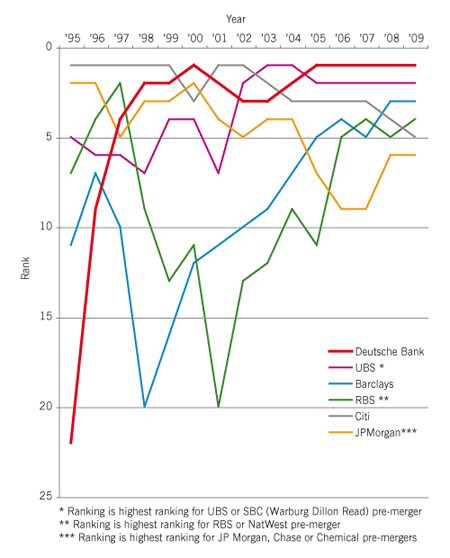
Deutsche’s ascent to the summit of FX was rapid: from 22nd place in 1995 to the top position in 2000. The firm’s competitors said its leadership would never last, that Deutsche had simply bought its way to the top with salaries for leading bankers that rivals could not match, but which rendered its business unprofitable. They believed their suspicions were confirmed when Deutsche slid down the poll for the next few years. Amrolia admits: “We had expended a lot of energy getting to the top of the industry, which was a clear goal, and it was even tougher to stay at the top.” He himself decamped to Goldman Sachs.
But the team Deutsche had put together was stronger than many competitors believed. At its heart was the principle that there is a strong connectivity between cash and derivatives businesses: the policy espoused by the ultimate head of the business, Anshu Jain. “The secret of our success is applying smart thinking to simple problems, like algorithmic trading in spot, electronic risk management in options and leveraging prime brokerage into our Select platform,” says Amrolia.
The second is that FX has never been a standalone product at Deutsche. Jain explains how FX has always been a way into other client business for the bank, from the days when it had limited traction in areas such as M&A and equities. Amrolia is quick to point out that the foreign exchange business benefits from a two-way flow, from both capital markets and from relationships in Deutsche’s growing global transaction banking franchise.
|
Deutsche’s rise to the top of foreign exchange |
| Overall market share ranking in Euromoney polls, 1995-2009 |
 |
Source: Euromoney |
Just as important is a consistent team that has grown up with the business under a succession of strong managers. Deutsche gained the top spot for the first time in 2000 under the leadership of Hal Herron, who succeeded deSa. Jim Turley, who took over from Herron, was at the helm when Deutsche returned to the top in 2005. Amrolia returned to Deutsche in 2004, and replaced Turley two years later. Deutsche’s growth in FX has mainly been organic, but it received a boost in talent through the acquisition of Bankers Trust in 1998. Turley was the most high profile individual, but ex-BT staffers still hold senior positions: Kevin Rodgers is head of options and Rob Mandeno runs spot and e-business.
Others have stayed with the business for many years. Rashid Hoosenally, now global head of the client strategy and solutions group, joined with Amrolia from CSFP.
But Deutsche has created its own bench of talent. One of the key decisions according to Amrolia was to rebuild the sales force and move in a lot of structurers and graduates that could be trained up in 1997. Some of those graduates are now senior within the group: Clifford Cheah runs FX in Asia, while Jason Shell runs corporate sales globally.
Can anyone challenge Deutsche’s leadership? It could face a threat from looming consolidation in the investment banking industry, but history shows that mergers have rarely boosted FX volumes. But then Citibank ruled the FX market for the first 20 years of Euromoney’s poll. No one thought the US bank would ever lose its crown. Deutsche’s management should take nothing for granted.


