 Full results page Methodology |
 |
THE WARM GLOW of recovery that has bathed the capital markets over the summer may have cheered many a trading desk but it may also have blinded some participants to the severe problems that still lie ahead. In the US alone there is a $3 trillion elephant in the room. It is made up of commercial real estate loans and it is a problem that isn’t going away any time soon. “We haven’t got to the worst of it yet in commercial real estate” is the bleak warning from Jon Vaccaro, global head of commercial real estate at Deutsche Bank in New York. “US government support has so far focused on correcting issues in the financial markets – this has been very helpful and worked well. However the government’s efforts for commercial real estate have been modest, as the task is very difficult.”
The figures are certainly not pretty. Total delinquency rates among US CRE loans reached 4.1% in June and are likely to increase sharply over the next two years. There are already 2,158 delinquent fixed-rate loans (totalling $27.9 billion) and Deutsche Bank now predicts term losses in the US CMBS market of between $31.3 billion and $46.4 billion. The vacancy and income side is deteriorating, particularly in lodging and retail. Deutsche Bank real estate analyst Richard Parkus predicts that for hotel loans this downturn might well exceed that of 2001 to 2003, when cumulative default rates reached nearly 25%. And he describes the degree of deterioration in retail, where total delinquency rates were already 6% in June, as “simply stunning”. In New York City some office rents have fallen from $160 per sq ft to between $50 and $60 per sq ft.
Predictions of a 50% to 70% peak-to-trough value decline in US CRE make uncomfortable reading on both sides of the Atlantic, particularly the UK. “The US real estate market has traditionally had more of a boom-and-bust cycle than continental Europe because the barriers to entry are higher in the latter. But in this cycle the US and UK are going to track very closely peak to trough,” warns Vaccaro.
Real estate values in the UK had already fallen 45% over the two years to July, while values in continental Europe were down 20% to 25% over the same period. “Repricing in the UK has been pronounced and rapid – it has been less wrenching in continental Europe,” says Simon Dunne, director at Savills Capital Advisors. Dunne joined the UK property group from Morgan Stanley in January this year to develop a debt advisory business.
Maturity wall
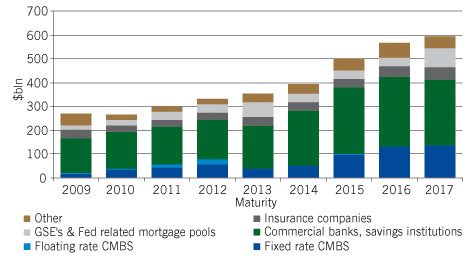
In the US, $2 trillion of commercial mortgages are due to mature by 2013, but a full $400 million to $450 million of these would not qualify to refinance at maturity. The reason is simple: the buildings are now worth a fraction of the loans that are secured on them. Many of the loans are also pro forma loans – an underwriting technique that emerged in late 2005 through which lending is based on the expected financials after a proposed business plan rather than the ‘as is’ financials at the time the loan is written.
This alarming statistic underlines the scale and severity of the problem the market faces in clearing the volume of outstanding CRE loans on bank balance sheets and limiting the damage that the projected level of defaults will cause. “Loan refinancing is the number one issue for pretty much everyone in commercial real estate,” says Matt Anderson, partner at Foresight Analytics in Oakland, California. “It is a big issue and there don’t appear to be any easy fixes.”
|
“The government’s efforts for commercial real estate have been modest, as the task is very difficult.” Jon Vaccaro, Deutsche Bank |
 |
A clear distinction needs to be drawn between CRE loans that have been securitized via the commercial mortgage-backed securities market and those that are sitting on bank balance sheets. In Europe, CMBS was still in its infancy when the markets collapsed in 2007, but in the US the vast majority of CRE loans were securitized. Indeed, any loan that fitted the criteria and could be securitized was. This left the worse-quality, riskier loans (such as construction loans and condo development loans) sitting on bank balance sheets. “The banks are holding immature loans – the type of loans that would never have made it into a CMBS,” says Ron D’Vari, chief executive at NewOak Capital, a real estate investment firm. “The biggest risk is acquisition and development loans on residential [multifamily or planned community] and commercial real estate development loans [such as condo loans].” The situation is made bleaker still by the nature of the banks that have done the lending. According to Foresight Analytics, CRE loans make up just 6.6% of the total charge-offs taken in 2008 and the first quarter of 2009 by commercial banks with total assets of $100 billion or more. But for banks with assets of $1 billion to $10 billion this percentage rises to 44.3%. Indeed, more than half of CRE loans outstanding in the US were written by regional and community banks with assets of less than $50 billion.
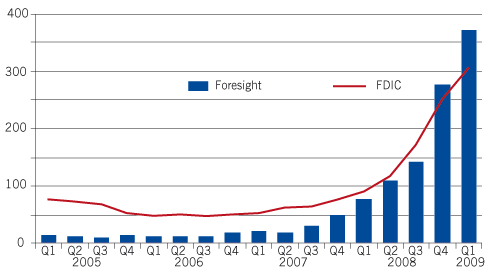
And these banks are in no position to stomach the levels of delinquency that have been predicted. The result has been a surge in failures, pushing the number of problem banks identified by the Federal Deposit Insurance Corporation to 416 at the end of August. The FDIC has taken over 81 banks this year, many of which have been victims of excessive exposure to real estate (see Insolvency: BBVA sees opportunity in US banks’ distress, Euromoney, September 2009). For example, Chicago-based Corus Bankshares was given a deadline of June this year to raise $390 million or face receivership: the bank, which has total assets of $7.7 billion, had written 18 mortgage loans on Florida condo developments totalling $1.38 billion. Default rates on condo loans are now running at 38% and Corus lost $317 million in the fourth quarter of 2008.
Because the loans now sitting on bank balance sheets are in higher-risk categories there is understandable concern that delinquency levels will soar. Many facilities that were written on the basis of rising rental income are now being kept out of default only by draining their interest reserve account. And even those where income is stable are struggling to service huge leverage multiples. The case of the Peter Cooper Village/Stuyvesant Town apartment development in Manhattan is a good example. The huge development incorporates 11,227 residential apartments and was acquired by Tishman Speyer and BlackRock Realty in 2006 for $5.4 billion. The plan was to convert rent-controlled apartments to market rents, and the borrowers took on $3 billion senior debt and $1.5 billion mezzanine debt based on the increased income that this would produce. However, by January this year the general reserve balance had been completely depleted and the debt service reserve balance was down from $400 million to $127 million. At the time, Fitch Ratings estimated that the borrowers had roughly six months-worth of reserves left, so a default on this enormous deal could now be looming.
If in doubt, extend
Not surprisingly, banks faced with unrefinanceable but maturing real estate loans are often opting simply to extend. “Late last year the initial reaction was to grant 12-month extensions on loans that were still performing,” says Anderson at Foresight. “Merely extending buys time but not much else. It just makes next year’s maturity problem bigger. And next year values will be just as impacted if not more.”
But even if banks push as many performing CRE loans down the road as they can for another 12 months, the question of how to deal with non-performing loans remains. “In the last downturn the government took distressed assets and sold them off to the market via RTC. This enabled the market to find a bottom,” says Vaccaro at Deutsche Bank. “The same need is true today. This market cannot recover until it finds a bottom and it cannot find a bottom until auctions are held.”
|
The scale of the problem |
|
Estimate of total upcoming CRE maturities $bln |
 |
|
Source: Barclays Capital |
Due to many banks’ exposure to commercial real estate, Vaccaro expects several US banks to disappear in this downturn (observers predict anything from 1,000 to 1,500 banks might go). DB is advising several clients on bank purchases. Deutsche is also working on the first $6 billion auction of assets by FDIC, which is due this autumn. “FDIC sales of assets will help establish price transparency and potentially a floor,” says Vaccaro. Bank reluctance to recognize real estate losses, combined with government support (and loan book accounting) which enables them to hang on to these assets rather than being forced to sell them, has inevitably delayed the kind of bloodletting that is necessary before there can be any recovery in the sector. “There is still another layer of loss recognition to go,” reckons Anderson. “The banks and regulators seem to want to stretch out the process and take losses incrementally. So for all the critiquing of the Japanese pattern of not taking losses the US seems to be heading in the same direction.” But he believes that the tipping point will come next year. “Capital markets distress is just starting to kick in. At some point – probably next year – the pessimism will have set in deeply enough and the prospects for turnaround become remote enough for banks to start selling.”
This will be good news for the opportunity funds and distressed debt buyers that have so far been frustrated in their attempts to take advantage of the situation – both in the US and Europe. “There is a lot of money waiting in the wings to profit from distress,” says Dunne at Savills in London.
This will be done either by buying assets directly from banks or by picking up deeply discounted CMBS. But the legal conflicts that have dogged CMBS structures as they deteriorate may serve to dissuade investors from buying into existing deals and highlight the advantages of buying the asset direct. “If you buy a bond you are delegating control to the servicer,” says Dunne. “People may wait until CMBS loans are enforced or look to buy loans in a loan-to-own scenario.”
The FDIC’s programme of structured sales, whereby it offers 85% leverage through the FDIC guarantee and an effective interest rate of 2.5% to potential buyers, has had some success this year. Pools of sub- and non-performing construction, commercial and residential loans have been sold by Market Street Mortgage Corp, First National Bank of Nevada, ANB Venture and IndyMac to Gulf Coast Bank and Trust, Pennymac, Kingston Management Services, Stearns Bank, Diversified Business Strategies and One West Ventures. Non-performing loans sold by FDIC during 2008 and early 2009 were bought at an average 73% discount to book value. Ron D’Vari at NewOak Capital participated in two of these sales. “Buying in the FDIC auctions is a huge option on the future,” he says. “You have to ask – what can I do with that asset that no one else can? Time and patience are huge elements. If you bid it cheap enough and manage it well enough it will come good. You need to establish a floor valuation by figuring out the exit price at a certain time horizon and figuring out the cost of carry from now until then.” But these auctions are a drop in the ocean in view of the scale of the problem. “The FDIC auctions will come at a slower pace and be less visible than many investors are hoping,” says D’Vari. “They are also getting harder to participate in – bidders need to put up more and more qualifications, which is good for both taxpayers (as they are participating in 80% of the upside in structured transaction sales) and investors.”
With the FDIC offering 85% leverage on structured sales it could be argued that it is hardly selling these assets – it is merely hiring the bidder to work for it. The real opportunity for distressed buyers might be in the upcoming bank auctions. The FDIC’s auction of the assets of Corus Bank had attracted a number of bidders by late August: New York developer Related Cos and Philadelphia-based investor Lubert-Adler have jointly bid for the assets, and a rival joint bid has come from private equity fund Colony Capital and iStar Financial, a New York-based Reit. The auctions are expected to attract significant interest from private equity funds – indeed Starwood Capital Group is also believed to be interested in the Corus auction.
CMBS market still shut
While the FDIC has stepped in to auction off many distressed real estate loans, the market itself has been proactive in resecuritizing sizeable volumes of performing US CMBS tranches in order to avoid downgrades (Restructurers roll boulders uphill, Euromoney, August 2009). In Europe, the much smaller CMBS market has remained shuttered, with defaults now becoming a reality. “The complete disappearance of CMBS ripped the heart out of the commercial property bubble,” says Robert Palache, founding partner at Bell Capital Partners, which was established in February this year by Palache and Robert Bell to raise mezzanine debt, hybrid capital and equity for real estate assets in the UK and Europe. The challenge to find alternative sources of capital in order to plug the gap left by CMBS is therefore very real – and very urgent.
 |
|
“I hope that we will see new non-bank investors coming in but it requires market players to come forward and demonstrate the merits of the case” Robert Palache, Bell Capital Partners |
According to Barclays Capital, European banks will face an €11 billion increase in their regulatory capital requirements in the second half of 2009 as a result of pending downgrades on CMBS exposure. In Europe two CMBS deals had defaulted by August: the White Tower 2006-3 deal and the synthetic Epic Industrious deal originated by RBS. While the former is in special servicing (or default) in a process being managed by CB Richard Ellis, the assets of the latter have been auctioned by Ernst & Young and partially acquired by Max Property Group, which has bought 90 properties for £232 million ($384 million). The sale price gives the assets a loan-to-value ratio of 206% – a shocking collapse from their initial 74%. The Max Property purchase was partially funded by Eurohypo, which has also been linked to potential interest in the White Tower assets. “We are actively seeking new lending business,” confirms Max Sinclair, co-head of Eurohypo in London. “As the year has progressed, there have been increasing levels of competition for loans up to, say, £60 million to £75 million for the right client and the right assets. Above this level, the market is still thin and in any case the amount of liquidity available is nowhere near levels seen pre-2007. Active players include not only other German banks but several UK banks are also back on the scene. This is quite encouraging.” The German bank provided £130 million financing to Max Property – which was set up in May by entrepreneur Nick Leslau and hedge fund Och-Ziff in order to take advantage of dislocation in the commercial property market – for the purchase. If a wave of such defaults is to be avoided, then injecting new funds into transactions is vital. “There is a great big unpicking and unravelling process under way,” says Dunne at Savills. “There is a need to channel capital to unblock transactions.” Given the dearth of new senior lending available, advisers are hoping that intermediate lenders can be attracted to the new risk/return profile on offer. “There will be deals where people are able to get some equity upside,” explains Palache. “And mezzanine investors can see that there is an attractive yield there for the risk. There has been a lot of work done and a lot of negotiation, but outcomes where people have come in with fresh mezzanine are few.”
While there may be some encouraging signs of activity on the loan side in Europe, this is a glimmer of activity in an otherwise utterly changed landscape. “Banks will get lending again thanks to the profits they have made trading governments and corporates,” says Palache. “But this will be very conservative and very expensive lending and will keep yields on property permanently high. New transactions which are precisely structured to meet the requirements of the Pfandbrief market have the possibility of getting done, but they have to be very good deals with very good tenants and will still price at 250bp over,” he warns.
What the market needs is new sources of intermediate and non-bank capital to plug the gap that has been left by the disappearance of senior debt.
As with so many other asset classes, commercial real estate borrowers are hoping that non-bank lenders might go some way towards easing the freeze on new bank lending. Insurance companies such as MetLife have traditionally been active in lending to the highest-quality borrowers in US real estate, but in general such firms’ participation in lending to real estate borrowers has always been a shadow of their participation in the market on the fund side. The hope is that the returns now available will entice these investors to lend. “With spreads at 300bp to 400bp over Libor non-bank investors are able to get an unlevered return of around 7%,” says Palache. “I hope that we will see new non-bank investors coming in but it requires market players to come forward and demonstrate the merits of the case.”
Finding a bottom
That process of finding a bottom-of-the-market level has been delayed by government support on both sides of the Atlantic that has dissuaded banks from recognizing and dealing with their exposure to the sector. Many believe, however, that banks with large real estate exposure will become increasingly prepared to dispose of these assets in return for share price recovery. This will be welcomed by the opportunity and distressed debt buyers that have been frustrated in their attempts to profit from value destruction so far. There are clear signs that opportunistic buyers now see value in the market: for example Fortress Investment Group recently bought up sufficient deeply discounted mezzanine debt in a condo project on the west side of Manhattan, Sheffield57, to foreclose on the property, and in similar vein mezzanine buyers have recently foreclosed on the John Hancock Tower in Boston.
Unclogging the backlog of legacy loans and securities from the boom years will affect this market for years to come. Large loans have traditionally performed much better than smaller loans in a downturn, but in this cycle the reverse will be true as underwriting standards have weakened so much for larger loans. And speculative ownership has meant that for many buildings that were repeatedly refinanced during the boom the original owner now has an equity interest of zero – and commensurately zero motivation to support their buildings now.
Will this be the end of CMBS? The technique has proved robust in the US with re-remic activity, and there are even signs that new deals – albeit federally supported – might emerge. US Reit Developers Diversified Realty (DDR) has confirmed that it is working on two CMBS deals for $250 million and $300 million that would be eligible for federal support. “Everyone’s hopes are pinned on CMBS,” says Anderson at Foresight Analytics. “There has been a whiff of activity. All eyes are on DDR and other Reits are looking at the same sort of thing.”
|
Bank distress looms large |
|
FDIC problem institutions vs. Foresight watch list |
 |
|
Method changed in Q4 ’08 |
In Europe, a recent transaction for Tesco (CMBS: Tesco turns back the clock, Euromoney, July 2009) indicated that there was appetite for the risk – but more for corporate than true property exposure. “In Europe the demand for CMBS was non-traditional demand from institutional investors because practically all of it came from the SIVs,” warns Deutsche Bank’s Vaccaro, who is not positive on that market’s chances of recovery. “It is very messy out there and it will be a mess for many years to come,” agrees Palache at Bell Capital Partners. “Everyone is working in a great hurry and there is no proper market practice.” But there is no doubt that recovery will come eventually. “In real estate you have to reinvent yourself every couple of years as the market is dynamic and changes,” says Vaccaro. As Palache wryly observes: “Most banks were conduits into the capital markets – the regulators may like to fantasize that they were not but they were.”