 |
|
|
A new beginning: the Oyu Tolgoi mine |
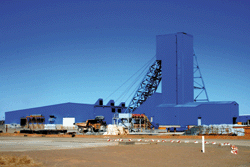
Nine years after it first began exploring the Oyu Tolgoi gold and copper deposits in Mongolia, Canadian firm Ivanhoe and its larger partner Rio Tinto have secured the mining rights deal that could transform the country’s economic prospects. The long-awaited deal, signed on October 6 – the most auspicious day of the year according to the Mongolian-Tibetan Buddhist calendar – allows Ivanhoe and Rio Tinto to mine the site’s deposits after completing investments projected to total $4 billion. News of the deal will come as a relief to almost everyone with a stake in Mongolia’s future: from the foreign mining companies and investors who had begun to despair of realizing the potential of the country to the Mongolian people who faced declining employment prospects. “The impact of this deal will be huge,” says Chad Blewitt, CFO of Ivanhoe, in a call from the Oyu Tolgoi site. “The project by itself could cause a rise in GDP of around 30%, and then there’s the multiplier effect on the economy as supporting services and infrastructure build up. As well as increasing the number of our personnel we’ll obviously be bringing in a lot of construction material, maybe 80 truckloads a day at times, and at the moment the physical infrastructure isn’t there for that.”
Preconditions
Ivanhoe shouldn’t find it too difficult to secure funding for the project once 10 final preconditions are met, with sources close to the deal saying that the involvement of Rio Tinto and its staff has been instrumental in preventing the whole project from turning sour. There was much debate over the form that an upfront payment from Ivanhoe should take, and on the government’s part some degree of agonizing over how to ensure that Mongolia and its people benefit from the extraction of the country’s resources as much as foreign companies do. In the event Ivanhoe will invest $100 million in Mongolian five-year treasury bills on October 20, and a further $150 million by the time it secures funding for the project. The bills will have a total face value of $287.5 million. Funding for the development of the project comes largely from Rio Tinto, which has increased its stake in Ivanhoe mines from 9.9% to 19.7%. Rio is allowed to increase its stake to 46.6% over the next two years.
|
“Who knows when there’ll be a sovereign? They’ve been talking about it for years, but when they could have done it they decided they didn’t need the money and then when they needed the money they couldn’t get it” Peter Morrow, Khan Bank |
“The hope for securing enough capital investment [in Oyu Tolgoi] is Rio Tinto,” says Dogsom Ganbold, president of the Mongolian National Mining Association, in an email interview. “The more Rio Tinto has participation in the project, the fewer financial difficulties will be encountered. Of course, it doesn’t mean that there will not be any financial problems.” The Oyu Tolgoi agreement requires many changes to Mongolia’s tax and foreign investment laws, including the repeal of a deeply divisive 68% windfall tax on profits from gold and copper mining. It is hoped that deals for Mongolia’s other natural resources will follow.
And building up the required infrastructure and services industry to support Oyu Tolgoi and subsequent projects will require a level of investment that, according to the World Bank, cannot be met by domestic supply. While much of the necessary capital can be raised by foreign firms internationally, the race is on for Mongolia to improve its barely functioning capital markets so local firms can join in.
“There’s suddenly a lot of interest in Mongolia,” says Mandar Jayawant, founder of the Mongolia Investment and Development Fund, one of a handful of private equity funds looking to raise capital in the country.
“It’s tough at the moment for portfolio investors looking to get exposure to the Mongolia story,” he continues, “because the exchange here is virtually dead, with daily volumes of maybe $200,000 on a good day. That might pick up over time as more companies look to list but for now there’s little activity.”
Jayawant says his fund is near to a first close with some $15 million raised, mostly from developmental financial institutions and a few strategic investors. He hopes it will eventually reach $100 million.
Infrastructure
Ivanhoe’s Blewitt says that his firm is working closely with the government in developing infrastructure. The country’s rulers clearly have an important role to play in boosting domestic growth – the problem is finding the money to do it. In changing the outlook on Mongolia’s sovereign rating of B negative to B stable after the signing of the Oyu Tolgoi deal, Fitch Ratings noted that the agreement was positive for the country but that concerns remain about its vulnerability to external shocks. It’s not clear, says Peter Morrow, chief executive of Khan Bank, if Mongolia would now be able to borrow from the international capital markets at a reasonable rate.
 |
|
|
Ivanhoe’s total purchase of Mongolian treasury bills |
“Who knows when there’ll be a sovereign?” he says. “They’ve been talking about it for years, but when they could have done it they decided they didn’t need the money and then when they needed the money they couldn’t get it. At Khan Bank we’re awash in liquidity because there’s not been much loan demand, but longer term Mongolia’s got to get access to the capital markets and a benchmark sovereign issue would really help.” Morrow says that other sources of capital are available to the country’s top banks – Khan Bank has a medium-term note programme listed in Singapore and $75 million in commitments from multinational development agencies. Smaller banks in Mongolia do not necessarily have those options; when Savings Bank of Mongolia and Mongol Post Bank announced a merger on October 12, the news came as little surprise to local observers such as investment bank Frontier Securities which has been predicting industry consolidation for some time.


