 |
|
Thought leadership The leaders of nine of the world’s pre-eminent financial institutions discuss the challenges facing the global banking industry: restoring trust among policymakers and stakeholders; avoiding regulation that will hurt economies as well as banks; bringing compensation back into line; and making money in a radically changed world. Lloyd Blankfein, chairman and CEO, Goldman Sachs: How to safeguard the value of risk capital |
| Ken Lewis, chief executive and president, Bank of America: Global reach and capital remain king |
| Bob Diamond, president, Barclays: Banks must work with regulators to shape a prosperous future |
| Paul Calello, chief executive, Credit Suisse: We must apply the lessons of the crisis |
| Josef Ackermann, chairman of the management board, Deutsche Bank: Banking industry must regain trust |
| Stephen Hester, chief executive, RBS Group: Earning our way back to respect |
| Emilio Botín, president, Banco Santander: The basics don’t change |
| Mike Rees, chief executive of wholesale banking, Standard Chartered: The world has changed: so must banks |
| Dieter Rampl, chairman, UniCredit Group: Putting the teeth into corporate governance |
|
Return to main index |
I have heard recently from many investors and analysts that markets today lack “visibility”, that they can’t see much beyond the next two or three months because of the momentous changes we have been living through these last two years. I disagree. I think there are guides to the future, which can be found in the past and the present. What stays the same will be just as important as what changes. To sum up, some things will change but the basics won’t. · The basics of banking will not change
The basic function of a bank is to reallocate money from those with a surplus to those with a shortage. This is a valuable service, which as a concept is very simple. Doing it well, however, is not so simple. It requires expertise in risk management, in information technology and operations, the ability to recruit and retain the best talent a society has to offer, a careful balance of the interests and rights of customers, employees and shareholders, and a high degree of institutional self-discipline. These basics will remain the same.
· The strongest banks will be those that do branch banking very well
The relationship with customers will remain the key to good banking. This means that branches will not disappear. As long as I have been in banking, I have heard that branches are the past and that electronic banking – by telephone or by internet – is the future. During that time, Santander has grown from around 1,000 branches in 1960 to 14,186 today, to have the largest branch network of any international bank. This has clearly been one of the differentiating factors in our success, allowing us to know our customers very well and foresee their needs. For example, in the current crisis we have seen how crucial branch networks are in protecting and attracting deposits. In the next cycle, they will be just as important in managing loans. Physical closeness to customers will remain essential for a good bank.
· Risk management will be front and centre in banking for decades to come
The banks that have suffered most in the current crisis are those that lost sight of the fundamentals of good credit risk management and control. Many ignored the trade-off between risk and profit, and forgot the distinction between market risk and credit risk. As a result, they strayed far from their core businesses. Going forward, we can already see a consensus forming about the best risk policies and practices: risk management must be independent from business areas, with independent reporting lines; risk policies must be decided and scrutinized at the level of the board of directors; risk management must be focused on knowing the customer. This requires time and resources at all levels of a bank, from the boardroom to the branch. There are no short cuts. The banks that do this best will thrive.
 |
|
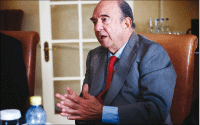
Emilio Botín, president, Banco Santander |
· Banks will continue to consolidate across borders
Cross-border growth is a very difficult challenge for institutions, regulators and supervisors. There are many pitfalls. But the benefits of having banks that span national boundaries is enormous. The economies of scale, efficiencies in allocating resources, the spread of innovation and best practice all point to a continuation of this trend once markets and economies recover from the current downturn. This will be a constant driver of change in international banking. · Competition will remain strong
Although more international banks like Santander and HSBC will emerge, there will be no oligopoly or dominant player. Instead, there will be a healthy blend of many small and medium-sized national banks providing local competition to a larger number of bigger, international players. This is partly because of certain competitive advantages local players enjoy in terms of their history, their role in their community or country and their ability to innovate. But it is also because banking and financial markets are, by their nature, highly competitive, and an innovation in price or services can almost immediately be matched by one’s rivals. Moreover, banking is essentially a low cost of entry business. These factors will keep competition alive.
· Business cycles will continue and will decide the fates of banks
Forty years is enough time for several business cycles to occur. The challenge for banks will be to remain prudent during times of growth and the excesses that usually accompany it, so as to be strong during times of downturn. This is not as easy as it sounds, as the latest crisis makes abundantly clear. It requires vision and self-discipline. But how well a bank’s leadership manages those cycles will be the most important factor in distinguishing successful from unsuccessful banks.
· The biggest challenges facing banks will be to recruit the most talented and most ethical people from their societies
There are many lessons to be learned from the crisis of the past two years, but I would say the most important one is that people matter. The human factor in leadership, strategy, management and execution has been the single most important differentiator between good banks and bad banks. To work in a bank, whether as cashier or chairman, is to assume a huge responsibility: you are safekeeping people’s savings, their security and their opportunities. Young people entering banking today and in the future must understand this, and not merely be joining a bank because “that’s where the money is”. That requires ethics, in character, education and training.




