The back office, as Euromoney wrote in 2006, has not only become a business differentiator, but has also possibly become a barrier to entry (see Centrally cleared FX: More players for FXMarketSpace, Euromoney, November 2006).
According to consultancy company McLagan (Z/Yen), the internal costs of processing an FX trade, which include operations and IT charges, ranged between $1.50 and $9.25 for tier-1 and 2 banks at the end of 2006. Those figures, which exclude other charges such as brokerage and settlement fees, will have since come down because the cost of maintaining a back office is largely fixed. This means that a greater number of tickets pushed through must result in a lower per ticket cost. But, with such wafer-thin margins, there is a danger that many smaller banks are being priced out of the market by their post-trade expenses.
Given the present wave of consolidation in the industry, this should cause concern, even to the large players that have been able to use their volumes, and subsequent lower processing costs, to gain a competitive advantage. The liquidity that has been added to the market by the banks that are now disappearing has to be replaced. If it is not, it is inevitable that the incredible volume growth rate seen in FX will slow. So the launch by Wall Street Systems of its Electronic Settlement Network (ESN) should prove welcome.
Agnostic view
Inevitably, any new settlement initiative in FX is almost immediately portrayed as a challenge to CLS. But Tony White, the managing director of ESN, is swift to play this notion down. He says that ESN should be viewed as an agnostic service that can connect to virtually any trading platform and be used to settle trades in whatever manner clients wish. That includes bilateral and multilateral netting, as well as CLS.
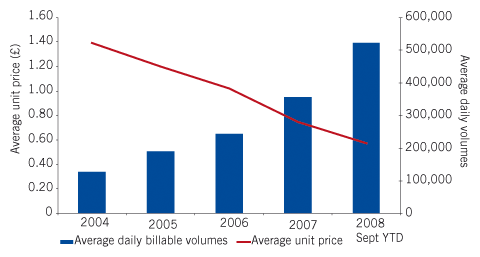
Average daily volumes and average unit prices |
£ per instruction |
 |
Source: CLS |
The fact that outsourced settlement is a feature in many other markets – Broadridge is a strong player in fixed income, for instance – supports the logic of what Wall Street is looking to achieve. As McLagan (Z/Yen) states: “To remain competitive, banks will need to invest in technology but, with decreasing margins, can the less profitable banks afford to update their applications to provide state-of-the-art functionality? Is the industry wasting its money in maintaining individual systems at individual banks?” Another issue is that even the larger players, which are able to achieve economies of scale, have to spend money maintaining what are essentially redundant systems, put in place to handle volume spikes that might or might not materialize. White says ESN can be used as an insurance policy or back-up by large tier-1 players to cope with sudden volume surges as and when they happen. By creating economies of scale by acting as the amalgamation point for the post-trade processes, ESD argues that it can deliver these to its clients. The theory is that this then makes their front-office activities more economically viable.
Industry is littered with the corpses of good ideas. But for the moment, the timing of the venture looks sound. White says all the infrastructure is in place and the company is signing up clients.



