The New Masters of Risk? How insurers are testing out their capabilities in finance
The New Masters of Risk? How insurers are testing out their capabilities in finance
Insurance poll results
Profiles
 |
|
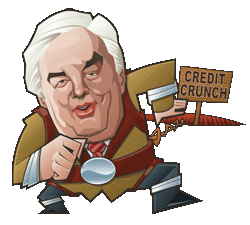
Martin Sullivan, CEO, AIG |
INVESTORS IN GLOBAL insurance stocks shuddered in February when auditors at AIG, the industry leader, announced that they had discovered a material weakness in the way the company valued credit default swaps. Just a few months earlier, AIG had suggested that it might take a write-down of a little over $1 billion on its credit portfolios. But when it published audited results at the end of February 2008, write-downs amounted to $11.1 billion, mainly in AIG Financial Products Corp, with a fourth-quarter group loss for 2007 of $5.3 billion. It’s a challenging moment for chief executive Martin Sullivan, who took the top seat at AIG three years ago when the legendary Hank Greenberg, who drove the company to its global leadership position, left amid a dispute over questionable accounting for reinsurance that entailed less than complete risk transfer.
Martin Sullivan admitted: “AIG’s results in 2007 were clearly unsatisfactory. This was a challenging year in which the deterioration of both the US residential mortgage and credit markets significantly affected several of our operations and investments.” Sullivan went on to warn investors: “During 2008, we expect the US housing market to remain weak and credit market uncertainty will likely persist. Continuing market deterioration would cause AIG to report additional unrealized market valuation losses and impairment charges.”
AIG executives are far from happy at having to report market value write-downs on investments whose cashflows they project might yet be largely unimpaired, leading to much lower recorded losses. But Sullivan promised: “We continue to invest in improvements in internal controls, processes, systems and overall effectiveness and will continue to assign the highest priority to remediation efforts over our material weakness in internal control and oversight over the fair value valuation of AIGFP’s super-senior credit default swap portfolio.”
Euromoney reported in its March cover story (How do you mark to market?, Euromoney, March 2008) on the increasingly impassioned debate over market value accounting at a time when many credit markets have clearly failed and are closing down. AIG has been one of the leading victims.
It’s just as well, then, that the company appears to be good at the day job. Customers Euromoney contacted rated AIG the best global insurance company, best globally for claims resolution, best at product innovation, with the best product range, and oh, the best for price as well. It’s also the top-ranked global firm for directors and officers’ liability insurance, a high-priority form of cover for corporate executives in today’s markets. Its global power is revealed in its top ranking in the regions of north America, western Europe and Asia.
Customer loyalty and depth of relationships are evidenced by the fact that AIG writes about 95% of the US-domiciled Forbes 2000 list, and averages about 6.5 product sales per firm.
Nicholas Walsh, executive vice-president of foreign and general insurance for AIG and president and chief executive of American International Underwriters, suggests that the company has clearly staked out the ground that its competitors are chasing of being a trusted risk management adviser bringing many skills and disciplines to large corporate clients.
Walsh says: “As the market leader, we have to defend our position and we do that in a number of ways. As far as price is concerned, we think our paper is worth more. For one thing, our claims service is unsurpassed for its breadth of experience and its global reach. We have hundreds of people in locations all over the world. There has been a globalization of liability for multinationals. Companies now operate in multiple countries, subject to US-style litigation, particularly in the management liability arena. In a class action from a group of US shareholders a corporation needs the breadth of an organization like AIG and its extensive global claims network.”
He stresses the importance in serving large corporate customers of focusing on product development. “AIG is unsurpassed in its ability to understand the dynamics of change in, say, legal dynamics, or environmental risks, or energy risks, and then create an appropriate cover and risk management protocol through this institutionalized AIG product development process. It’s invaluable to the customer. And that’s the way we create relationships: by bringing the whole of AIG to the customer.
“For example, you could take a look at the retail sector, and how contaminated product coverage (and malicious product tampering) has become more and more important to our customers. There’s a recent Freshfields study that points out that the increasing number of recalls in Europe has more to do with tougher regulation and heightened consumer awareness than poorer products. Yet, according to the study, many large companies remain unprepared. These are large risks: at AIG we’ve been writing them for years.”
Investors, customers and national regulators are increasingly focused on environmental protection and sustainability, bringing new risks and potential liabilities for customers to consider.
Walsh says: “There’s an increased demand for environmental solutions and we’ve responded with a number of initiatives and products, including property and pollution liability products that provide additional coverage to rebuild in an eco-friendly way. We’ve introduced an alternative energy underwriting unit. Because of our financial strength and experience, we can fill the risk management and insurance needs of these alternative energy clients, worldwide. To illustrate how the pieces fit at AIG, on the investment side, we’ve adopted a sustainability policy that makes sustainability an integral part of the analysis and management of investment portfolios, and in our financial products division, we’re launching carbon emission credit products.”
The AIG Consultants unit works closely with large corporate customers to analyse risk and create strategies to reduce or even eliminate the risks in the environmental, healthcare, energy and property sectors, among others. It also provides crisis management services in the instance of a contaminated product or malicious product-tampering incident or an environmental incident.
As an example of industry specialization, HSB Solomon Associates, an AIG subsidiary, provides benchmarking and consulting services to the energy industry with a global perspective and nearly 30 years of experience.
For now, investors’ concerns over AIG are focused more on its investment portfolio and less on the underlying insurance business. Yet many insurance industry participants Euromoney speaks to see worrying trends even in a low-loss environment with good returns that has now lasted for three years. There is a debate within the global insurance industry over appropriate capital management. Should insurers be preserving it, to protect against the bills coming due for Warren Buffett’s rented suits (see The New Masters of Risk?, Euromoney, April 2008), or for potential D&O claims that are sure to follow from the spectacular collapse of the credit markets? Should they be returning it , or investing it in the business?
Walsh shares this sense of concern: “There is a malaise in the industry that manifests after periods of low claims activity and good results. Insurers tend to invest the resulting build-up of surplus capital, rather than return it in the form of dividends or share repurchases. There has been a tendency for insurers to diversify into new product lines that aren’t perhaps fully understood, price for market share rather than risk, and acquire companies at multiples that are difficult to defend. When the excess capital is used up because of a significant natural catastrophe, or the mathematics of market share pricing breaks the business model, the only thing to do is withdraw or get prices up.
“Recently, we’ve seen a new dynamic, where new capital rushes in post-catastrophe. Greater competition may come from new sources as we saw in the brief hard property market after Katrina. New capital risk structures were introduced to take advantage of that market, which shortened the cycle for traditional insurers.
“In the western economy, we’re now in a slowdown, possibly a recession, with the inevitable constraint on credit. In certain countries, rates are creeping up. Australia and the UK are retreating from the spectacular results of three or four years ago due to significant natural catastrophes in the form of floods.”
For all this, Walsh doesn’t see the competitive landscape becoming any easier in a hurry.
“Unfortunately, I think you will see some new capacity increasingly desperate to write companies in this segment – the large commercial segment – which may lead to poor underwriting and pricing decisions, and lead to carrier insolvencies and a repeat of past mistakes. Fortunately, continuous innovation and a very deep product mix have helped AIG remain market leaders in this market segment (launching an average of one new product or service per week in 2007).