THANKS IN NO small part to their name, catastrophe bonds have always attracted attention. But they are only the most visible means by which risk is transferred from the insurance market to the capital markets – there are up to 15 other vehicles by which this can be achieved. These range from securities to derivatives, insurance-linked warrants (ILWs) and sidecars. Non-life risks have been transferred via club deals, cat bonds, collateralized insurance, sidecars and ILWs, and life deals have included life cat bonds, embedded value securitizations, surplus relief (Reg XXX) deals and life settlements.
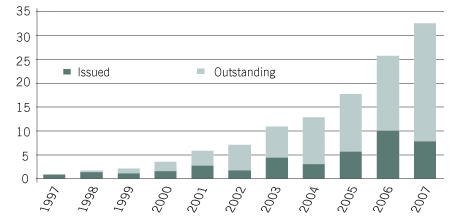
According to Swiss Re, total insurance-linked bonds outstanding at September 2007 totalled $32 billion. The risks backing these bonds have ranged from US wind, embedded value and extreme mortality to earthquakes in Mexico, Taiwan and the Pacific Northwest and event cancellation. But this has been a long time coming, and the much-vaunted convergence between insurance and capital markets has been a topic of conversation for a very long time. A random Google search on the subject brings up a research document entitled Evaluating the effectiveness of index-based insurance derivatives in hedging property/casualty insurance by the index securitization task force of the American Academy of Actuaries. This sounds pretty topical – except that it was published in October 1999.
Cat bonds were created in the wake of Hurricane Andrew, which caused widespread damage in the US in 1992. But by 2000 less than $1.5 billion of cat bonds had been sold into the market. This early inertia has been attributed to a combination of cost, insurance company recalcitrance and some criticism of how the banks initially approached the market. “In the early days the banks did not approach this in the right way,” claims one observer. “They tried to kill the competition, which is why reinsurers now view cat bonds as a threat.” Although it is always hard to change behaviour in a market, relationships between insurers and reinsurers are particularly entrenched. “They price twice a year and the rest of the time they socialize and play golf,” the observer muses. “The brokers are very tight with the companies so it is very hard for the latter to tell them that they are doing a cat bond – it absolutely has to come from the top.”
According to one banker, there are generally three types of approach to cat bonds among insurance companies: “There is one class that sees insurance-linked securities (ILS) as strategically important in managing the balance sheet, a second class that makes lots of noise about doing a cat bond but never does and a third class that just cares about the bottom line and will not look at it.” So the key job of the banks is to try to get as many companies in the second class as they can to move into the first.
This job was made a lot easier by the events of 2005, when the US was battered by three severe hurricanes in quick succession: Katrina, Rita and Wilma (known in the trade as KRW). Losses caused by KRW totalled $56.2 billion. To put this in perspective, losses post-Hurricane Andrew were $15.5 billion and those caused by the World Trade Centre attacks in 2001 hit $18.8 billion. The result was that the traditional reinsurance market’s capacity for catastrophe cover was quickly exhausted and cat bonds rapidly came to the fore as an alternative. Reinsurance industry capital-raising post-KRW totalled $34 billion. In 2006, total new issuance of insurance-linked securities more than doubled to $4.92 billion from $2.13 billion. And even though the hurricane season in 2007 was relatively benign, cat bond issuance has continued to grow. “There has not been an event in this market for several years and reinsurance costs have fallen – but there was $7 billion of cat bond issuance in 2007,” explains John Dziadzio, global head of insurance capital markets at Lehman Brothers in New York. “Realistically, traditional insurers have capacity constraints so this provides an additional level of capacity.”
 |
|
“Credit and insurance are not correlated. We placed cat bonds in December at tighter levels than we expected – most of the issuance in this market has placed tighter recently” |
The arguments for catastrophe bonds can be compelling, and certainly KRW has helped acceptance of the concept since 2005. In 2007, John Seo, co-founder of dedicated ILS investment fund Fermat Capital Management, claimed that it might be reasonable to forecast another tripling of the cat bond market to $50 billion in five years’ time – and even another tripling to $150 billion in liquid cat bonds outstanding 10 to 15 years hence. His reasoning? “The amount of property value we put into every square mile in key US and overseas earthquake and hurricane zones is doubling every 10 years,” he told the US House of Representatives in September. “On the other hand, global reinsurance and insurance capital available to earthquakes and hurricanes does not double every 10 years – it probably increases something like 35% every 10 years. This fundamental shortfall between risk and capital growth is what will drive cat bond supply.” The benefits of the structure are sold on the basis that it reduces uncollateralized exposure to the reinsurer, can provide multi-year cover and can be competitive on cost and pay out more quickly. Direct exposure to the reinsurer is an obvious concern for companies looking to offset catastrophe-type risks – or “peak peril” risks. “Peak peril risk is the most concentrated risk and you cannot diversify out of it,” observes Nelson Seo, managing principal at Fermat Capital and co-founder with brother John. “Insurance companies used to be prepared to take it on because there wasn’t much of a capital charge against it but things are very different now and people need to get rid of this high-end risk.” The problem with peak peril risk is that insurance companies are looking to hedge the type of risks that occur once every 100 or 1,000 years. And in such a situation you can be pretty sure that any reinsurance company that has provided traditional reinsurance cover will no longer be around.
Multi-year cover has obvious advantages for an industry that saw reinsurance premiums rocket and capacity disappear after KRW. It was this dynamic that saw the rise of quota share non-life insurance deals (or “sidecars”), where hedge funds were able to provide short-term capacity by essentially sharing the risk with the insurance company (see Calmer days after hedge funds’ whirlwind success, Euromoney, April 2008). But market conditions today are very different: the price of reinsurance fell by 10% in 2007 and is likely to do the same in 2008. Temporary capital in the form of sidecars (which are simply products of the cycle) will disappear and the case for cat bonds on a pure like-for-like cost comparison will be increasingly tough to make.
Judging by the pace of activity in the cat bond market in 2007, the logic of the concept seemed to be gaining traction in the insurance industry. Immediately before the credit crisis of the summer, a series of deals hit the market that seemed to push the envelope of cat bond technology. In June, Aon Capital Markets, Citi and Merrill launched the largest cat bond ever, the $4 billion Merna Re deal. The $500 million three-year triple-A notes priced at 50 basis points over Libor and $1.2 billion double-As priced at 150bp over. May 2007 saw the first catastrophe collateralized risk obligation (CRO). This was a $310 million deal issued by Nephila Capital, which was structured and distributed by Goldman Sachs, called Gamut Re. “This was a diversified portfolio of natural catastrophe insurance risk,” explains Michael Eakins, responsible for originating, structuring and distributing ILS at Goldman Sachs. Gamut was significant as it allowed active management of the insurance pool and involved three classes of notes being issued: single A minus paper came at 140bp over, triple B minus at 300bp over and double B minus at 700bp over. Swiss Re was also instrumental in another market innovation mid-year, the $140 million Fusion 2007 cat bond, which was the first deal to reference an existing cat bond. The deal offered protection against Japanese typhoon and Mexican earthquake risk – and used the existing Cat-Mex bond issue as a trigger.
Earlier in the year another Swiss Re deal had been the first of its kind to reference earthquake risk in central America (namely El Salvador and Guatemala) – the $895 million GlobeCat issue.
Life skills
Along with cat bonds there has been encouraging growth in the volume of life insurance securitization. The first products to take off in this segment were embedded value monetizations (which securitize future cashflows from a closed book of life insurance policies) but recently Regulation XXX deals have boosted issuance. In the US, life insurers are required to hold statutory reserves in excess of economic reserves, and they have used securitization to fund the difference between the two – freeing up capital in the process.
According to Swiss Re, this sector has now reached $20 billion to $25 billion in size. And deals have been done since the debt market ran into trouble: Bank of Ireland inked a €400 million embedded value deal (dubbed Avondale) at the end of October last year and Prudential has completed a Reg XXX deal in the US.
The question now facing the ILS industry is whether this pace of growth can be maintained in today’s fast-deteriorating market conditions. The securitization concept has taken a mighty battering over the past nine months, and investors remain largely paralysed as the much-anticipated new-year recovery fails to materialize. Ambac wrapped €380 million of Bank of Ireland’s Avondale trade to triple-A. Would such a trade be possible today? Luca Albertini, managing director in financial services at Swiss Re, does not think so. “I don’t think it would be possible to do a monoline wrapped deal now but an unwrapped deal would be possible,” he says. “We did the first embedded value trade without a monoline (the Queensgate deal) in 2005.” Even if a monoline wrap could be found, appetite for triple-A paper is a fraction of what it was a year ago. Indeed, some in the market claim that deals are only getting done because underwriters are guaranteeing execution. “The balance of power has shifted,” says one. “These are complicated transactions with high execution costs – originators need to be sure that the deal will go through in these markets. Banks are guaranteeing execution in the hope that the market will become rational again and they can offload the risk.”
But bankers remain confident that the performance of the life and non-life ILS market throughout the recent turmoil will act as a magnet for new money to the sector. “The marketplace for ILS is an oasis of calm. This is the one market that has remained open,” says Eakins. Albertini at Swiss Re agrees that the stability of this asset class has caught investor attention. “Non-investment-grade notes have been unaffected in their secondary market values by the turmoil, so investors can see that this market is not volatile,” he explains. “Credit and insurance are not correlated. We placed cat bonds in December at tighter levels than we expected – most of the issuance in this market has placed tighter recently.”
But does this mean that funds will now allocate away from their traditional business and towards insurance? This depends on their risk appetite. Albertini is confident that this will be the case. “We have a lot more buyers than before,” he says. But unwrapped ILS rarely achieves a rating above single-A and given the type of spreads now on offer in the credit market, it may struggle to compete. “I don’t think that investors are looking at insurance as an alternative to their core markets,” says one ILS investor. “They are looking at their core markets – say, RMBS – and seeing how good the spreads are.”
The recent $1.5 billion mortality bond issued in February by Munich Re saw single-A minus paper issued at 135bp (see Munich Re sells the ultimate risk, Euromoney, April 2008). Single-A paper from Swiss Re’s Vita Capital mortality bond programme has been at 120bp, but you can now buy triple-A rated mortgage paper for that spread. Data show that spreads on a series of cat bond programmes tightened in by between 17% and 33% to August 2007 – even as the credit crunch began to bite. But continued spread tightening could have a detrimental impact. “There is a lot less appetite for cat bonds at current rates,” reckons one observer. “There is no doubt that money has gone from this space. Demand is still somewhat outstripping supply but people are patient. They will not chase spreads down.”
 |
“Traditional reinsurers have now realized that capital markets distribution is the way forward” |
Dziadzio at Lehman is confident that appetite for ILS will remain despite the attractive spreads now on offer elsewhere. “This is uncorrelated risk and you need to have it in your portfolio,” he explains. “The state of stress in the markets has impacted this market and both specific ILS funds and multi-strategy funds are focusing on deleveraging. This is taking the focus away from new issues but funds are looking to add expertise and to continue to increase their exposure to insurance.” Cat bonds do have a very good track record considering their ratings: just one non-investment grade bond has tripped a trigger – a double-B rated note issued by Kamp Re. Tighter spreads should make cat bonds a more attractive proposition for the insurance companies themselves – even in the face of the falling cost of reinsurance itself. And that could include smaller insurance companies as well as the larger regional players that have already done deals, such as State Farm. “There are 2,000 property and casualty companies in the US that could do this,” says Steve McElhiney, president at reinsurance intermediary EWI in Texas. He advocates taking a pooled approach, whereby smaller companies could join forces in order to achieve the critical mass for a cat bond, and is talking to a number of companies in Bermuda to cultivate the idea. “There is a general awareness of the product among these firms and if you signed up all the companies in a certain region then you could undertake pooled transactions.” The logistics of such an undertaking do appear daunting but if smaller companies could be persuaded of the benefits this is a huge pool of potential business.
McElhiney argues that comparing cat bonds and reinsurance on a like-for-like basis does not make sense. “When people compare cat bonds and insurance-backed CDOs with traditional reinsurance they are just looking at the dollar cost but this is the wrong way to approach it,” he explains. “You need to look at the time value of money. With a CDO or Cat bond, if there is an event you are going to get your money back much faster.”
It is certainly true that the simpler the cat bond structure, the faster its payout mechanism will be. And the speed with which that process takes place is very much contingent on the nature of the triggers that are embedded in the structure. A straightforward structure involving a parametric trigger could involve investors being paid out two to three months after an event – far faster than under a traditional reinsurance contract, which requires evidence of loss. Indeed, one observer tells of a conversation with a disgruntled reinsurance client still waiting to get paid out after the World Trade Centre event – not the attack in 2001 but the bombing in 1993.
Trigger happy
Cat bond triggers can be pure parametric, indemnity, industry index, parametric index or modelled loss. Parametric triggers are based on certain event characteristics such as hurricane intensity or specific earthquake magnitude and are tailored to events with certain predefined physical parameters. Indemnity triggers closely replicate traditional reinsurance in that they are linked to the actual loss sustained by the cat bond issuer. Industry triggers are linked to wider industry losses (as measured by indices such as the Property Claim Services (PCS) index). Indemnity triggers were initially popular in that issuers were comfortable with the concept but they can cause problems because of the sheer time it takes to calculate actual losses after an event – and the need potentially to reveal sensitive company data. An index trigger might seem like a more straightforward solution but this introduces basis risk into the transaction: the risk that the losses to the issuer of the cat bond might not be particularly closely correlated with overall industry losses.
|
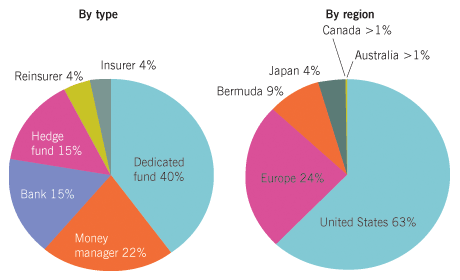
Who is buying ILS? |
|
Investor segmentation |
|
|
Capacity surge post-KRW |
|
Total ILS outstanding, by year |
|
|
Source: Swiss Re |
Dissatisfaction with the various index approaches has led to the development of more hybrid triggers in an attempt to make cat bonds more attractive. “An indemnity trigger is not applicable for all insurance clients,” admits Eakins at Goldman Sachs. “But indemnity transactions were getting done in 2007 and are getting done in 2008,” he says. “If you have robust management you can get an indemnity transaction done and take the basis risk off the table.” Indeed, according to Swiss Re, while just 4% of cat bonds in 2006 had indemnity triggers, this percentage had risen to 46% in 2007. And hybrid triggers are mitigating the basis risk inherent in index triggers. “There is a trade-off between the amount of basis risk you want to transfer and what you want to pay.” In the recent Glacier Re deal, a $75 million cat bond covered US earthquake and hurricane risk and wind storm risk in Europe. The three-year deal incorporated index triggers for the US events and modelled loss triggers for the European wind storm events. “With the Glacier Re deal (Nelson Re) we took the PCS index and applied weightings to it to reflect Glacier’s business model, which helped reduce the basis risk to a negligible level,” says Eakins. The single-B rated deal paid 1,190bp over Libor. The fact that the Glacier Re deal used an index trigger for its US exposure highlights a concern for the cat bond market in Europe – the lack of an appropriate index to reference a trigger to. This is something that the Chief Risk Officers (CRO) Forum is working on with the industry in the hope that it will act as a spur for more capital markets activity in the region. “We are working on a European index and hope that it will be in place next year,” says Albertini at Swiss Re. “We need a transparent, reliable index which involves the majority of the market. That will facilitate more ILWs in Europe.”
Another development that might facilitate more ILS across the board in Europe is the introduction of Solvency II, the new capital adequacy regime for the European insurance industry. This is due to be in place by the end of 2012, and uncertainty over its timing has dampened down some activity. “Solvency II will stimulate change as it will require insurance companies to examine their exposure to reinsurers, and hold capital against the associated risk of counterparty default,” says Eakins.
Dead cert
If it wants to maintain the hard-fought momentum that it has now achieved, the job of the ILS industry is to standardize products as much as possible and apply them to new risks. And the risk that could really unlock the market is longevity risk.
“This is the holy grail,” says Albertini. “People want to buy longevity risk protection but there has always been a huge gap between bid and offer.” New mortality tables have enabled pension companies to price risk on a more arm’s length basis and to apply a discount factor, and this has generated the real transfer of longevity risk on a bilateral basis, particularly in the UK. At the beginning of March, for example, Goldman Sachs subsidiary Rothesay Life bought the pension scheme of gaming group Rank, just the latest in a series of pensions buyouts in the market.
There have been a handful of securitizations in the extreme mortality space but what this sector needs is credible mortality indices and this is something that the industry is working hard to create. JPMorgan (which declined to speak to Euromoney for this article) has developed a series of mortality indices and in mid-March Deutsche Börse launched its Xpect indices – which are initially focused on life expectancy and mortality in Germany but will be expanded to include the UK and the Netherlands. If such indices are widely accepted, and basis risk in individual deals mitigated, then the growth potential for this part of the ILS market is tremendous.