Munich Re sells the ultimate risk
 |
|
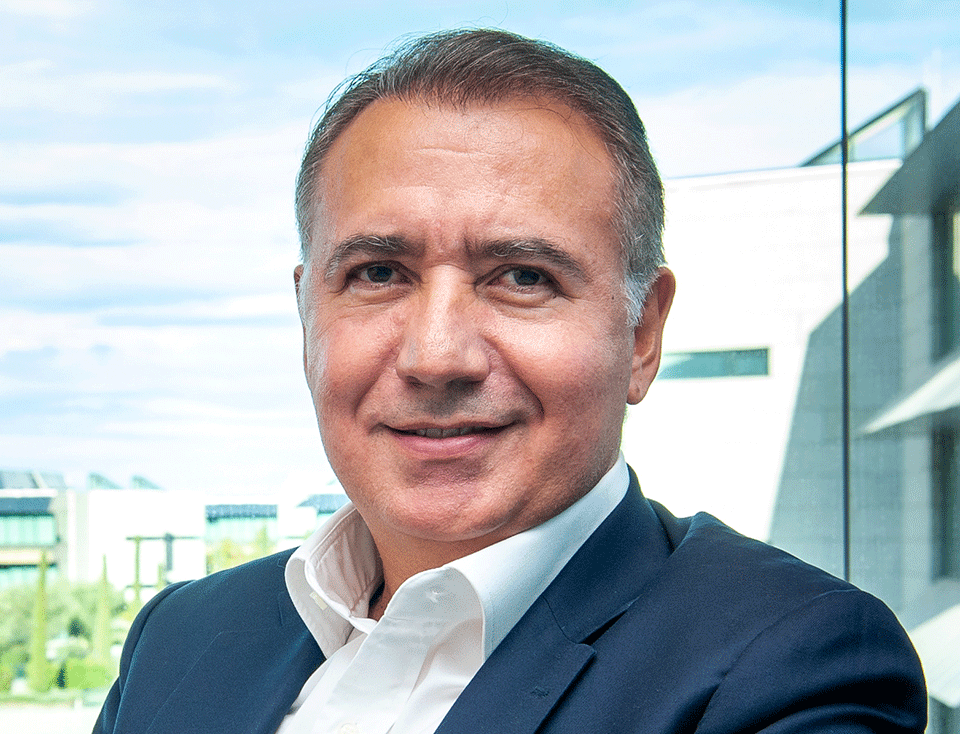
“We are considering longevity derivatives and branching out into other insurance asset classes” |
WHEN THE WORLD’S largest interdealer broker plunges into a new financial market, it’s a reasonable bet that it is one set for substantial growth. In February 2007, Icap, which boasts a daily transaction volume of more than $1.5 trillion in interest rate, credit, energy, foreign exchange and equity derivatives markets, established a joint venture with insurance broker Jardine Lloyd Thompson to operate in the markets where insurance, financial derivatives and securities are converging. Setting up operations took time and it wasn’t until late last year that it completed its first deal, an over-the-counter catastrophe swap on North American windstorm risk of undisclosed size between two unnamed counterparties. Since then, business has been brisk, Michael Spencer, chief executive of Icap, tells Euromoney. “Icap-JLT began broking its first catastrophe derivatives in December 2007, and has since brokered a number of both wind and quake swaps.” He says: “We have also recently expanded the business to include a secondary market cat bond broking business, and have completed a number of cat bond transactions as well.”
The insurance-linked securities primary market enjoyed a breakthrough year in 2007, with 27 public deals worth $7 billion, up from the $4.7 billion issued in 2006 and just $2 billion in 2005. While hedge funds, dedicated insurance-linked securities funds and even conventional institutional investors have all taken note of rising new-issue volumes, less attention has focused on the growing private secondary market, where, depending on who you ask, volumes in insurance-linked securities are now anywhere between $3 billion and $7 billion a year compared with total outstandings of $13 billion.
The catastrophe swap market is estimated to be anywhere from $5 billion to $10 billion a year.
At first sight, those are modest sums but they illustrate how the insurance derivatives and Cat bond markets are moving to a second stage of development. New capital markets investors have taken on catastrophe risk for a diversification benefit relative to their conventional fixed-income and equity portfolios. Similarly, some money managers have taken such exposure through derivatives, typically on a buy-and-hold basis. Now active secondary trading is beginning and the intermediation of specialist brokers promises more efficient and transparent price discovery.
The main participants in the insurance derivatives markets are reinsurers looking to refine their portfolios by handing off or acquiring specific risks, hedge funds attracted to the low correlation of insurance returns, and banks managing their own and third-party money. They can each be buyers or sellers of insurance risk, which is typically quoted by three metrics: geographic territory, type of peril (often wind or quake) and attachment point, often the level of industry-wide insured loss at which a seller of protection may lose principal. So, for example, Icap might seek to match anonymously potential buyers and sellers of Florida hurricane risk to a limit of $100 million.
Insurance-linked derivatives are an advance on warrants, which principals used to exchange on a buy-and-hold basis. Robert Turner, director at Icap-JLT, says: “What appeals with OTC derivatives is their flexibility, tradability and low frictional costs. The contracts are Isda-based and the frictional costs are lower than those in the traditional reinsurance market. There can also be trading opportunities for protection buyers and sellers. If you sell, say, a $10 million limit Florida wind swap at a price of $2 million and it turns out to be a quiet wind season and prices fall, you might be able to buy that back at $1.5 million.” Similarly, of course, a reinsurer or hedge fund that has bought cheap protection might look to take profits if rates rise in a season of extreme weather.
Young market
That’s the intention. But the market is still very young and hasn’t operated through a full annual wind season yet.
Spencer has no doubts though. “The potential for this market is very significant and there are a number of risks that could lend themselves to capital markets products,” he says. “However, we consider our near-term opportunities to be in the catastrophe field – life catastrophe would be an obvious extension of our existing business. In the medium to long term we are considering longevity derivatives and branching out into other insurance asset classes.”
The business is not a perfect one. Buyers and sellers of derivatives have to be matched anonymously and if, when terms are agreed and names of principals are finally disclosed, it turns out that one side is full to the limit on the other’s credit, then a transaction might fall away. But over time, greater liquidity, transparency and more efficient price discovery might transform the market.
Spencer says: “The traditional insurance market cycle is one of peaks and troughs, with insurance rates hardening, or becoming more expensive, in line with catastrophic events. The role of Icap-JLT is at the point where the insurance and capital markets converge and we aim to assist in smoothing out the peaks and troughs of this traditional cycle and the ensuing volatility for the markets, increasing liquidity for all market participants.”
The main players in these new insurance-linked derivatives and securities market are the reinsurers. These wholesalers of spare capacity to the primary insurers play an important role in enabling insurers to generate business through their expensive distribution networks, in the comfort that they can lay off exposures if unhealthy concentrations arise. Insurers are taking an increasingly scientific approach, measuring, for example, storm patterns and incidence of large storms making landfall and matching these very precisely, using GPS technology, against their own geographic exposure. If they conclude that their front-end sales and distribution networks have produced too much exposure in one location and perhaps too little in another to give an optimal portfolio of similar risks subject to different triggers, they go to the reinsurers.
The reinsurers themselves, in seeking to further refine these exposures, might be attracted to any pool of capital to which they might cede risk at a price, including to hedge funds, to specialist sidecars and capital markets investors.
Right now, however, amid soft rates, abundance of capital and low recent catastrophe losses, insurers are retaining more risk and ceding less to reinsurers. So it seems odd, in such circumstances, that the catastrophe bond market should have enjoyed its busiest year to date. Could this be a sign that capital markets takers of insurance risk have graduated from the merely opportunistic – appearing only when large insured losses such as 9/11 and Katrina lead to hard markets and then disappearing when rates soften – to being a more reliable and established feature of the insurance business?
Greg Case, chief executive of Aon, the leading insurance broker, says: “Rates are likely to soften further this year, though at different rates in different sectors. The claims environment is pretty benign at the moment, which will tend to keep rates soft, as will the hangover from record underwriting profits.
“It’s not just the amount of capital that’s available; it’s the speed with which it enters or leaves the insurance markets that is important. With sidecars and other special purpose vehicles we expected to see marginal capacity moving more quickly than before but there’s little sign of that yet, despite the sub-prime crisis. Insurance risk returns might be lower than year on year due to the soft rating environment but it is still more attractive than many other areas of investment and we would expect strong interest in the capital markets in 2008 from hedge funds and other capital providers.”
Lingering uncertainty
There is, however, a lingering sense of uncertainty within the industry of how to address new pools of capital from bond investors and hedge funds at a time of apparent over-capacity. The criticism from the insurance establishment is that such capital is short-termist and volatile. Yet, of course, capital availability is a good thing.
Suspicion works both ways. Capital markets investors have in the past shown a general reluctance to take indemnity-based insurance risk from the industry specialists and instead showed a preference for deals with so-called parametric triggers. That is, instead of simply taking a parcel of risk from one reinsurer and promising to take a share of the losses for a share of the premium, capital markets investors have seemed – oh, cynical world – to fear that they will be handed the worst risks at the thinnest price.
Rather, they have preferred deals that either take their loss-triggers from industry-wide insured losses or, better yet, are calibrated against an independently administered and verifiable index. That of course increases the basis risk for issuers of catastrophe bonds between their own actual loss experience and what the outside trigger may denote in cover.
Yet in 2007 there were more indemnity deals written than ever before. Could this be a sign that capital markets investors in insurance risk feel increasingly confident they have mastered the insurance industry’s inner workings?
There is an obvious attraction for a capital-intensive industry in having other providers of capital, perhaps with different views on underlying risks and different price expectations, to deal with. However there is also the risk of potential competition.
For now, it is mainly reinsurers that deal with capital markets investors and swap counterparties from the wider financial world. Could not primary insurers go straight to those same capital markets investors, without first ceding risk and premium to reinsurers, and so cut out the middleman? And could corporations conceivably take the same leap, by-passing the insurers themselves?
In October last year, East Japan Railway, one of the world’s largest passenger rail operators, serving 16 million passengers a day, sold a $260 million bond to gain protection on Japanese earthquake risk. It used Munich Re as a pass-through reinsurer. But the deal prompted talk of whether other utility-type corporations might seek insurance protection directly in the capital markets.
Catastrophe bonds typically have multi-year terms, whereas most insurance and reinsurance contracts are renewed annually. In the aftermath of extreme events, traditional cover can be hugely expensive or unobtainable. After 9/11 some corporations found themselves in the uncomfortable position of being unable to renew property insurance at year-end and going uncovered into 2002.
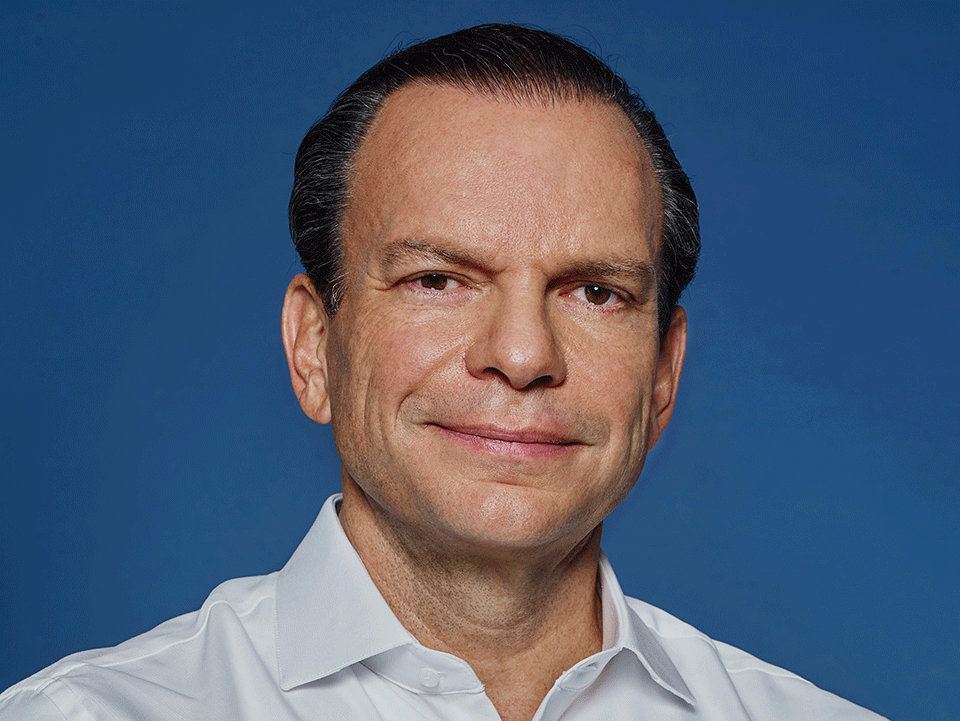
“Look,” says Joseph Plumeri, chairman and chief executive of Willis Group Holdings, the insurance broker, “at a time when the total amount of risk to be insured in the world is increasing all the time, the total capitalization of the insurance industry worldwide is only $600 billion to $700 billion. It may not be comparing like for like but there are several individual banks with balance sheets of their own bigger than that. The total capacity of the Lloyds balance sheet is anywhere between $16 billion and $35 billion. Citi [Plumeri worked for many years running various divisions of Citi for Sandy Weill] has a balance sheet of $1.5 trillion. What does that mean? Well, if the insurance industry doesn’t do things better – write better policies, settle claims better – then others may do it for them. Risk capital will seek places to go and investors and investment banks will be much more curious about insurance as their returns decline elsewhere and the risk on other exposures they’re holding goes up.”
The insurance derivatives and securities markets have grown beyond being a mere sideshow. At the very least they have broken the boundary between the world of insurance and the rest of the financial markets.
Clement Booth, chief executive of the global corporate and specialty group at Allianz and member of the Allianz management board, doesn’t even like to talk about the so-called convergence of insurance and capital markets. “The insurance world is part of the capital markets world and always has been. Now, if I am an investor and I want to take insurance risk, I can buy the shares of an insurance company, or, if I would like to be much more specific and see flood or earthquake risk as having low correlation to the rest of my portfolio, can buy a particular securitization.” He adds: ‘There is space for both long-term and short-term capital markets investors and I think we can and will do more to offer them investment opportunities beyond simply insurance stock. The transaction costs have come down significantly and there may be times when it will be preferable to securitize rather than reinsure.”
While most capital markets activity up until now has centred on natural catastrophe risk, which accounts for 40% of insured losses, the bigger opportunity by definition is in non-catastrophe risks. Motor insurance risk is one that is being explored. There have been several deals based on risks of pandemics (see Munich Re sells the ultimate risk, Euromoney, April 2008).
To date, the experience of investors has been highly favourable. Losses have been rare and small. Perhaps for the simple reason that insurance deals securitize liabilities, investors have engaged in hefty due diligence to understand the risks. Ironically, the losses investors then suffered on asset securitizations have turned out to be enormous by comparison. And this may explain the appetite even for indemnity-based deals.
Booth says: “As data standards, modelling and access to information have improved, this is all very viable. And if a reinsurer can be comfortable taking a share of your portfolio’s premiums and losses, there’s no reason that can’t also work with capital markets investors. If they can be comfortable that you are on top of the underlying risks, then indemnity-based transactions may become more common.”
Buyer beware
Buyers of insurance risk need to be wary, though. In recent months, insurance rates have come down. These rates are analogous to insurance bond coupons and, in a falling rate environment, bond prices should be rising. In fact, they have been falling. Perhaps this is a sign of forced selling by certain holders, including leveraged investors, of good investments to cover ever mounting losses in the credit markets.
It’s a lesson that while insurance-based securities might occupy their own little niche, they are not entirely divorced from the rest of the financial markets and might suffer in tandem with them.
Investors perhaps would do well to question their own assumptions on correlation. It is all very well today, when insurance losses are low, to justify taking on the risk of hurricane, earthquake or even an outbreak of bird flu on the basis of negligible correlation to bond and equity market risks. But if a catastrophe is big enough or a flu outbreak deadly enough, then conventional financial markets will crash too and correlation to that catastrophe bond will shoot from negligible to near complete.