
More on sovereign wealth funds

A PROJECT IS under way to turn a quiet little town into one of the world’s most famous capital cities.
Sitting atop immense oil and capital reserves, Abu Dhabi is already cementing its position as a financial powerhouse. Its recent $7.5 billion lifeline to Citi demonstrated that.
With huge financial muscle behind it, Abu Dhabi is no longer content to play the sleepy neighbour to Dubai. Nor is it content to quietly invest and reinvest abroad in small stakes of equity, real estate and debt. It wants to concentrate more on putting its resources to use at home; and it wants others to help it do so.
“In America, when you say you’re from Abu Dhabi, almost nobody has heard of it,” says an Abu Dhabi businessman. “But when you say you’re from somewhere near to Dubai, people’s faces light up.”
Envy and admiration of Dubai’s status are important forces behind the will to make Abu Dhabi city, in its government’s words, a “great world metropolis”.
But the chaos Dubai has thrown up with its real estate development has also convinced the rulers of Abu Dhabi to adopt a more careful, planned evolution. Dubai, it is recognized, has become the region’s hub extremely quickly. But there are concerns that crime in Dubai is increasing. Traffic congestion is paralysing the city, and the economy is overly dependent on debt and a seemingly never-ending real estate bubble.
“Dubai could be anywhere,” says a Dubai banker. But Abu Dhabi wants to retain its Arabian character. It wants to construct the infrastructure before the real estate, and attract a higher class of visitor.
Building to last
Abu Dhabi’s 67,000 square kilometres make it by far the biggest and most powerful of the seven United Arab Emirates. With 9% of the world’s proven oil reserves, Abu Dhabi could maintain rates of oil production for the next 100 years. It has nearly 5% of the world’s gas reserves too.
But Abu Dhabi reportedly gains more income now from its financial investments than from its oil revenues. For financiers, it is home to the fabled Abu Dhabi Investment Authority: the world’s biggest sovereign wealth fund, and one of the most secretive.
If Abu Dhabi’s wealth were split equally among its citizens, they would have (at a conservative estimate) at least $2 billion each in international financial investments. Abu Dhabi’s $46,000 GDP per capita is one of the highest in the world. But that figure takes into account 1.4 million residents of Abu Dhabi. If only the 350,000 or so Abu Dhabi nationals were considered, per capita GDP would be more than $500,000.
It was partly to make up for its lack of the resources that Abu Dhabi can boast that Dubai, the second largest of the United Arab Emirates, decided to embark on its transport, tourism, and real estate boom.
Abu Dhabi is now following with a port whose capacity will be greater than that of Dubai’s Jebel Ali, which is the Gulf’s busiest port. Abu Dhabi is also establishing the world’s biggest industrial free-trade zone, which will house the world’s biggest aluminium smelter.
An estimated $100 billion will be invested in infrastructure projects in Abu Dhabi over the next five years, and the emirate’s population is expected to double in the next decade. But the most visual expressions of both Dubai and Abu Dhabi’s expansions encapsulate the differences between their economies.
Developers in Dubai have become famous worldwide for constructing flamboyant man-made islands that reach out in patterns into the Gulf. In contrast, Abu Dhabi is already surrounded by a number of natural islands that it is colonizing as it grows.
In order to house new districts of the city, these natural islands need to be protected from the sea and to be furnished with roads, water supply systems, drainage, and sewerage.
“These are comprehensive developments,” says Gurjit Singh, chief property development officer at Sorouh, one of Abu Dhabi’s biggest developers.
Even so, the opportunities and costs of building on islands that already exist would seem to be far more attractive than Dubai’s experience.
In addition, rather than primarily being places for people to live, Abu Dhabi’s islands are trying harder to be places where people would go to have fun and to make money. For example, Abu Dhabi city’s biggest island development, the $27 billion, 27 square kilometre Saadiyat, will contain both businesses and homes, and will focus on providing cultural activities. Among other attractions, it will house a branch of the Guggenheim Museum, as well as the first subsidiary of Paris’s Louvre.
Further to the southeast, Yas Island will include a Formula 1 motor-racing circuit, as well as the world’s first Ferrari theme park (Mubadala, a state-owned investment fund, has a 5% stake in the Italian car maker) and Al Suwwah Island is to be the heart of the city’s financial district, and will house an outlet of the Cleveland Clinic, a US teaching hospital.
A concerted effort
“The approach to the city is very visual, symbolic, and memorable. For example, it is proposed that the Boulevard will travel under seven high arches, representing the seven Emirates of the UAE, and terminate at the main capital square.”
This is an excerpt from Plan Abu Dhabi 2030: a 180-page document that sets out “themes to be refined in further planning and design” as well as conceptual land-use plans and street patterns. Conceived with an eye to the high quality of life enjoyed in Vancouver in Canada, it is meant to provide a guide for the Urban Planning Council, a government agency created last September.
Abu Dhabi, the document says, should be a “contemporary expression of an Arab city”, with measured growth and a sustainable economy. A will to avoid the bad memory of Dubai is evident everywhere.
“We have to follow guidelines in Plan Abu Dhabi 2030 for the creation of balanced communities. We come up with more detailed plans, which have to be approved by the Urban Planning Council,” says Singh.
Yet perhaps more important to the practicability of Abu Dhabi’s new vision for itself is the extent to which the various fiefdoms in the emirate share the dream. The development of Saadiyat, for example, might demand the cooperation of the heads of the state departments of transport and tourism, as well as the cooperation of the head of the department of water and electricity.
“Abu Dhabi has announced plans like this in the past, but the will and drive for change was not there,” says Jeremy Parish, chief executive of Abu Dhabi and Al Ain at Standard Chartered.
It might be different this time. No less than seven highnesses and 11 excellencies from the government of Abu Dhabi have formally pledged to coordinate their departments towards goals specified under the authority of the president of the UAE and the ruler of Abu Dhabi, Sheikh Khalifa bin Zayed. They have signed a document, entitled Policy Agenda 2007-2008, which commits Abu Dhabi to “strategically expand the industrial sector” and create “a global city” with “a dynamic business environment”.
A statement attributed to Sheikh Khalifa says: “The publication of this agenda signifies the beginning of a new era for our government and public sector, in terms of accountability and transparency.”
Standard Chartered’s Parish says: “It is a huge step forward.”
Sheikh Khalifa & Co
One of the first requirements of Policy Agenda 2007–2008 is that the government should be restructured, and that the services it provides should where possible be outsourced to the private sector. An “ideal environment for local and foreign investment” should be created, with “the private sector the main driver of economic growth”, it says.
A source at the government of Abu Dhabi tells Euromoney that the number of government employees has already dropped from 65,000 in 2005 to 14,000 and is still falling. However, state ownership pervades so much of Abu Dhabi’s economic life that it is sometimes difficult to see where the private sector begins and ends.
 |
|
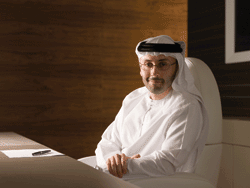
“The government should act as a regulator not as an actor in the economy” |
This is perhaps inevitable when a citizen body of just 350,000 has such massive resources, and when members of the same extended family necessarily head both the state and the government. As royals throughout the ages have found to their chagrin, if one is born into office, it is difficult to have a private life. “The government should act as a regulator, not an actor in the economy,” said Waleed Al Mokarrab at a conference in Abu Dhabi. Al Mokarrab is the director general of the Economic Development Council.
Abu Dhabi’s privatization drive, however, sometimes seems more about marketing and different management styles than about systemic change. Its policy documents could be said to support top-down, dirigiste expansion.
The United Arab Emirates has been a member of the World Trade Organization since 1995. But Abu Dhabi is run like a massive family office. It tries to look and act like a company. So capitalism in Abu Dhabi has become a labyrinth of interacting quasi-governmental agencies and departments that try to compete at the same time as co-operating.
“The country pays its citizens dividends,” is how an Abu Dhabi businessman puts it.
Phoney capitalism
The workings of Abu Dhabi – the corporation – can be seen in miniature in the Abu Dhabi Investment Company.
From its birth in 1977 until two years ago, Adic was a part of the Abu Dhabi Investment Authority, which focused on regional and domestic investments. But in 2006, Adic’s ownership was transferred to the newly created Abu Dhabi Investment Council, a body that also took on board Adia’s domestic holdings that were not held under Adic.
Adic, which still focuses on the Middle East and North Africa, has separate groups for treasury and credit, asset management, real estate, private equity, and infrastructure. The asset management section, for example, has a staff of 20, including analysts, traders, and portfolio managers, with a focus either on the Gulf or on the rest of the Middle East and North Africa.
Its infrastructure lending has mostly been in Abu Dhabi, particularly to majority government-owned water and power companies. But last November Adic led the financing for a $675 million expansion of Jordan’s Queen Alia airport, and it plans forays soon into Turkish healthcare and transport, as well a Jordanian port and refinery.
The company made its first private equity investments in the mid 1990s and, since 2002, it has bought into private equity funds from top-tier European and North American providers. Its direct private equity stakes are all in the UAE but it plans to buy directly in Egypt, Turkey, and Tunisia in the near future.
The only entity owned entirely by the private equity group is Al Wathba, a procurement firm. The Abu Dhabi Water and Electricity Authority (Adwea) sold Adic a 51% stake in Al Wathba in 2005. But this was not an ordinary private equity deal.
This was a case of a government company buying out a subsidiary of another government company whose customers were predominantly governmental, and in most cases other subsidiaries of the same government company (Adwea).
Adic says Al Wathba has been more motivated to make a profit and gain non-governmental customers since the transfer, while Adwea, it says, has been relieved of a cost centre. But the comment made by Mark Thompson, executive director of infrastructure at Adic, when he explains his company’s ownership structure to Euromoney might be more to the point.
“You can be here a long time and still not really understand how all the things fit together,” he says. Thompson moved to Abu Dhabi in the late 1990s.
Adic’s aim now is to be more like an investment bank. Eventually, it wants its own capital to fund only a minority of its investments. As part of this, it is opening a first subscription period for a new fund of hedge funds on May 1. By the end of the first half of 2008, it expects to launch a $500 million infrastructure fund alongside UBS Asset Management. Its private equity arm hopes to launch a fund in April for other institutional investors (both inside and outside Abu Dhabi). Adic was also in the process of closing its first leveraged buyout as Euromoney went to press. The target was a UAE company outside Abu Dhabi, and an international bank was providing the financing.
But despite all this, Adic is ultimately under the responsibility of its owner, and the man who is the chairman of the Abu Dhabi Investment Council: Sheikh Khalifa.
Buying industrialization
The government (in all of its guises) lies behind almost all of Abu Dhabi’s development schemes, and among these one of the most important actors is Mubadala.
Mubadala was created in 2002 out of the Offsets Group, a programme begun shortly after the first Gulf war, in which foreign companies in defence and other industries that are recipients of the government’s capital are required to help build industries in the UAE. It still functions rather like an offsets programme: in its purchases it aims to create both financial returns and opportunities for business within Abu Dhabi.
Mubadala has units for aerospace and technology, energy and industry, healthcare, infrastructure and services, and property development. As well as the firm’s investment in Ferrari it has a 7.5% stake in the Carlyle Group. It also owns half of Dolphin Energy, the company that built the Gulf’s first international gas network. It is, furthermore, half of the international joint venture for the world’s biggest aluminium smelter, and half of the international joint venture developing Al Suwwah Island.
Also in Abu Dhabi, Mubadala owns the local branch of the Cleveland Clinic, as well as a diabetes centre set up in conjunction with London’s Imperial College. It is building the first foreign campus of Paris’s Sorbonne university in the emirate. But perhaps Mubadala’s most revolutionary project, and one that it owns outright, is the Abu Dhabi Future Energy Company, also known as Masdar.
Masdar is constructing the world’s first carbon-neutral city in Abu Dhabi. In addition, there is a $250 million Masdar fund that was set up in 2006 to invest in companies in the clean technology sector. There is also an arrangement with Massachusetts Institute of Technology to provide masters and doctorate degrees of alternative technologies in Abu Dhabi.
Governmental incubators
Khaldoon Mubarak, chief executive of Mubadala, has said that the state should act as an incubator for private industry. Indeed, Mubadala owns minority stakes in companies that were set up as part of the offsets programme and then floated on a local stock exchange.
Oasis International Leasing, Abu Dhabi Ship Building, and the district cooling company Tabreed all evolved like this. A French tank manufacturer called Giat, for example, helped the establishment of Tabreed.
“Dany Safi [Tabreed’s chief executive] had a meeting with the crown prince. He was convinced of the company’s viability, and lent his support,” is how Karl Marietta, Tabreed’s deputy chief executive, describes his firm’s birth in the early 1990s.
Abu Dhabi still has an offsets programme that is separate from Mubadala – one that is said to wield considerable power. But there are a number of other government incubators for the private sector.
One of the most important of these is the General Holdings Corporation (GHC). This was set up in the 1970s, and today manages several government-owned industrial and manufacturing companies. These include cement and iron and steel factories, as well as a cable company, and a firm that provides piping for the oil and gas industry. Its mantra is to “Create, develop, privatize, reinvest.”
Minority stakes in at least two GHC companies have been floated over the past three years. However, Mukhtar Safi, chief financial officer of GHC, tells Euromoney: “Nothing that we have right now is due for privatization.”
Other notable incubators include the Tourism Development and Investment Company, a division of the Abu Dhabi Tourism Authority, whose main project is Saadiyat Island. There is also Taqa, an investment arm of Adwea that has domestic and international infrastructure assets worth about $15 billion. With developments announced since 2005 of $65 billion, Aldar, the developer of Yas Island, also has substantial direct and indirect government ownership via (perhaps among other avenues) Mubadala, Adic, the Abu Dhabi National Hotels Company, and the National Corporation for Tourism and Hotels.
This is despite the fact Aldar is listed on the local stock exchange.
Too much for some
Bankers say Abu Dhabi’s wealth could make it a centre for asset management and insurance, rather like Edinburgh in the UK. Dubai has already become the region’s financial centre, and the main international banks have invested significant amounts in setting up there.
But Abu Dhabi’s local banks will in any case be able to exploit substantial domestic financing needs as the emirate grows. Last year, the revenues of the two biggest banks, National Bank of Abu Dhabi and Abu Dhabi Commercial Bank, grew at 24% and 36% respectively, much of it thanks to strong growth at home.
Both NBAD and ADCB are majority owned by the government through the Abu Dhabi Investment Council. They are the state’s preferred financiers and, as a borrower, the ubiquitous government of Abu Dhabi could hardly be more reliable.
Eirvin Knox, chief executive of ADCB, says: “Because of high inflation and other problems, Abu Dhabi may find that it cannot execute its plans as fast as it would wish. But one of the advantages in Abu Dhabi is the huge amount of wealth that underpins its development. All of the big projects here are supported by the government.”
Some market observers say a disadvantage of this is that the banks have no need to lend to riskier, smaller borrowers. In Abu Dhabi, simply having a good family name is enough to guarantee better access to land, and money at attractive interest rates. On the other hand, if a person lacks links to the extended family in power, success is much more difficult to come by.
This is a huge barrier to the development of small and medium-sized enterprises and genuine private economic activity. It is so big, in fact, that even an ultra-light tax regime might not be able to solve it.
The $80 million Sheikh Khalifa Fund was established last year. In association with the United Nations Industrial Development Organization, this helps young Emiratis with the expertise and cheap financing needed to start their own businesses. The piecemeal privatization programme might also help to distribute wealth, as might a new consumer mortgage company being set up by real estate developers Sorouh and Aldar, and ADCB.
But for global banks and fund managers, the good times already roll from Abu Dhabi. The national companies for oil and petrochemicals are said to be preparing to float minority stakes. But perhaps more important for international financiers is the number of big, well-connected Abu Dhabi entities including Sorouh and the Abu Dhabi Tourism and Investment Company that plan to issue bonds this year.
In a multi-billion dollar international financing programme over the past two years, Taqa has shown that quasi-government debt from one of the richest countries in the world usually has a market.
So as its oil price and sovereign wealth funds keep growing stronger, connections to Abu Dhabi’s royals will be almost as valuable outside as they are inside the emirate.



