SANTANDER
The Spanish bank has built a unique international franchise, taking risks and at the same time sticking to what its management knows best.
|
Also shortlisted in this category: |
 |
|
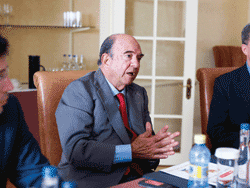
Emilio Botin: delivering value on a global scale |
The past 12 months is not a period many bankers will look back upon fondly. Hundreds of billion of dollars have been written off in bad debts; still more billions have been wiped off the value of some of the most prestigious names in the global financial industry. The heads of chief executives have rolled. Few firms have been immune.
Against this backdrop, one might think that Euromoney’s editors had a tough job finding banks that had achieved much, and made good money, in the past year; that it would be a case of choosing the least worst bank, rather than the best one, for this award.
Far from it. All of the shortlisted candidates have much to commend them. BNP Paribas has avoided much of the toxicity in the credit markets, despite a growing credit derivatives operation (see award), while making significant inroads on its investments in Italy.
JPMorgan Chase might even be seen as the saviour of the financial markets in 2008, for its rescue of Bear Stearns. It has certainly survived the credit crunch better than any of its US peers. Meanwhile its investment bank shows signs of returning to the pre-eminent position it held in the 1990s.
If you talk to bankers who believe emerging markets are the future, no institution is better positioned than Standard Chartered. Its successful focus on Asia, the Middle East and Africa will surely bring this award to the bank’s boardroom before long.
But this year’s winner takes Euromoney’s award for best global bank on a number of counts: for delivering hugely impressive growth numbers in difficult global markets; for not just attempting, but succeeding in, ventures that others said were too difficult; for sticking to a strategy that suits the institution, and not pandering to the whims of the market; and for being what is, very probably, the best-run big banking group in the world right now.
Three years ago, Euromoney recognized Santander for its remarkable transformation over 20 years from a small Spanish bank to a player on the international stage. That transformation has continued: from one of the top seven banks in Spain to one of the seven largest banks by market capitalization in the world today.
Santander could have stood still, or paused for thought, but that is not in the nature of the bank’s hugely energetic chairman, Emilio Botín, or his management team – which is led by the often unheralded externally but hugely rated internally chief executive Alfredo Saenz.
The headline numbers of what Santander is achieving are impressive enough in themselves. For full year 2007, the group posted profits of just over €9 billion, up 19% on the previous year. Results for Q1 2008 showed momentum increasing despite what one rival chief executive on this short list describes as “the toughest three months we have ever encountered”. Net profit was up 22% on the same period for 2007. Crucially, the group’s efficiency ratio fell to 41.9%. Two years ago that number was above 50%.
But it is not just about the numbers. Santander took a chance when it took over struggling UK lender Abbey. Few would doubt the wisdom of its purchase now. At a time when most UK high street banks and their parents are suffering, Abbey is making enormous strides. Its share of the UK mortgage market is increasing at a remarkable rate; and Abbey, as one of the few lenders with abundant liquidity, has been able to grow its share while cherry-picking the borrowers with the best credit profiles.
The jewel in the crown of the past 12 months, however, must be Santander’s take-out from the consortium’s raid on ABN Amro. Santander’s share of the bid was in the region of €20 billion. It recouped almost half of that immediately with the sale of Antonventa in Italy. For a consideration of just €10 billion, it bought Banco Real – one of the most sought-after banking assets in the world, for its strong position in the huge potential that Brazil represents. When Santander merges this with its existing Brazilian assets, it will have a unique banking proposition: it will be the only international bank to have a top-three franchise in one of the Bric countries.
Arguably the greatest challenge for Santander is to prove to the market that its diverse banking group has cumulative value, and is not just a collection of businesses. Perhaps this has already been achieved: although Santander is only Europe’s 10th-biggest bank by assets, it is the largest by market cap in the eurozone.
And for his next trick… Botín weaves his magic at Santander
August 2008