Emission control’s neglected area
Getting microfinance to the farmers
TO UNDERSTAND THE impact of today’s higher food price environment it is important to understand how the factors behind the rally are different from those that drove previous price spikes.
“We’ve had falling real food prices for a whole century,” says Josef Schmidhuber, senior economist and head of the global perspectives studies unit at the UN’s Food and Agriculture Organization in Rome. “For decades, this reflected rapid productivity growth combined with declining population growth and a growing saturation of food demand. Prices for individual crops have spiked from time to time but the last time we saw the price of all agricultural commodities soar was in 1973-74 when we had the world food crisis,” he says. “While there are some similarities between that period and today, such as a spike in oil prices and a falling dollar, the big difference with today’s situation is that high oil prices are creating a completely new, much larger market, making it more difficult to meet market demand for agricultural produce.”
High energy prices and concerns about energy security that have spurred demand for biofuels derived from crops including corn and sugar cane and economic growth have made the picture for demand radically different from that of the 1970s.
“Today, energy creates a paradigm shift for agriculture,” says Schmidhuber. “The biofuel market generates perfect elasticity at parity prices. As a result, we will not see agricultural prices fall much below their energy equivalents, and energy prices will determine long-term agriculture price levels. Biofuels represent insatiable demand that’s huge relative to the total market and creates a floor price.”
Economic development has also led to significant changes in both the level of demand and in consumers’ sensitivity to higher prices.
“Another thing that has changed since the 1970s is that revenues from oil exports have turned the Near East and North Africa into the largest food-importing region in the world,” says Schmidhuber. “What is also different is that many other and by now richer emerging markets have become less price elastic so that they continue to buy the same amount despite higher prices.”
It is hard to overestimate the impact of biofuels on agricultural commodities.
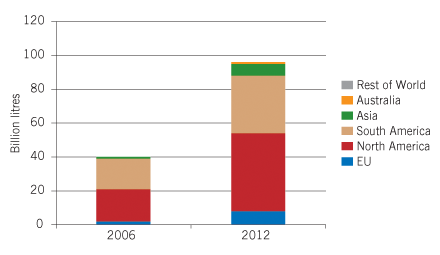
The US government’s corn-based ethanol production policy has changed the structure of the US grains and oilseeds market and had an impact on the global market. Rabobank, a leading international bank in the food and agribusiness sector, estimates that nearly 25% of the US corn harvest was directed towards ethanol production in 2007. Furthermore, it projects that that proportion will need to increase to at least 30% in 2008 and 40% within five years in order to meet government targets. The increase will have a big effect on corn prices worldwide as the US is the largest producer and largest exporter of the commodity. Rabobank estimates that by 2012, 15% of total global corn production and 28% of global sugar production could be used as feedstock for ethanol.
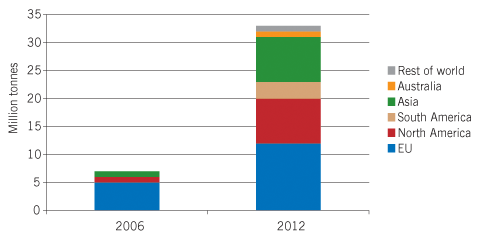
The EU’s biofuel policy, introduced in 2003, has generated high demand growth for vegetable oils, particularly rapeseed oil and imported crude palm oil and soya bean oil. The diversion of vegetable oils and animal fats into biodiesel production has increased by 500% since the policy was implemented and Rabobank estimates that as much as one-fifth of the global demand for oilseeds could come from biodiesel by 2012.
Biofuel programmes first appeared in the 1980s after the second oil shock in 1979 spurred interest, particularly in Brazil. As oil prices collapsed, however, so too did pro-ethanol programmes, which became less competitive.
Both a lower oil price and a higher price for commodities such as corn have the potential to make US biofuel production unprofitable, a situation almost reached in June when the price of corn shot up to nearly $8 a bushel on the back of fears that floods in the US Midwest would damage harvests.
“The correlation between oil and the agricultural commodity market has increased significantly, largely because of the fact that we are now converting commodities like corn, soya bean and sugar into transport fuel,” says Francisco Blanch, global head of commodities research at Merrill Lynch, in London. “This is likely to continue for years to come because there is simply no other way to increase non-Opec supply growth enough to meet demand without biofuels.”
The rise in agricultural commodity prices, partly driven by the rise in demand for them as feedstock for biofuels is, however, also having an impact on the profitability of biofuel producers, depending on the crops they use as feedstock.
“At today’s prices, biofuels are still attractive,” says Merrill’s Blanch. “Oil prices have come down but so too have the prices of many agricultural commodities, such as corn. “Gasoline today trades at about $118.50 a barrel while US ethanol costs about $92 a barrel and ethanol from Brazilian sugar cane $78 a barrel. Ethanol is still cheaper than gasoline and refining margins are profitable for US producers, very profitable for Brazilian producers, but negative for most European biodiesel producers.”
The rise in agricultural commodity prices has knock-on effects throughout the food industry. Although high prices are welcome news for farmers and their suppliers, they result in higher input costs for companies farther down the road between farm and fork. For these companies, the rise in agricultural commodity prices is leading to a re-evaluation of business models.
“What we see along the entire length of the food and agribusiness supply chain, with the exception of farmers, is pressure on margins,” says Harry Smit, industry analyst at the food and agribusiness research and advisory department at Rabobank in Utrecht. “Everyone is struggling to find a new balance of who should bear the burden of higher input costs. The dust has yet to settle.”
Refocused attention
The rise in input costs has refocused management attention on the area, bumping sourcing up the agenda and also leading to consolidation and recapitalization pressures as companies benefiting from higher prices look at opportunities and those suffering seek options.
“In the past, big food businesses were very much more focused on consumer issues and there was very little time spent worrying about sourcing. But this has now changed,” says Smit. “More and more food processors are now looking at their sourcing options and how to secure sourcing, with some even looking at forms of backward integration with their suppliers. Brewers, for example, are exploring alliances with maltsters, and maltsters are looking for alliances with barley growers.”
Higher input costs are also bringing consolidation pressure to the food-processing industry as companies both large and small seek greater bargaining clout either through M&A or strategic alliances.
This August, for example, Cofco, a state-owned Chinese food-processing group, and Japanese trading house Itochu, announced an alliance between their global food-purchasing operations that will involve the two companies teaming up to buy grain, dairy and other agricultural commodities.
Consolidation pressures, however, are greatest in emerging markets where the food-processing and food retail sectors tend to be most fragmented and where demand growth for processed foods is strongest. Only 30% of food eaten in China is processed, compared with an average of 75% in western nations, but changing consumption patterns mean that proportion is rising fast.
The fortunes of food retailers and producers are closely linked because of the importance of processed foods in retail operations. The expansion of food retail is influencing the processing industry because large retailers use consolidated purchasing desks and so want large-scale suppliers to deal with. In some cases, retailers also face pressure to take control of upstream activities to address quality and consistency concerns.
Those best positioned in the evolving market are the large food companies with the scale, brands and pricing power to pass on their higher costs to consumers, squeeze suppliers and exploit sophisticated hedging strategies.
A fear that higher input costs would eat into margins killed investor appetite for food company shares earlier in the year and many of the largest companies in the normally defensive food and household consumer products sector underperformed the DJ Stoxx 50 index, which fell 20%. Valuations for these companies fell well below their 10-year average to about 14x, a level only seen three times since 1997.
“Major food companies have managed to pass on their higher costs to an unprecedented extent,” says Charlie Mills, a food manufacturing and household goods analyst at Credit Suisse. “Unilever, Kraft and Nestlé, the three biggest food producers, have just reported second-quarter results that showed no margin declines despite significant inflation in their input costs. Retailers seem to recognize that there are structural factors at play behind the rising prices and so have accepted them and passed them on to the consumer. The surprise is that there has been only limited backlash in terms of trading down or decreasing volumes.”
Consumers in developed countries have swallowed the price rises with little discomfort partly because the substantial rise in agricultural commodity prices only translates into a relatively small increase in the supermarket shelf price, Credit Suisse calculates that a 30% increase in raw material costs leads to just a 4% increase in supermarket prices, and partly because food costs make up a relatively small part of household budgets.
There is concern, however, about how long global food companies will be able to raise prices in emerging markets where expenditure on food accounts for a greater share of household budgets.
Procter & Gamble, which reported fiscal fourth-quarter profits of $3.02 billion, up from $2.27 billion a year earlier on June 30, warned that it expected its commodity and energy costs to rise by $3 billion over the next year, twice the increase it saw over the last fiscal year, while rival Nestlé, which also reported a strong increase in operating profits, warned that food companies could not continue passing on the rising cost of food to customers, especially in emerging markets.
The rise in input costs has, unsurprisingly, made hedging a more strategic priority for food companies. Kellogg’s has hedged 90% of its raw material exposure this year and P&G has said that it has increased both the breadth and tenure of its hedging activities.
The higher value and higher volatility of agricultural commodities has led to a big increase in interest in hedging, and greater liquidity has extended the duration of hedges that companies are interested in to as far as five or even seven years.
Interest in hedging, however, depends on a company’s activity. Palm oil producers in Malaysia and Indonesia that have to invest a lot in plantations that take time to mature are keen to hedge by selling forward; sugar cane companies in Brazil exposed to sugar and ethanol prices tend to hedge less, so that they can remain flexible and divert production to whichever product has higher prices.
|
Power up |
|
Global bioethanol production will more than double… |
 |
|
…while Global biodiesel production is set to soar |
 |
|
Source: Rabobank |
Hedges hurt
Australian wheat farmers, hit by drought last year, also found that hedges can hurt when poor harvests left many unable to deliver on forward-selling commitments.
For commercial cereal framers in the developed world, soaring agricultural commodity prices have meant booming incomes. Despite this, farmers are finding that the higher cost of land and stricter lending conditions make it difficult to invest in increasing output.
“Farming is generally a family rather than a corporate business,” explains Smit at Rabobank. “The return on equity in many developed countries is about 0% when taking into account the real cost of labour. When farmers have more cash they typically want to reinvest it in their business and with the expectation of higher prices they may also look at the option of taking out a bank loan. The problem they face is that the doubling of land prices, as we have seen in some countries, affects their returns and makes it difficult to expand economically. A farmer who wants to increase his land by 10%, for example, will find that it does not look economical because the returns from the extra land are not compensated for by the cost of the additional land. Banks have also become a lot more strict about lending now because of the credit crisis.”
While high prices have benefited rich cereal farmers, they have passed by many farmers in the developing world, who do not have enough surplus to sell and who lack access to banking facilities (see Getting microfinance to the farmers , Euromoney, September 2008), and have hurt livestock farmers. High cereal prices mean lower margins for livestock farmers because they cannot adapt quickly as animals take much longer to reach the market. Livestock prices have not kept pace with feed prices and as a result many livestock farmers have been losing money and are expected to slash herd sizes.
For physical traders of agricultural commodities, higher prices mean greater working capital and credit requirements. The rise in value of assets and receivables has caught some off guard and left them unable to meet margin calls.
The drain on capital has led some diversified food companies to dispose of their trading arms. Financial traders, interested in gaining a foothold in physical market to improve their insights in the supply chain, have proved eager buyers. US food company ConAgra Foods, which owns, among other brands, Hebrew National sausages and Orville Redenbacher’s popcorn, this March sold its trading and merchandising operations to hedge fund Ospraie Management for $2.1 billion.