The global credit crisis has spread to emerging economies. The real worry is that this will have nasty feedbacks into the rich countries.
The global credit bubble of the past 10 years kicked off excess consumption in many rich economies. That was the meal on which the factory economies of Asia fed. In turn, other emerging markets that produced food and energy benefited from the insatiable appetite created by the economic boom of the factory economies.
Now that credit is being removed, however, the world’s leveraged rich economies must rediscover thrift. With consumer and investment demand plummeting, export demand for the products of emerging economies is caving in.
|
With consumer and investment demand plummeting, export demand for the products of emerging economies is caving in |
Chinese export growth is rapidly declining. And China will export a part of its pain to others, such as Australia, which supplies it with industrial commodities. Australia, whose exports contain few imported components, cannot re-export its pain. Thus less growth in China risks creating recession in Australia. Most emerging economies do not have sufficiently robust domestic demand to offset the impact of falling exports. Their domestic economies are just too small to take up the slack. In China, for example, the consumer accounts for 36% of demand and investment for 42%, much of it export-related. In the US, the figure for the consumer is 70%.
Emerging economy exports were not the only beneficiary of excess credit growth. Capital flows were just as important. Excess liquidity flooded into these economies as portfolio flows and foreign direct investment. This drove up their currencies and bloated domestic money supply and credit. In turn, this boosted asset prices and created more wealth.
Now contracting liquidity has already caused asset prices in emerging markets to fall, destroying household wealth that in many of them was only at an incipient stage of being built up. Falling household wealth will make it doubly difficult to substitute domestic demand for collapsing export growth.
Ironically, although the private sector in emerging economies was leveraging itself with cheap dollars during the boom years, these economies also became big net investors in the rich countries. The US was the main beneficiary of this dollar recycling and consequently had no difficulty financing the big current account deficit that excess consumption generated.
This self-financing Ponzi scheme was temporarily a costless exercise for the US because the US dollar was the world’s reserve currency – so no one could do anything with their surplus dollars except recycle them into US financial assets. This prolonged the expansion of the US liquidity pyramid and all its economic distortions.
This is now over. Financing US government borrowing (which is set to hit $2 trillion – 12% of GDP – in 2009/10) from foreign sources will become problematic. This will force the US to raise savings rates. The post-credit crisis decade will be characterized by a shift from leverage to thrift.
Liquidity contraction in emerging markets is a real and present danger for the global economy. Many emerging economies have built up private-sector foreign-currency debt and in many their banks have foreign-currency liabilities in excess of 5% of GDP.
Tough times |
EM banks with FX liabilities greater than 5% of local GDP |
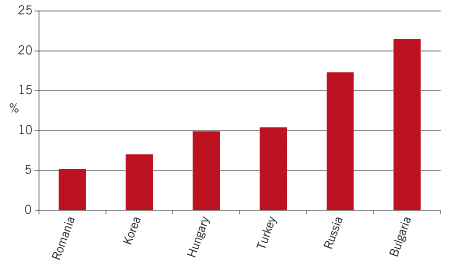 |
Source: Datastream |
These debts have to be rolled over. Yet rich countries’ banks, in the middle of painful deleveraging, will not be there to do it. Private capital markets will not meet the need for increased foreign funding. The IMF, the US Treasury and the European Central Bank have rushed out packages that seek to ring-fence the emerging market crisis by offering oodles of aid to the virtuous. But the cost of bailing out all those in trouble will be greater than the resources they have available. So emerging market authorities will allow their currencies to slide to combat debt deflation and recession through 2009.
Indeed, history shows that IMF programmes have a limited effect: for example, they had little immediate effect in stopping Asian currency rates from falling further during the 1997/98 crisis. And few of those currencies ever recovered fully. As for equities, they also continued to fall for a while longer during the Asian crisis, reaching lows at 40% of previous highs before starting to recover and not returning to pre-crisis levels for another year. So far this year, emerging market assets have fallen sharply and now they might well have priced in the present crisis. But it could be a long time before they start to show a sustained rally.
David Roche is president of Independent Strategy Ltd, a London-based research firm. www.instrategy.com


