Samruk: the outsider’s inside story
 |
|
“You go around the organization, there’s a lot of talent and there’s a hell of lot of knowledge in these businesses but there is no mechanism for sharing it. There’s a silo mentality” |


EVANS: There was one really important thing to Borat, it caused people to ask: “Where the hell is this place called Kazakhstan?” There was suddenly massive interest in this place. [Borat, the comedy alter-ego of Sacha Baron Cohen, has been officially invited to Kazakhstan but has yet to accept].
EVANS: (laughs): Obviously I do because otherwise I wouldn’t have taken it. I took a lot of persuading to come and take it.
EVANS: No, just that I have a lot on in the UK. The PM and president were pressing hard for me to come and do the job and they wore me down to a certain extent. I was over here on a review of the airline, we had lunch at the palace and the prime minister said he wanted to talk to me again about Samruk there and then; after nine months of being warmed up, I said: “Fine, OK, I’ll do it.” I don’t think I could’ve said yes had I not seen a lot of them and got to know them quite well. It’s clear the opportunities for this country are phenomenal and to be a part of it is hugely challenging.
EVANS: Unlocking the information within. You go around the organization, there’s a lot of talent and there’s a hell of lot of knowledge in these businesses but there is no mechanism for sharing it. There’s a silo mentality. People are accustomed to working in their silos and they don’t think laterally so there is really nothing that joins the silos together. As the culture changes, the knowledge is shared so we are not constantly reinventing the wheel. The prime issue for me coming here is to begin a serious programme of corporate governance brought into Samruk to carry down into the national companies. The bigger issue, very much a cultural issue, is a much longer programme. This is a country that is human capital-scarce but there are high-quality people. But because of the history, it’s exceedingly short of people who’ve got western and commercial business experience. The big challenge is to develop that experience, and that is a generational thing.

WOKURKA: The job is not is to dismantle Samruk but to manage it, to increase the value and to beautify it for potential future partial privatization.
EVANS: The problem here is managing what we’ve got. The original “Big five” companies are a hell of a burden and although these other 15 or so companies are small, sometimes they require more resources and effort than the bigger businesses. We’ve got to digest what we’ve got first. But if there were other pieces that are complementary or add value to what we are doing, then we would be better off owning them. Our mandate is to make two and two add up to more than four, to get the management working to a clearly defined set of objectives, deliver that value. If we want any of these businesses to go to market we’ve got to fundamentally change the governance of them. It’s putting in proper management controls; audit, risk management, information systems, all the tools that a good company needs to run the business effectively and safely for the shareholder, what is happening down inside the business. The value of me for senior people here is to have somebody around to tell them the way I see it and tell them very clearly what I think is the truth.
WOKURKA: I would say it’s at least a couple more years before anyone should seriously consider disinvesting.
EVANS: I would say we are just scratching the surface. At the most senior levels of government, we are maybe 50% but in the bowels of the bureaucracies we’d be about 10%. It’s very difficult for the government to understand that it no longer has direct access to and control of these national companies, that Samruk is the shareholder. We are saying this to the finance minister, the economics minister, energy, the president, the PM. And we have to keep on explaining this… the accountability of Samruk to the government has to be a normal shareholder-company relationship, clearly defined. Take the definition of an independent director… you’ve got to tell the guy from the economics ministry: “I’m sorry, under the terms of the code, you are not independent. You can stay on the board but you are not independent.” I think it’s important to have these people around because of their inputs but you’ve got to be realistic about it, they are not independent directors. We get complaints from government because although the transition has taken place legally, that doesn’t mean to say its happened up here [pointing to his head]. This has to change, people have to get in line with the law.
EVANS: Yes, and in the context of decision-taking you wish like hell you could transfer some of it to the west. If you’ve got an idea and you want to do something and you get the government behind it, it’s very easy to do it.
EVANS: When I first came here, people expected to be told what to do and then went and did it. The big difference today is that people are encouraged to engage in the decisions that they take, and own them.
 |
|
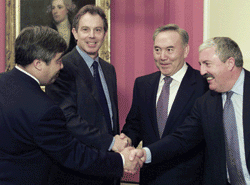
UK prime minister Tony Blair introduced Richard Evans to Kazakhstan’s president Nursultan Nazarbayev at the start of the decade. Left to right: Foreign minister Yerlan Idrisov, Blair, Nazarbayev and Evans |
WOKURKA: Kazakhstan has one-10th the number of oligarchs Russia has and they are more in a cooperative mood [with the government] here. We have seen moves taken by the president to form a sort of national alliance, with the state sector and private sector…
EVANS: It’s almost Japanese…
WOKURKA: …with the goal of creating the foundation for future generations that may not benefit from hydrocarbon wealth.
EVANS: There were obviously occasions – and still are – when references were made back to Temasek. But now there is a general recognition of big differences, this is a huge country with a lot of natural resources and with a vast geographical disposition of these businesses. I think people here have increasingly realized that the differences between here and Singapore are really much bigger than people may have first thought. Today, increasingly, you actually get a lot more people talking about the Malaysian model, Khazanah. In the Temasek businesses, it’s a sort of revolving door process, people revolving around them, going from one company to another, which doesn’t happen so much here. The other big difference is that there’s really only one of the Samruk offshoots that is an external-facing organization, the oil company KazMunaiGas. The rest of them are totally inward-facing – post, railways, telecoms, energy. Unlike Singapore, they’ve never engaged in the external commercial world. The Singapore government had some very clear long-term objectives in setting up Temasek in the mid-1970s and the businesses and positions it has subsequently acquired are part of a long-term economic and industrial plan. That is completely different to the situation here, derived out of a centralized economy with the residue and history of its past. You don’t find a cohesive national government strategy for, say, mining. These companies didn’t transfer across to us with a highly developed strategy and a sophisticated plan matched against it to deliver the strategy…
EVANS: Absolutely. It is probably the single biggest challenge these companies have today, and therefore Samruk as their shareholder, is to actually understand and plan for where their industries will be in 20 years’ time. There is clearly going to be a point in time where some decisions will have to be taken as to how that business responds to the challenges of the market. There is much more an argument here that the companies will find they need to team up or joint venture to meet market demands.
WOKURKA: We are talking about assets within Samruk that are officially declared to be of strategic importance and therefore any sale or acquisition requires written approval of the government. The question of a strategic investor in these sectors would have to go to the political decision-makers before the business case can be made. As far as I know, and this is a quickly moving country and the political agenda often changes quickly, there is no plan to invite investors to these strategic industries, with two exceptions; telecoms and aviation. I believe competition could happen but we should note the attractiveness is relative. We have the ninth-biggest landmass in the world with a population of just 15 million, so population density is low and accordingly the business potential is limited, as is the purchasing power. There’s not much room for a second or third player.
EVANS: Nobody has come in here and really looked at how you drive value out of these businesses. It has not been done, therefore it remains to be done and therefore it’s a huge opportunity. All of these businesses have got big scope for improvements in economic and financial performance and to do that you have to have the right managers in place.
EVANS: It’s a hell of a lot less than it was and there is certainly a desire at the governmental level to deal progressively with it but it’s not something you can wipe out overnight. There’s another area – nepotism – where people expect to put their families into jobs, to be taken care of. My view is that they have to come through transparently in the way they are recruited, particularly at senior levels. However, when you begin to understand the history of this place, there’s an explanation for nepotism that again will take time to change, which goes back into the Soviet era, into the early period of the collectivizations, the early 1930s, harsh times, people perished and the only way you could survive was to hunker down into families, the family chief looking after everybody. It was a matter of survival – there’s a certain instinct of that still around the place here, a responsibility to look after relatives which goes back into history.
 |
“The job is not is to dismantle Samruk but to manage it, to increase the value and to beautify it for potential future partial privatization” |
(Euromoney opens the page of the 2006 Samruk annual report that displays President Nazarbayev’s son-in-law, Timur Kalibayev, as Samruk’s deputy chief executive, describing him as “married” but making no mention of his relationship to Nazarbayev)
EVANS: Yes, pretty well, though it’s much better to have people come along with you. You’ve got to have due cause, but the principles are pretty much the same as anywhere else.
EVANS: Technically, my boss is the minister of economy, because he is the shareholder, but the governance of the business on behalf of the government is vested in a special committee chaired by the prime minister.
EVANS: Yes, and I’ve got to say the one thing in this country that is really good is that whenever you’ve got to see somebody senior, the PM or the president, their door is open. There’s a bureaucracy at a certain level in the place but if there is something going on and I need to see the PM, it’s very unusual not to get in the same day.
EVANS: There’s a danger of being treated as a cabinet minister but the problem is if you allow it to happen then the organization becomes another ministry. It’s a really serious issue. It would be very easy for Samruk to become a super-ministry and all it then does is simply put another layer on top. It’s a constant fight to stop it happening. I cannot afford to engage in politics and it’s not my politics anyway. My situation is very simple – to the best of my ability I tell these guys what needs to be done, help them to do it and, internationally, tell them where to go to find help. To put a foreigner into the job sends big messages for Kazakhstan, that this is not a closed society, that it needs outside help and it is going have to find more foreign expertise.
EVANS: Most people ask: “Where the hell is Kazakhstan?” Central Asia for the West ceased to exist for 100 years, it just disappeared off the map but now it’s increasingly coming back; people are paying a lot more attention and understand that some of these places are going to be the key economies for the 21st century. And it tilts west rather than to China.
EVANS: Contractually I’m here until I terminate my contract with the board, or the board terminates me. There’s no deadline.
EVANS: If there was something to occur here that was absolutely contrary to what we are trying to achieve with transparency and proper governance, that would cause me to leave. I’d tell people the truth why I’d left. I’d tell it like it is. Or when it got to the point where I ceased to be interested by it, when it ceases to engage me.