Infrastructure funds are taking off as the new alternative investment for institutions. Traditionally the realm of Australian and Canadian pension funds, the asset class is now being looked at by European and US investors. Calpers (the California Public Employees Retirement System), the largest US pension fund, recently announced that it had approved a $1.5 billion pilot programme to invest in infrastructure globally. In November last year, Vältion Elakerahasto, the $12 billion Finnish state pension fund, said it would be adding more infrastructure funds to its portfolio. Probitas Partners, an alternative investments solutions provider, conducted a survey of institutional investors in 2007 to gauge interest in infrastructure funds. Of the 115 respondents, 50% said that their appetite for infrastructure investments would increase in the year ahead.
New focus
Danny Latham, portfolio manager for First State’s infrastructure funds, attributes the increasing global interest from pension funds to the focus on absolute return products, and the need for asset/liability matching. “Property has traditionally fulfilled this need but it is a cyclical market. A greater supply of infrastructure assets has encouraged firms to look at the asset class.” This supply is being generated by governments that are coming under increasing funding pressure when trying to maintain and augment existing infrastructure, says Latham. “There are several sources of infrastructure investments,” he says. “Some governments are struggling to balance their books to cover infrastructure. In the EU, the limits on issuing debt have led them to sell off assets in order to raise money. Another source is through corporate restructuring, such as Shell and Exxon selling the BEB pipeline in Germany but maintaining access rights.”
Infrastructure needed for the EU runs into trillions of dollars, and US infrastructure investment needs over the next five years are put at $1.6 trillion, according to research by Probitas Partners.
First State opened an office in New York in 2007 in order to be closer to the infrastructure sector there. “Some of the themes in Europe have been even more pronounced in the US. Road networks, for example, have not had material investment really since Eisenhower, and are in need of an upgrade. It is a similar story with transmission networks,” says Latham.
Utility deals
Another area opening up to public investment is the utility sector. Until recently, the sector has been privately owned but there have been some big deals over the past 12 months, such as TXU.
|
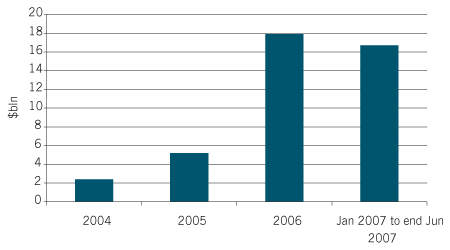
Infrastructure funds more appealing |
|
Global infrastructure fundraising |
 |
|
Source: Probitas Partners |
Latham says funding in the US for such projects has often come from muni bonds, but saturation in this market has led firms to look to other means of financing.
 |
“As the number of investors increases, there will start to be a liquidity mechanism in the infrastructure market itself, and we will end up with almost a secondary market” |
The fund is open-ended, but Latham says he does not expect liquidity to be an issue even though the fund is making long-term buy-and-hold investments. “As the number of investors increases, as with real estate funds there will start to be a liquidity mechanism in the infrastructure market itself, and we will end up with almost a secondary market.” Latham says this will mean that infrastructure funds do not need to be listed. A growing number of infrastructure funds have listed but Latham says investors are looking for infrastructure funds as an alternative investment and do not want to be exposed to market volatility.
Just where infrastructure funds should be assigned to in a portfolio is still open to question. Almost half the experienced investors surveyed by Probitas Partners made infrastructure investments a separate asset class in their portfolios. Almost 40%, however, made allocations to infrastructure within a private equity portfolio, and 15% in a real estate portfolio. Under 4% included infrastructure funds within a general alternatives portfolio.
As allocations to infrastructure increase, Latham expects assets to come from various asset classes. “It will depend on the risk appetite. It could be an allocation away from equities as a defensive move, or away from property and fixed income as a search for higher but lower-risk returns.” Returns are between 10% and 14% for defensive infrastructure investments, and 14% to 17% in developing areas, estimates Latham.



