 |
“Long-term data show that reserve managers historically have refrained from shifting their reserves abruptly” |
The release by the IMF of the composition of foreign exchange reserves (Cofer) data for the third quarter of 2007 provides clues as to whether or not the world’s central banks are diversifying their dollar holdings. But a lot of care does need to be taken in analysing what the data actually imply. Derek Halpenny, senior currency economist at Bank of Tokyo-Mitsubishi, says that there is some suggestion that the euro’s failure to break above 1.50 against the dollar is because the central banks’ appetite for the single currency has waned. However, from his analysis of the IMF’s Cofer, Halpenny feels that this is not necessarily the case. “The focus of the foreign exchange market on reserve diversification has diminished somewhat recently but the data for the third quarter [of 2007] revealed that the rate of growth in foreign exchange reserve accumulation has been steadily increasing,” he says.
Appetite
He adds: “The record rate of annual growth in global foreign exchange reserves is 31.8%, recorded in the first quarter of 2004. From then, the annual rate of growth slowed to a trough of just 11.4% at the end of 2005 before accelerating in each quarter since. The annual rate of growth reached 27.1% in the third quarter of last year, the second-fastest rate since the quarterly data began in 1999.” From this, it would seem that the central banks’ appetite for the euro remains very much intact.
Also commenting on the Cofer figures, Mansoor Mohi-Uddin, managing director of FX strategy at UBS in Zurich, asks: “Should we worry more about the risks of foreign reserve diversification?” Mohi-Uddin points out that the data show that the central banks’ dollar holdings declined over 1% in the third quarter of 2007 – the largest quarterly fall since the fourth quarter of 2004.
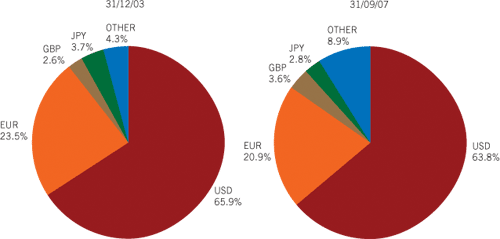
Halpenny also notes this trend. He says: “The reports of reserve diversification have on occasions been exaggerated. There has been only one notable period of reserve diversification since the euro began trading and the IMF quarterly data series began in 1999. A substantial shift out of the US dollar and into the euro was evident in the two-year period between the end of 2001 and the end of 2003 – the first two years of the dollar bear market. There was a more notable increase [in euro holdings] in the third quarter of 2007 – the most recent data – to 26.4%.” But Halpenny then makes a key observation: “The IMF data highlight the fact that central bank buying of euros over most of the period since 2003 has been done to ensure that allocations remain stable, not to diversify more into euros.” (See pie charts.)
|
FX reserve allocations around the world |
|
In constant FX terms, 2003 and 2007 |
 |
|
Source Bank of Tokyo-Mitsubishi |
Mohi-Uddin agrees with the view that central banks seldom make sudden adjustments to their holdings. “Long-term data show that reserve managers historically have refrained from shifting their reserves abruptly,” he says. “Instead central banks have only gradually changed the optimal mix of their currency holdings and when short-term exchange rate shifts have resulted in sharper changes in their reserves (as they did in Q3 2007 and Q4 2004), managers have responded by rebalancing their portfolios back towards their original allocations,” He adds that the composition of reserves only ever changes slowly. Distortion
Halpenny says that because the Cofer data are not adjusted for exchange rate changes, sometimes the picture can be distorted. In other words, as the euro rises in value, which it has broadly done since the end of 2001, the percentage of euros held when measured in dollar terms naturally increases. “Looking at the latest data, the allocations in constant 1999 foreign exchange terms reveal that the euro allocation stood at just 20.9%, the lowest since the second quarter of 2000,” he argues. “Unsurprisingly given the record level of the euro at the end of the third quarter of last year, the difference between the euro allocation in current and in constant foreign exchange terms in the third quarter of last year was the largest ever at 5.5 percentage points.”
The implication very much is that because central banks tend to try to maintain a constant composition of their reserves, valuation effects actually lower the need for them to diversify them. “When sharp exchange rate shifts lead to sudden near-term changes in the currency shares of reserves, reserve managers rebalance their portfolios by purchasing depreciating currencies and selling appreciating currencies in order to move back towards their original allocations,” says Mohi-Uddin. In other words, their “steady as it goes” approach means central banks are more likely to be buyers of currencies on dips and sellers at highs.
Mohi-Uddin says the market will now try to ascertain how the central banks will juggle their reserves this year. “It will be interesting to see what will happen and whether the yen appreciates,” he says. “As the interest rate differentials [against the dollar] narrow, the attraction of the yen, which is relatively undervalued, should increase.”