SINCE TURKEY EMERGED from the aftermath of the 2001 currency crisis, it has made huge advances in attracting foreign investors. The economic and political stability of the country has revealed its investment potential, and the Turkish economy has grown at an average annual rate of 7.5% for the past six years. Inflation, which was above 50% at one point, is now at around 8%. Foreign direct investment was about $20 billion in 2006, and that figure is growing. Perhaps belatedly, private equity firms are finally beginning to see the potential.
TurkVen, Turkey’s first independent private equity firm, raised its second fund last year. At $428 million, the fund is 10 times bigger than the company’s first fund, launched in 2002, and amounts to one of the largest increases in a fund size ever for a second raising. TurkVen had originally planned to raise about two-thirds of what was finally raised but increased and eventually limited that figure, halting at $428 million when it could have raised more. Last month, the fund took a stake in BC Partners’ deal to buy 51% of Turkey’s largest supermarket chain, Migros, in the country’s largest-ever LBO. The potential for private equity funds in Turkey is only now becoming evident, and it has been a long road.
 |
|
“It was a huge achievement to raise the fund in 2002, which we did through sheer persistence. The only way to get rid of us was to give us money” |
TurkVen was established in 2000 but its first fund wasn’t launched until 2002 because of the currency crisis. “Fortunately, we went into the crisis with no money to destroy,” quips Seymur Tari, managing director at TurkVen. “Still, it was a huge achievement to raise the fund in 2002, which we did through sheer persistence. The only way to get rid of us was to give us money.” Although FDI levels have rocketed in Turkey over the past few years, private equity has remained conspicuously absent. Turkey’s historical volatility has kept private equity investors away and, as that volatility has disappeared, private equity funds, even those experienced in emerging market operations, have not been quick on the uptake. “Turkey is not like other emerging markets,” says Ahmet Yildirim, general manager at Yapi Kredi in Istanbul. “Private equity companies are followers, and have been waiting for a better environment. I may be pessimistic, but among the FDI into Turkey, private equity is not as much as we should have seen”
Market leader
TurkVen is no follower, as its status as the country’s first independent private equity firm attests. Nor was pioneering private equity in Turkey an easy achievement, especially for a team that were, for the majority, in their early 30s at the time of raising the first fund. To combat this inexperience, TurkVen teamed up with Advent International, which has invested in more than 500 companies in 35 countries since its inception in 1984. “We knew enough to know that we didn’t know how to do this,” admits Tari. “The agreement was that we bring Advent into Turkey, and they teach us how to do this.”
So far the relationship has been a happy one, with Advent matching TurkVen’s investments, and this arrangement will continue. Tari goes along with Advent’s central and eastern European investment head Joanna James’s view that private equity is a craft and not an art and that Advent’s 20-year head start in the business will mean that TurkVen will always have a lot to learn.
That said, it is a good time to be learning. Although Turkey has been for some time a fairly liberal market, it also had an unwelcoming mentality towards foreign investors. That was one of the biggest challenges to the single-party AKP government elected in 2002, and its ultimate reversal one of its biggest achievements. It is the AKP government that is largely responsible for Turkey’s spectacular rise into the upper echelons of the world’s emerging markets.
When it was first elected in 2002, with a two-thirds majority, it was seen as more of a voting out of the old coalition government than a voting in of the new, single party. The common belief in Turkey is that while the coalition party had the right ideas, the fact that each had to be debated seemingly endlessly crippled its ability to act. “In the old multi-party government no one could take the glory, and so no one wanted the responsibility,” says Tari.
The AKP party has not made much in the way of radical policy changes, but the word most used to describe its members is “doers”. It took the necessary actions to stabilize markets, seeking to give confidence in the long term rather than falling back on short-term populist actions. And it worked. In the government’s first term, from 2002 to 2007, it sought to control the expenditure side of the budget, thus increasing tax funds. Heightened confidence led to a lowering of interest rates, further curtailing budgetary expenses. What it also did was to open the country to foreign investors. “The AKP party didn’t come with brilliant ideas, but they were always pragmatic,” says Tari. “They knew growth would come primarily from foreign finance. It’s a simple conclusion, but hard to do. These guys are doers.”
Targeting the source
TurkVen is a direct beneficiary of that foreign finance. Its new fund has solely foreign capital. European investors have provided about 50% of the assets, with the rest coming mostly from the Gulf region. TurkVen’s new fund is expected to create a diversified portfolio of growth companies in a broad range of industries. The need for private equity investment in Turkey comes in no small part from the fact that there are numerous small and medium-sized companies with solid fundamentals that face capital constraints. It is these that TurkVen’s new fund will target. At the larger end, Turkey is very well banked, with institutions such as Credit Suisse, Merrill Lynch and Morgan Stanley all having a strong presence. Any transaction where earnings are upwards of $3 million is highly competitive, and equity tickets of $200 million or more are shopped around heavily. In this respect, Turkey is similar to most of central Europe.
At the lower end there is far greater opportunity. At the same time, there are significant obstacles. It is a market in which sellers have little experience selling, and one with less-sophisticated advisers with less money who can’t afford to fly in teams to assist the operation of the companies they invest in. That its competitors are all foreign-based is where TurkVen has the advantage. “At times it can be a game of last man standing,” says Tari. “And if you want to be the last man standing, you can’t be located elsewhere.”
He explains that the actual execution of deals is not the hard part of his business. Turkey, now more than ever, is a dynamic market, with constantly changing rules and regulations. It has a good regulatory environment compared with a few years ago, and the government continues in its efforts to make it ever easier and more practical. To keep up, one needs a hands-on approach. “If you don’t have a management team on the ground, it is very hard to achieve your targets,” says Tari. “On the larger end, where big money is chasing big deals, you can hire a team. But on the smaller end, where you can make value investments, you have to be patient and baby-sit your investments.”
|
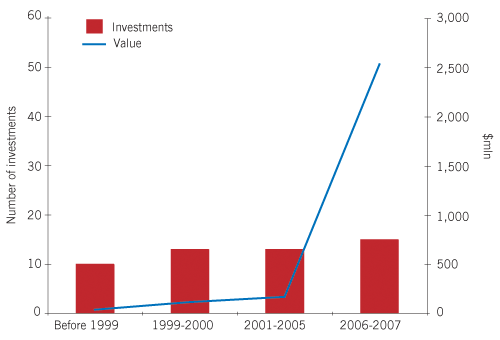
Steady, not spectacular growth |
|
Private equity investment in Turkey |
|
|
Source: Deloitte |
But this environment is improving, thanks to the government’s commitment to sound fiscal policy and in encouraging foreign investments. As Turkey comes to further embrace private equity investment, Tari expects to see significant growth in deal volume and the efficiency of execution. This will be important. TurkVen’s investments generally have a gestation period of about two years between the initial meeting with the parties involved and sealing the deal. Sellers do not always have the skills to value a company, or understand the workings of, say, shareholders’ agreements. “There needs to be mutual trust,” Tari says. “We have had occasions when a company on the very last day of execution has said they hope they’ve got a good deal.” Who cares about the EU?
That has now changed, and one of the main drivers of Turkey’s improved attractiveness towards investors is its progress towards EU accession. Recently, though, there has been a decline of positive sentiment surrounding Turkey’s pending EU membership.
Although progress reports from the EU have been broadly positive, support for accession is weakening in Turkey. Yildirim of Yapi Kredi says that most Turks are no longer concerned with it. “Two years ago, it was like a contest,” he says. “The government used it as a political tool, presenting it as a very attractive thing.”
Yildirim goes on to explain that more people in Turkey are now in employment, and incomes are rising. They are satisfied, and as a consequence now have new ambitions, such as for a new car or house. Within this trend lies another of the government’s successes: people are prouder. The more this continues, the less people will care about EU membership. One clear sign of this is that in last year’s elections the EU accession process went through a hiatus, rather than being pushed as a priority, as it was at the previous election five years earlier.
But the process itself has been positive for investment into Turkey, and TurkVen is set to reap the benefits. A look at the history of other nations in central Europe that have gone through the accession process, such as Poland and the Czech Republic, reveals several distinct phases. First, banks are bought out in big-ticket deals. This is followed by the privatization of big companies, which process filters down towards the small to medium enterprises that are TurkVen’s stock in trade. Turkey has already gone through the first phase, with such institutions as Fortis, Dexia and BNP Paribas, among others, either buying outright or taking large stakes in domestic Turkish banks. Now, following some big privatization deals, Turkey is seeing some smaller transactions. While big deals have attracted the usual suspects, such as Kohlberg Kravis Roberts, the mid-market is becoming more crowded, with regional funds coming in from central and eastern Europe, Russia and the Gulf. With first-mover advantage, though, TurkVen is in pole position to profit from the accession process, even if actual membership is not forthcoming, and despite increasing competition in the sector. TurkVen has taken the time to realize what it takes to maintain a strong reputation in Turkish private equity investments. “All advisers and shareholders know we’re here, says Tari. “We see every single deal, and have so far made all good investments. We are not known as sharks, people don’t mind showing us their deals, and we often get right of first refusal even on deals that have been chased by others, so we can pick and choose. But we can only sustain this if we’re straight and don’t waste time.”
Success from the start
And just because there are more opportunities for such funds as TurkVen does not mean that there aren’t significant difficulties. Turkey’s local business culture is one prone to long, hard bargaining. There is little in the way of low-hanging fruit, and anyone coming in looking for a quick transaction on the cheap will be disappointed. One needs to work hard to identify industries with advantages over others. In this, TurkVen enjoyed great success with its first fund, with investments in industries such as fleet rental. TurkVen invested in this area when it hardly even existed in Turkey, and is now a major shareholder in the largest fleet rental business in the country. This was then repeated in the alarm monitoring industry. Tari expects this form to continue with the new fund. “We take pride in identifying industries that grow faster than others, then finding the right company within those industries,” he says.
Tari points to the credit card processing business as another example of these high-growth industries. Walk into a shop in Istanbul and any number of credit card point-of-sale machines will be arrayed behind the counter, one for each credit card brand. Banks new to Turkey have been using the POS machines as a form of promoting brand awareness, as their priority is the acquisition of market share rather than limiting costs, and the POS machines are seen as a marketing expense. This will change as banks realize the cost and efficiency benefits of supporting more universal payment processing software. Now though, such an opportunity is being picked up on by others besides TurkVen. KKR has invested in First Data Systems, while Alliance Data Systems is under offer. For its part TurkVen has acquired 70% of Provus, the independent Turkish payment-processing firm.
Such opportunities abound. These are good times for Turkey, and after overcoming several obstacles TurkVen is positioned strongly. There are still challenges of course, such as the inherent currency risk associated with dealing in Turkey. TurkVen’s funds have been raised in euros but its investments are made in Turkish lira. But there is nothing to be done for this problem, and as long as Turkey can continue along its growth trajectory, the risk will not become a reality. In the meantime, TurkVen will persist with what Tari refers to as its “virtuous cycle”, having the right team finding the right deals with the right managers. TurkVen will look to make bigger investments in the mid-market, and Tari is already looking forward to fund number three, which he expects, rather than hopes, will break the $1 billion mark. “The more you work, the better you get,” he muses. “We think we’ll be the best private-equity investor in Turkey.”



